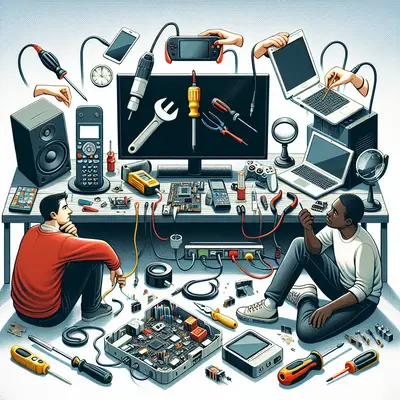
Electronics usually fail at the worst possible time—right before a video call, when you need to print a form, or as you’re trying to stream a movie. Most of these problems aren’t catastrophic; they’re often small issues you can solve yourself with a bit of patience and the right steps. This guide walks you through five common electronics problems and shows you exactly what to do before you pay for a repair or replacement.
When Your Laptop Won’t Turn On
Nothing happens when you press the power button—no lights, no fan, no screen. Before you assume the laptop is dead, work through these checks in order.
Confirm the power source is actually working
- Plug a different device (like a phone charger or lamp) into the same outlet. - If that device also doesn’t work, try another outlet or reset your power strip.
Inspect the charger and cable
- Check for frayed, bent, or exposed wires. - Make sure the plug is fully seated both in the wall and in the laptop. - If the charger has a power brick, see if any indicator light is on. - If possible, test with a known-good charger of the same specs (voltage and connector type must match exactly).
Look for charging indicators on the laptop
- Plug the charger in and wait 30–60 seconds. - Look for a small LED light near the power port or on the side of the laptop. - If the light is on or blinking, the battery might be drained but the system may still power with a “hard reset.”
Perform a hard reset (for laptops with removable or internal batteries)
- Unplug the charger. - If removable: remove the battery (slide the latches and lift it out). - Hold the power button down for a full 15–20 seconds to discharge residual power. - Reinsert the battery (if removable), plug the charger in, and try to power on again.
Try powering without the battery (if removable)
- Remove the battery completely. - Plug in the charger. - Turn the laptop on. - If it powers on without the battery, the battery itself may be bad and need replacement.
Check for life signs (even if the screen is black)
- Listen for fan noise or drive spinning. - Watch for keyboard backlight or power light. - If you get power signs but no display, you may have a display/boot issue, not a power problem.
If the laptop still doesn’t respond after these steps, it could be a failed power jack, mainboard, or internal power circuit. At that point, professional diagnosis is usually the most cost-effective next move.
When Your TV Has Sound but No Picture
The TV turns on, you hear audio, but the screen is black or very dim. Before assuming the panel is dead, run through this sequence.
Check brightness and picture mode
- Use the TV remote’s Menu or Settings button. - Increase brightness and backlight levels. - Turn off any “Energy Saving,” “Eco,” or “Ambient” modes that may darken the screen. - Switch picture mode to “Standard” or “Vivid” to rule out a too-dark preset.
Test with the TV’s own menu and built-in apps
- Press Menu or Home on the TV remote. - If menus or smart TV apps (like Netflix) display correctly, the panel and backlight likely work. The issue may be with the HDMI source or cable. - If even the menus are not visible (or only faintly visible when shining a flashlight at the screen), you may have a backlight problem.
Check HDMI and input settings
- Make sure the correct input (HDMI 1, HDMI 2, etc.) is selected. - Unplug and firmly reinsert the HDMI cable at both the TV and device (cable box, console, streaming device). - Try a different HDMI port on the TV. - Test with another HDMI cable and, if possible, another device.
Power-cycle the TV and devices
- Turn off the TV and unplug it from the wall. - Turn off and unplug any connected devices (cable box, streaming stick, console). - Wait 60 seconds. - Plug the TV back in first and turn it on, then reconnect and power up the external devices.
Try a factory reset as a last resort (settings only)
- Check your TV’s user manual or on-screen settings for “Reset,” “Factory Reset,” or “Initial Setup.” - Be aware this will erase picture settings and Wi-Fi details. - If the picture returns after a reset, a software glitch or misconfiguration was likely the cause.
If none of these restore the display and you never see any image (including menus), it may be a failed backlight, T‑Con board, or panel—components that usually require a professional repair quote to compare against replacement cost.
When Your Phone Won’t Charge Reliably
The charging cable only works when bent a certain way, charges slowly, or disconnects frequently. Many of these issues come down to simple maintenance.
Clean the charging port carefully
- Power off the phone. - Use a flashlight to inspect the port for lint, dust, or debris. - Gently insert a wooden or plastic toothpick and lightly scrape out any visible buildup. - Never use metal objects (pins, paper clips) that can short pins or damage the port. - Finish with a few short bursts of compressed air if available.
Inspect and test the cable and adapter
- Look for kinks, exposed wire, or bent connectors. - Try another certified cable (USB‑C, Lightning, or manufacturer-approved). - Test a different wall adapter or USB port. - If wireless charging works but cable charging doesn’t (and port cleaning didn’t help), the port may be physically damaged.
Check for software-related charging issues
- Restart the phone. - Make sure you’re using proper, compatible chargers (some phones limit charge with low-quality or low-power adapters). - On some devices, battery optimization or temperature controls may intentionally slow charging if the phone is too hot—remove case and let it cool.
Try safe mode or minimal usage while charging
- On Android, boot into Safe Mode (varies by brand; usually by holding Power, then long-pressing “Power off”). - If the phone charges faster and more reliably in Safe Mode, a third‑party app may be causing power drain. - Uninstall recent apps that coincide with new charging problems.
Check battery health (where available)
- iOS: Settings → Battery → Battery Health. - Some Android phones: Settings → Battery → Device Care/Device Maintenance. - If battery capacity is significantly degraded, charging may feel erratic because the battery can’t hold power well.
If cleaning the port and swapping cables/adapters doesn’t resolve the problem, and you have to angle the plug to charge at all, the port may need professional replacement—especially if the phone has been dropped or exposed to moisture.
When Your Wi‑Fi Is Slow or Keeps Dropping
Streaming constantly buffers, web pages stall, or your devices keep disconnecting. Before blaming your ISP, tune up your own network.
Verify whether the issue is local or service-wide
- Test Wi‑Fi with at least two different devices (phone and laptop). - Try a speed test (e.g., Ookla or your ISP’s speed test page). - If all devices are slow, the issue is likely the router, interference, or ISP—not just one device.
Reboot modem and router in the right order
- Unplug both modem and router. - Wait 30–60 seconds. - Plug in the modem first and wait until all status lights stabilize. - Plug in the router and allow it 2–3 minutes to fully restart. - Retest your connection.
Move and reposition your router
- Place it in a central, elevated, open area (not in a cabinet, corner, or behind a TV). - Keep it away from thick walls, metal objects, and major appliances. - Avoid placing it directly next to cordless phones or microwaves (common 2.4 GHz interference sources).
Adjust Wi‑Fi settings for better performance
- Log into your router’s admin dashboard (usually via a local IP like 192.168.0.1 or 192.168.1.1—check the label on your router). - Use the 5 GHz band where possible—it’s faster and less congested but has shorter range. - Rename your 2.4 GHz and 5 GHz networks differently (e.g., “Home_2G” and “Home_5G”) so you can manually choose the best band. - Change the Wi‑Fi channel from “Auto” to a less crowded one (a Wi‑Fi analyzer app can help you see congestion on nearby channels).
Check for device limits and background hogs
- Log into your router and see how many devices are connected. - Disconnect devices you’re not using (smart plugs, older phones, unused tablets). - On computers, open Task Manager (Windows) or Activity Monitor (macOS) and check if cloud backups, game updates, or large downloads are running.
If you still experience slow or dropping Wi‑Fi after optimization, contact your ISP with your measured speed results. They can check for line issues, outdated equipment, or congestion in your area—and may recommend a newer router or higher-speed plan.
When Your Printer Refuses to Print (Especially Over Wi‑Fi)
The printer shows as “offline,” jobs get stuck in the queue, or nothing happens when you hit print. Work through this sequence before assuming the printer is “just bad.”
Check the basics physically
- Ensure the printer is powered on and not showing any error lights. - Confirm there’s paper in the tray and no obvious paper jam. - Check ink or toner levels on the printer display or via its app/software.
Verify connection type (USB vs Wi‑Fi)
- If USB: make sure the cable is firmly connected at both ends; try another USB port on your computer. - If Wi‑Fi: confirm the printer is connected to the correct Wi‑Fi network (often displayed on the printer’s screen under “Network” or “Wireless”).
Restart printer and computer
- Turn the printer off and unplug it for 30 seconds, then power it back on. - Restart your computer or mobile device. - After both are back on, wait one to two minutes for the printer to reconnect to Wi‑Fi.
Clear the print queue and reset the print system (computer)
- On Windows: - Go to Settings → Bluetooth & devices → Printers & scanners. - Select your printer → Open print queue → Cancel all documents. - On macOS: - Open System Settings → Printers & Scanners → select your printer → Open Print Queue → cancel jobs. - Try printing a single-page test document after clearing the queue.
Re-add the printer as if it’s new
- Remove the printer from your computer’s printer list. - On the printer, run the wireless setup wizard (often under Network/Wireless settings). Reconnect it to your Wi‑Fi. - Then, on your computer, add the printer again via Printers & Scanners. - For mobile printing, reinstall or update the manufacturer’s app (HP Smart, Canon PRINT, Epson iPrint, etc.).
If the printer works via USB but not Wi‑Fi, the issue is likely network-related and not a hardware failure. In that case, ensuring the printer has a strong Wi‑Fi signal or connecting it to the router via Ethernet (if available) can provide a more stable long-term fix.
Conclusion
Most “broken” electronics aren’t really broken—they’re confused, misconfigured, or blocked by a simple physical issue like dust, a bad cable, or a poor signal. By approaching each problem methodically—checking power first, then connections, then settings—you can often restore your devices without waiting for a technician or buying replacements. Next time your laptop, TV, phone, Wi‑Fi, or printer misbehaves, use these steps as your quick repair playbook before you give up on the gear you already own.
Sources
- [Federal Communications Commission (FCC) – Interference to Home Electronics](https://www.fcc.gov/consumers/guides/interference-home-electronics) - Explains common causes of wireless and electronic interference and mitigation strategies
- [Apple Support – If your iPhone or iPad won’t charge](https://support.apple.com/en-us/HT201569) - Official guidance on diagnosing and solving common charging issues on Apple devices
- [HP Support – Printer is Offline (Windows, macOS)](https://support.hp.com/us-en/document/ish_1808268-1648008-16) - Manufacturer instructions for bringing offline printers back online and resolving connection issues
- [Microsoft Support – Troubleshoot blue screen errors and PC startup issues](https://support.microsoft.com/en-us/windows/troubleshoot-blue-screen-errors-and-pc-startup-issues-94fdf908-3c00-7b94-9ba6-9dff5d99bc59) - Detailed steps for diagnosing computers that won’t boot or start properly
- [Consumer Reports – How to Get the Best WiFi Performance](https://www.consumerreports.org/electronics-computers/networking-wireless-routers/how-to-get-the-best-wifi-performance-a6053996749/) - Practical tips for router placement, interference reduction, and signal optimization
Key Takeaway
The most important thing to remember from this article is that this information can change how you think about Electronics.