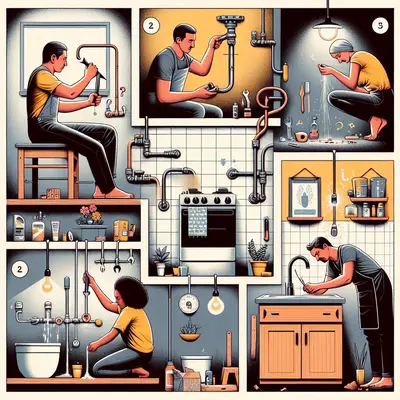
Small household problems rarely stay small. A dripping faucet becomes a mold issue, a loose cabinet door turns into a ripped hinge, and a slow drain suddenly backs up right before guests arrive. The good news: many of these annoyances are straightforward to fix with a few tools and a clear plan.
Below are five practical, step‑by‑step repairs almost anyone can handle—no contractor, no fancy gear, just a calm approach and a little time.
1. Silencing a Dripping Faucet
That constant drip isn’t just annoying—it wastes water and money. Most drips come from a worn-out washer or cartridge inside the handle.
What you’ll need
- Adjustable wrench
- Screwdriver (Phillips or flathead, depending on handle)
- Replacement cartridge or washer (match type/brand if possible)
- Small container or towel for parts
Steps
Turn off the water supply
Look under the sink for two shut-off valves (hot and cold). Turn them clockwise until they stop. Open the faucet to drain any remaining water.
Plug the drain
Use a sink plug or a rag. Small screws and parts can disappear fast down an open drain.
Remove the handle
- Pry off the decorative cap (if present) with a small flathead. - Unscrew the handle screw. - Gently pull the handle off. If it’s stuck, wiggle side-to-side instead of forcing straight up.
Access the cartridge or stem
Use the adjustable wrench to loosen the retaining nut. Carefully lift out the cartridge or stem assembly. Take note of how it’s oriented—snap a quick photo if needed.
Inspect and replace parts
- For compression faucets (separate hot/cold knobs), replace the rubber washer at the bottom of the stem and the O-ring on the stem. - For cartridge faucets (single lever or newer styles), replace the entire cartridge with an identical model.
Reassemble and test
- Reinsert the new cartridge or stem the same way it came out. - Tighten the retaining nut snugly but don’t over‑tighten. - Reinstall handle and decorative cap. - Turn on the shut‑off valves slowly and test for leaks.
If it’s still dripping: The issue might be a worn valve seat or incorrect cartridge. At that point, bring the old parts to a hardware store or consult a plumber.
2. Fixing a Slow or Clogged Bathroom Sink Drain
Most slow drains are caused by hair and soap scum near the top of the drain—not deep in the pipes—so you can usually clear them without harsh chemicals.
What you’ll need
- Rubber gloves
- Bucket or bowl
- Old toothbrush or small brush
- Plastic drain snake or zip‑it tool
- Adjustable wrench (if needed)
Steps
Remove the stopper
- If it lifts straight out, pull it and skip to step 3. - If it doesn’t: - Look under the sink for the horizontal rod attached to the drain pipe. - Unscrew the nut holding the rod in place. - Slide the rod out; the stopper should lift right out from the sink.
Clean the stopper
Use paper towels or an old rag to remove hair and gunk. Scrub with an old toothbrush and warm soapy water.
Clear the drain opening
- Insert the plastic drain snake into the drain. - Push down gently, then pull up with a slight twist. - Repeat until you’re no longer pulling up hair or debris.
Flush with hot water
Run hot (not boiling) water into the drain for a minute or two to wash away loosened buildup.
Reinstall the stopper
- Drop the stopper back in the drain. - Under the sink, insert the horizontal rod into the hole on the stopper’s stem. - Tighten the nut hand-tight, then snug it slightly with a wrench.
If the sink is still slow: The clog may be in the P‑trap (the U‑shaped pipe). Place a bucket under it, loosen the slip nuts, remove the trap, clean it, and reinstall.
3. Patching a Small Hole in Drywall
From doorknob dents to misplaced anchors, small drywall damage is inevitable. You can make it almost disappear with basic patching.
What you’ll need
- Spackle or lightweight joint compound
- Putty knife (2–4 inches wide)
- Sanding sponge or fine‑grit sandpaper (120–220 grit)
- Damp cloth
- Touch‑up paint and small brush or roller
Steps
Clean and prep the area
Wipe away any dust or loose bits of drywall with a damp cloth. For holes larger than a nail, lightly scrape the edges with the putty knife to remove crumbling material.
Apply the first layer of spackle
- Scoop a small amount of spackle on the putty knife. - Press it firmly into the hole, then smooth over the surface. - Feather the edges so the compound is thin around the outside and slightly raised in the center.
Let it dry completely
Check the product label for drying time—often 30 minutes to a few hours. Don’t rush this step; sanding damp compound will just smear it.
Sand smooth
- Lightly sand until the patch is flush with the wall and feels smooth. - Wipe away dust with a damp cloth.
Apply a second thin coat if needed
For deeper holes, you may see a slight dip after sanding. Add another thin layer of spackle, feather it out wider than the first, let dry, and sand again.
Prime and paint
- For small patches, some spackles are “paint‑ready” without primer. For larger or darker patches, a quick coat of primer helps prevent flashing (a visible patch under paint). - Apply touch‑up paint, blending slightly beyond the patch.
Tip: Use leftover wall paint if you have it. If not, bring a paint chip to a paint store for a close color match.
4. Quieting a Squeaky Interior Door
A squeaky door is usually a hinge issue, not the wood itself. Lubricating or adjusting the hinges normally fixes it in minutes.
What you’ll need
- Lubricant (silicone spray, dry Teflon spray, or petroleum jelly)
- Rag or paper towels
- Hammer and small nail or pin (optional, for stubborn hinge pins)
Steps
Identify the squeaky hinge
Open and close the door slowly. Listen and watch which hinge moves when the squeak happens.
Try lubricating in place first
- Spray or dab a small amount of lubricant onto the top of the hinge pin and along the hinge joints. - Open and close the door several times to work it in. - Wipe off any drips.
Remove hinge pin if squeak persists
- Place a rag under the hinge to catch drips. - Use a small nail or pin under the bottom of the hinge pin and tap gently upward with a hammer. - Pull the pin out.
Clean and lubricate the pin
- Wipe the pin clean of old grime. - Apply a thin coat of lubricant or a small amount of petroleum jelly along the pin.
Reinstall and test
- Slide the pin back into the hinge. - Open and close the door repeatedly to distribute the lubricant. - Repeat on other hinges if needed.
If the door still squeaks or rubs: The door may be out of alignment. Tighten hinge screws; if a screw just spins, use a longer screw or fill the hole with toothpicks and wood glue, then reinsert the screw.
5. Resealing a Drafty Window with Caulk
Drafty windows drive up energy bills and make rooms uncomfortable. Caulking gaps around the frame is an effective, low-cost fix.
What you’ll need
- Caulk (paintable exterior or interior latex caulk for window frames)
- Caulk gun (if using cartridges)
- Utility knife or scraper
- Painter’s tape (optional for neat lines)
- Damp sponge or rag
Steps
Find the gaps
- On a cool or windy day, carefully run your hand around the window frame to feel for drafts. - Look for visible cracks between trim and wall or frame.
Remove old, cracked caulk
- Use a utility knife or scraper to cut and peel away loose or brittle caulk. - Brush or wipe away dust and debris so the new caulk can bond.
Prepare the caulk
- Cut the tip of the caulk tube at a 45° angle, making a small opening. You can always enlarge it later. - Puncture the inner seal if needed (most caulk guns have a built‑in puncture tool).
Apply painter’s tape (optional)
If you want very clean lines, run painter’s tape along both sides of the gap, leaving the crack exposed.
Run a steady bead of caulk
- Hold the gun at a 45° angle. - Squeeze the trigger and move at a consistent speed along the gap. - Aim for a continuous, even bead—don’t worry if it’s not perfect; you’ll smooth it next.
Tool (smooth) the caulk
- Use a damp finger or a caulk-smoothing tool to press the caulk into the gap and create a smooth, slightly concave line. - Wipe excess onto a rag as you go.
Remove tape and let dry
- If you used tape, peel it off immediately, before the caulk skins over. - Allow caulk to cure as directed on the package before painting or exposing to heavy moisture.
Result: Fewer drafts, better comfort, and lower heating/cooling costs—often from less than an hour of work.
Conclusion
Most home headaches don’t require a toolbox the size of a truck or a professional call‑out. By learning a few straightforward repairs—fixing a dripping faucet, clearing a slow drain, patching drywall, silencing doors, and sealing drafty windows—you cut costs, prevent bigger damage, and keep your home more comfortable.
Start with the issue that bothers you most, follow the steps slowly, and don’t rush the details (like shutting off water or letting materials dry). Small, confident repairs add up to a home that feels well cared for—and a lot less stressful to live in.
Sources
- [U.S. Environmental Protection Agency – Fixing Leaks at Home](https://www.epa.gov/watersense/fix-leak-week) – Explains how household leaks waste water and why fixing drips matters
- [Family Handyman – How to Fix a Leaking Faucet](https://www.familyhandyman.com/project/how-to-fix-a-leaking-faucet/) – Detailed visual guide to faucet repairs and common faucet types
- [The Spruce – How to Clear a Clogged Bathroom Sink](https://www.thespruce.com/clear-a-clogged-bathroom-sink-2718682) – Step-by-step instructions with photos for unclogging bathroom drains
- [Lowe’s – How to Repair Drywall](https://www.lowes.com/n/how-to/repair-drywall) – Covers patching holes of different sizes with appropriate materials
- [U.S. Department of Energy – Air Sealing Your Home](https://www.energy.gov/energysaver/air-sealing-your-home) – Official guidance on finding and sealing drafts to improve efficiency
Key Takeaway
The most important thing to remember from this article is that this information can change how you think about Household Repairs.