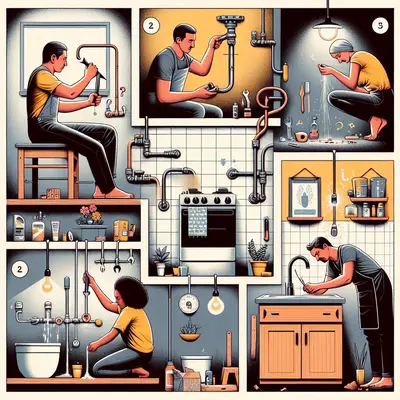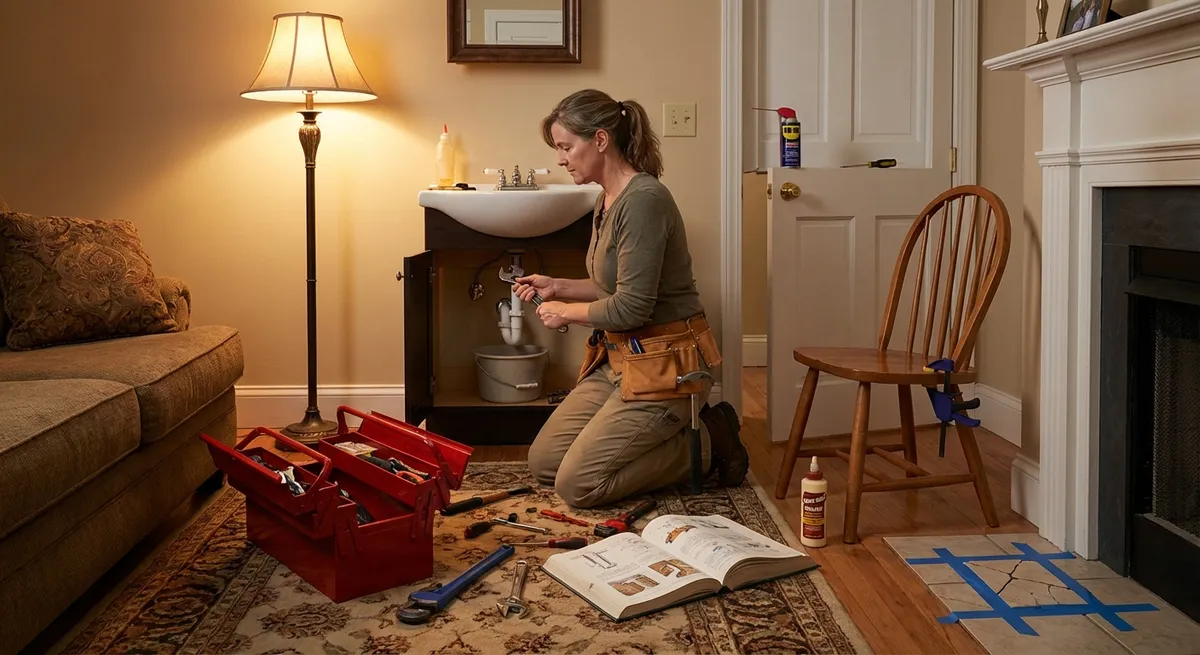
Household problems rarely show up at a “good” time—but most don’t need an emergency call to a pro. With a bit of guidance, you can handle a surprising amount on your own, safely and confidently. This guide walks you through five everyday issues, step by step, using basic tools and clear checks so you know when to DIY and when to stop and call in backup.
Fix 1: A Dripping Faucet That Wastes Water (and Money)
A slow drip can waste gallons of water a day. The good news: most leaks come from worn internal parts you can replace in under an hour.
What you’ll need
- Adjustable wrench or basin wrench
- Screwdrivers (Phillips and flathead)
- Replacement cartridge, O-rings, or washers (match to your faucet brand/model)
- Plumber’s grease
- Old towel or rag
Step-by-step
Shut off the water supply
Look under the sink for two small shutoff valves (hot and cold). Turn them clockwise until snug. If there are no valves or they don’t work, shut off the main water supply to your home.
Plug the sink drain
Use the stopper or stuff a rag into the drain. This prevents tiny screws or parts from falling in.
Remove the handle
- Look for a small cap (often marked hot/cold). Pry it off with a flathead screwdriver. - Remove the screw under the cap and lift the handle off. - If it’s stuck from mineral buildup, gently rock it side to side as you pull.
Identify your faucet type
Most household faucets are: - Cartridge (single lever, common in modern kitchens and baths) - Compression (two handles, older style with separate hot and cold) - Ceramic disc (often higher-end, smooth operation)
Snap a quick photo of the exposed guts so you can match parts at the store if needed.
Remove the internal parts
- For a cartridge: loosen the retaining nut with a wrench, then pull the cartridge straight up. - For compression: remove the stem by loosening the packing nut; the rubber washer at the end is usually the culprit. - For ceramic disc: remove the escutcheon and disc assembly carefully; don’t force it.
Inspect and replace worn pieces
- Look for cracked, flattened, or brittle rubber washers or O-rings. - Check the cartridge for cracks, mineral buildup, or deformation. - Replace with exact matches. Use your photo and the old parts at the store to confirm.
Apply plumber’s grease and reassemble
Lightly coat O-rings and moving parts with plumber’s grease (not petroleum jelly). Reinstall in reverse order: internal parts, retaining nut, handle screw, handle, decorative cap.
Turn the water back on slowly
- Open the faucet handle first. - Turn the shutoff valves counterclockwise gradually. This prevents sudden pressure from damaging new parts. - Let the water run for a few seconds, then close the faucet and check for drips.
When to stop and call a pro
- The shutoff valves won’t turn or start leaking.
- The faucet body is cracked or heavily corroded.
- You’ve replaced the internal parts and it still drips from multiple places.
Fix 2: A Running Toilet That Won’t Stop Filling
A toilet that keeps running isn’t just annoying—it can add a lot to your water bill. Most of the time, the problem is in the tank, not the drain.
What you’ll need
- Adjustable wrench (optional)
- Replacement flapper or fill valve (depending on the issue)
- Sponge or towel
Step-by-step
Remove the tank lid and observe
Flush once and watch what happens inside. Focus on: - The flapper (rubber piece at the bottom) - The fill valve (tall assembly where water comes in) - The overflow tube (vertical pipe in the middle)
Do a quick flapper test
When the tank is full and the toilet is “running”: - Gently push down on the flapper with a stick or long spoon. - If the running stops, the flapper is likely leaking and needs replacing.
Check the chain and handle
- Make sure the chain isn’t too tight or tangled; it should have a little slack. - Adjust by moving the hook to a different link if the flapper can’t fully close. - Confirm the handle moves freely and isn’t sticking.
Replace a worn flapper (most common fix)
- Turn off the water to the toilet (valve on the wall behind the tank). - Flush to empty most of the water. - Detach the old flapper from the overflow tube and unhook the chain from the handle. - Attach the new flapper to the same spots; cut or adjust the chain so the flapper closes fully without being held up.
Adjust or replace the fill valve if needed
If water is constantly flowing into the overflow tube: - Adjust the float level (screw or clip on most models) so water shuts off about 1 inch below the top of the overflow tube. - If the valve doesn’t respond or is corroded, replace it. Most kits include clear instructions and a fill line marking.
Turn water back on and test
- Open the shutoff valve fully. - Let the tank fill, then listen. A properly working toilet should go quiet within a minute. - Drop a few drops of food coloring into the tank and wait 10–15 minutes without flushing. If color appears in the bowl, you still have a leak (usually flapper or seat).
When to stop and call a pro
- Water is seeping from the base of the toilet.
- The shutoff valve is stuck, leaking, or crumbles when you touch it.
- There are cracks in the tank or bowl.
Fix 3: A Wall Outlet That Stopped Working
A dead outlet doesn’t always mean you have a major electrical problem. Often it’s a tripped safety outlet, a breaker, or a simple wiring issue.
Safety first
If you ever smell burning, see scorch marks, feel heat at the outlet, or hear buzzing: stop and call an electrician immediately.
What you’ll need
- Plug-in device (lamp or phone charger)
- Non-contact voltage tester (strongly recommended)
- Flathead and Phillips screwdrivers
Step-by-step
Confirm it’s the outlet, not the device
- Test your device in a different outlet. - Test a known-good device in the “dead” outlet.
Look for a nearby GFCI outlet
In kitchens, bathrooms, garages, and exterior walls, regular outlets may be protected by a nearby GFCI outlet (with “TEST” and “RESET” buttons). - Press RESET firmly until it clicks. - Re-test your outlet. - Check all GFCI outlets in the same room, not just the closest one.
Check your breaker panel
- Find the electrical panel (basement, utility room, garage). - Look for a breaker that’s in the middle position or doesn’t line up with the others. - Turn it fully OFF, then firmly back ON. - Label the breaker if you figure out what it controls.
Inspect the outlet cover (power OFF for this step)
If the breaker reset doesn’t help: - Turn off power to the suspected circuit at the breaker. - Use a non-contact voltage tester at the outlet slots to confirm power is off. - Unscrew the cover plate and gently pull the outlet out a bit, keeping wires attached.
Check for loose connections
- Look for loose or disconnected wires, discoloration, or melted plastic. - Back-wired “stab-in” connections are more prone to loosening; side-screw connections are more secure. - If a wire has slipped out, you may be able to re-strip (if needed) and reattach it to the side screw (clockwise under the screw head).
Reassemble and test
- Carefully push the outlet back into the box, avoiding sharp bends. - Tighten mounting screws, reinstall the cover plate. - Turn the breaker back on and test the outlet with a device.
When to stop and call a pro
- You see damaged or melted wires, scorch marks, or smell burning.
- Multiple outlets or lights are dead on the same wall or room and resetting breakers doesn’t help.
- You’re not comfortable working near live wires even with a tester.
Fix 4: A Door That Won’t Latch or Keeps Swinging Open
Misaligned doors are common, especially in older homes or where humidity changes a lot. Most of the time, you can fix it without replacing the whole door or frame.
What you’ll need
- Screwdrivers
- Hammer and small nail or punch
- Wood toothpicks or wooden matchsticks
- Wood glue (optional but helpful)
- Chisel (for stubborn cases)
Step-by-step
Figure out the problem area
- Close the door slowly and watch what happens. - Does the latch miss the strike plate? Hit above or below? Not reach far enough? - Note whether the door rubs at the top, bottom, or latch side.
Tighten hinge screws first
- Open the door and tighten all hinge screws (door side and frame side). - Be firm but don’t strip them. - Often this alone pulls a sagging door back into alignment.
Reinforce loose hinge screw holes
If screws just spin: - Remove the loose screw. - Fill the hole with wood toothpicks or matchsticks dipped in wood glue. Tap them in gently. - Break off flush, then reinsert the screw. This gives it solid wood to bite into.
Adjust the strike plate if the latch is off vertically
- If the latch hits above the hole, move the strike plate up slightly; if below, move it down. - Unscrew the plate, mark the new position, and chisel a shallow recess so the plate sits flush. - Reinstall the plate and test.
Deepen the strike plate recess if the latch doesn’t catch
- If the latch just barely misses engaging, remove the strike plate. - Use a chisel to deepen the mortise slightly. - Reinstall the plate and test again; go in small increments.
Stop a door from swinging open or closed on its own
- Remove the top hinge pin. - Lay it on a hard surface and tap it gently in the middle with a hammer to create a slight bend. - Reinsert the pin; the friction usually holds the door in place.
When to stop and call a pro
- The door frame is cracked, warped, or pulling away from the wall.
- The door sticks badly and you’d need to shave off a large amount of wood.
- There’s evidence of water damage, rot, or termites.
Fix 5: A Clogged Sink That Drains Slowly (or Not at All)
Chemical drain cleaners can damage pipes and fixtures. Mechanical clearing is safer and usually more effective for household sinks.
What you’ll need
- Bucket
- Old towel
- Plunger (cup-style for sinks)
- Drain snake or plastic drain cleaning tool
- Adjustable pliers or channel-lock pliers
Step-by-step
Clear the area and prepare
- Remove everything from under the sink. - Place a towel and bucket beneath the P-trap (the U-shaped pipe).
Try a plunger first
- For bathroom sinks, block the overflow hole with a wet rag. - Fill the sink with enough water to cover the plunger cup. - Plunge with firm, steady strokes for 20–30 seconds. - Check if water starts draining; repeat a couple of times.
Clean the stopper (bathroom sinks)
- Many clogs start at the stopper, not deep in the pipe. - Under the sink, locate the horizontal rod that connects to the drain. - Loosen the retaining nut by hand or with pliers, then pull out the rod. - Lift the stopper from the sink, clean off hair and gunk, then reassemble.
Use a drain snake or plastic tool
- Feed the snake or plastic strip into the drain, twisting gently. - When you feel resistance, rotate and pull back to remove hair and debris. - Repeat until you can move the tool freely.
Remove and clean the P-trap if still clogged
- With the bucket under the trap, loosen the slip nuts on each end of the P-trap with pliers. - Lower the trap into the bucket; it will be full of water and debris. - Clean thoroughly, then check the straight section of pipe going into the wall with the snake. - Reassemble, ensuring washers are seated properly and nuts are snug but not over-tight.
Flush with hot water
- Run hot water for several minutes to carry away remaining residue. - Check under the sink for leaks; tighten connections slightly if needed.
When to stop and call a pro
- Both sink and nearby fixtures (like a tub) are backing up at the same time.
- You suspect the clog is further down the main line (e.g., multiple drains slow).
- There’s sewage smell or visible sewage backing up.
Conclusion
Most everyday household problems don’t require a toolbox the size of a truck or years of experience—just a structured approach and a willingness to work step by step. By shutting off utilities when needed, observing carefully before you take things apart, and knowing when to stop and call a professional, you can handle a big chunk of routine repairs yourself.
Bookmark this guide, share it with someone who just moved into a new place, and the next time a faucet drips, a toilet runs, an outlet dies, a door drags, or a sink backs up, you’ll have a clear plan instead of a rising sense of panic.
Sources
- [U.S. Environmental Protection Agency – Fix a Leak](https://www.epa.gov/watersense/fix-leak-week) – Statistics and guidance on household water leaks and their impact
- [The Home Depot – How to Fix a Leaking Faucet](https://www.homedepot.com/c/ah/how-to-fix-a-leaky-faucet/9ba683603be9fa5395fab901c4d15fe) – Visual reference for faucet types and part replacement
- [Family Handyman – How to Fix a Running Toilet](https://www.familyhandyman.com/project/how-to-fix-a-running-toilet/) – Additional diagrams and troubleshooting tips for toilet internals
- [U.S. Consumer Product Safety Commission – Electrical Safety in the Home](https://www.cpsc.gov/safety-education/safety-guides/home/electrical-safety-in-the-home) – Safety best practices for working around household electrical systems
- [Lowe’s – How to Unclog a Sink](https://www.lowes.com/n/how-to/unclog-a-sink) – Extra illustrations and alternative methods for clearing sink drains without harsh chemicals
Key Takeaway
The most important thing to remember from this article is that this information can change how you think about Household Repairs.