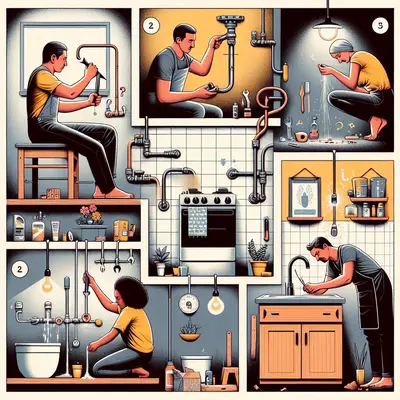
Small problems around the house usually don’t need a full toolbox or a professional visit—what they do need is a clear process you can repeat. Instead of random one‑off fixes, you can use simple “repair routines” to handle common issues quickly and confidently. This guide walks through five highly practical repair workflows you can reuse whenever these problems show up.
Stop a Dripping Faucet: The “Diagnose, Disassemble, Replace, Rebuild” Routine
A dripping faucet wastes water, raises your bill, and can stain sinks. Most of the time, the fix is a worn rubber or cartridge part inside the handle.
Step 1 – Identify your faucet type
- Look at the handle(s):
- One handle that moves up/down and left/right = likely cartridge or ball faucet
- Two separate handles = likely compression or ceramic disk faucet
- This matters because you’ll be replacing different internal parts.
Step 2 – Shut off water and prep the work area
- Turn off the shutoff valves under the sink (clockwise).
- Open the faucet to relieve pressure and confirm water is off.
- Plug the sink drain (with a stopper or rag) so you don’t lose small screws.
- Lay a towel to protect the sink and catch parts.
Step 3 – Remove the handle and access the valve
- Pry off the decorative cap with a flat screwdriver (if present).
- Unscrew the handle screw and remove the handle.
- You’ll see a nut, cartridge, or stem depending on faucet type. Take a clear photo before touching anything so you can reassemble correctly.
Step 4 – Remove and inspect the internal parts
- Use an adjustable wrench to loosen the retaining nut.
- Gently pull out the cartridge or stem.
- Look for:
- Cracked rubber washers
- Damaged O-rings
- Mineral buildup on surfaces
Step 5 – Take old parts to the store and match exactly
- Bring the cartridge/stem and any rubber parts to a hardware store.
- Match brand, size, and shape—“close enough” often leaks again.
- Consider buying a small faucet repair kit for future fixes.
Step 6 – Clean, reassemble, and test
- Clean mineral buildup with white vinegar and an old toothbrush.
- Lubricate O-rings with plumber’s (silicone) grease if available.
- Reinstall new parts in the same orientation as your photo.
- Tighten the retaining nut snugly (not over-torqued).
- Reattach handle, turn water back on slowly, and test for drips.
If it still drips after replacing internal parts, the faucet body itself may be worn or cracked—at that point, replacing the entire faucet is usually more cost‑effective than chasing more micro‑repairs.
Quiet a Running Toilet: The “Observe, Adjust, Clean, Replace” Workflow
A toilet that keeps running wastes water and is often fixable without special tools. The key is to watch what happens inside the tank after you flush.
Step 1 – Remove the tank lid and observe a flush
- Gently lift the tank lid and set it on a towel.
- Flush once and watch what happens as the tank refills.
- Pay attention to:
- Does water stop before reaching the top of the overflow tube?
- Is the flapper sealing properly?
- Is there water trickling into the bowl continuously?
Step 2 – Adjust the water level
- If water is overflowing into the vertical overflow tube, the water level is set too high.
- For float‑cup fill valves (sliding collar on a rod):
- Turn the screw or squeeze the clip to lower the float.
- For float‑ball types (ball on an arm):
- Gently bend the arm downward so the valve shuts off sooner.
- Aim for the water line marked inside the tank, or about 1 inch below the overflow tube.
Step 3 – Check and clean the flapper
- Turn off water to the toilet (valve at the wall). Flush to empty the tank.
- Inspect the rubber flapper at the bottom:
- Is it warped, cracked, or slimy with buildup?
- Clean the sealing surface with a sponge or cloth.
- If the rubber feels stiff or misshapen, plan to replace it (they’re inexpensive).
Step 4 – Replace a faulty flapper
- Unhook the old flapper from the overflow tube and unclip the chain.
- Install the new flapper per the package direction (match style and size).
- Reattach the chain with a slight slack—too tight and the flapper won’t seal; too loose and it won’t lift fully.
Step 5 – Fine‑tune and test
- Turn on water, let the tank refill, and listen:
- The toilet should fill, then go quiet.
- No water should be trickling into the bowl.
- If the toilet still runs:
- Recheck water level adjustment.
- Confirm the chain isn’t stuck or tangled.
- If the fill valve is hissing constantly, it may be worn and need replacement (many universal fill valves install with basic hand tools).
This same observe‑adjust‑clean‑replace routine applies whenever the toilet starts running again—once you know what “normal” looks like inside the tank, you can fix most issues in minutes.
Restore a Weak Shower: The “Blockage, Balance, Build‑Up” Method
When water pressure drops in the shower but is fine elsewhere, the issue is usually local to the showerhead or mixing valve—not your whole plumbing system.
Step 1 – Confirm the problem is isolated
- Turn on the bathroom sink and kitchen faucet:
- If they’re fine, the main supply is likely okay.
- If all fixtures are weak, contact your water provider or check your main valve and pressure regulator.
Step 2 – Clean the showerhead
- Unscrew the showerhead (use a cloth and adjustable wrench if it’s tight).
- Inspect for mineral deposits in the small spray holes.
- Soak the head in white vinegar for 30–60 minutes to dissolve buildup.
- Scrub with an old toothbrush, rinse thoroughly, and reinstall with fresh Teflon tape on the threads if needed.
Step 3 – Check internal flow restrictor (if appropriate)
- Many showerheads include a small plastic flow restrictor.
- Removing or modifying it may violate local codes or water‑use regulations, so check your local rules and the manufacturer’s instructions first.
- If allowed, you can gently remove and clean around it, then reinstall.
Step 4 – Balance hot and cold (pressure‑balancing valve issues)
- If the shower goes weak only when other fixtures run (like a toilet flush), the pressure‑balancing valve in the wall may be sticking or worn.
- Remove the trim plate and handle per the manufacturer’s instructions.
- Gently clean reachable parts with vinegar and a soft brush.
- If the cartridge looks damaged or stiff, it may need replacement with an exact match (this is where brand/model identification on the trim is useful).
Step 5 – Consider a more efficient showerhead
- Replacing an old, heavily scaled showerhead with a modern WaterSense‑labeled model can improve the feel of the spray while using less water.
- Install by:
- Cleaning the shower arm threads
- Wrapping with 2–3 turns of Teflon tape
- Hand‑tightening the new head, then snugging gently with a wrench if necessary
If these steps don’t help and other fixtures show similar problems, it’s time to look at whole‑house pressure, a failing pressure‑reducing valve, or partially clogged pipes—those are typically pro‑level jobs.
Fix a Door That Won’t Latch: The “Alignment First, Hardware Second” Approach
When a door won’t latch or scrapes, many people jump straight to replacing locks. Most of the time it’s a simpler alignment issue caused by gravity and seasonal movement of the frame.
Step 1 – Identify what’s actually wrong
- Gently close the door:
- Does the latch hit above or below the strike plate hole?
- Does the door rub at the top or side?
- Does it close fully but the latch doesn’t catch?
Step 2 – Tighten the hinge screws
- Open the door and check all hinge screws, especially those in the door frame.
- Use a screwdriver to snug them up—loose top hinge screws often cause doors to sag and miss the strike.
- If screws spin without tightening, replace with longer wood screws that bite into the framing behind the jamb.
Step 3 – Adjust alignment with simple shimming
- If tightening screws isn’t enough:
- To raise the latch side: slightly tighten the top hinge and/or loosen the bottom hinge (very small changes).
- To lower the latch side: reverse that.
- For more precise adjustment, you can insert thin cardboard or plastic shims behind hinge leaves to tilt the door subtly.
Step 4 – Tune the strike plate
- If the latch is just slightly off:
- Use a metal file to enlarge or shift the opening in the strike plate.
- Loosen strike plate screws and move it up/down/forward as needed, then retighten.
- For a larger adjustment:
- Remove the strike plate, chisel the mortise slightly in the needed direction, and reinstall.
Step 5 – Check the latch and knob hardware
- With the door open, turn the knob/lever and release it—does the latch spring in and out smoothly?
- If the latch sticks or feels gritty:
- Spray a small amount of dry lubricant (not greasy oil) into the latch mechanism.
- If it remains rough or fails to spring back, consider replacing the latch set; modern units are usually drop‑in replacements requiring only a screwdriver.
Once you’ve gone through this alignment‑then‑hardware process, you’ll know how to quickly correct future doors that start sticking or failing to latch as the house shifts over time.
Clear a Slow Sink Drain: The “Top‑Down, Not Chemicals First” Strategy
A slow drain is usually a localized clog in the trap or nearby pipe—not a full‑on plumbing emergency. Doing a top‑down mechanical cleanup can avoid harsh chemicals and protect your pipes.
Step 1 – Remove and clean the stopper
- For bathroom sinks:
- Look under the sink for the horizontal pivot rod connected to the stopper.
- Loosen the retaining nut, disconnect the rod, and pull the stopper straight up from the sink.
- Clean hair, soap scum, and debris off the stopper and from the drain opening.
Step 2 – Use a small drain tool or manual method
- Try a plastic drain cleaning strip or a simple zip‑tie with notches cut in it.
- Insert into the drain, wiggle, then pull out to remove hair clogs near the top.
- Repeat several times, then flush with hot water.
Step 3 – Disassemble and clean the P‑trap (if needed)
- Place a bucket under the trap (the U‑shaped pipe).
- Loosen the slip nuts by hand or with adjustable pliers.
- Remove the trap and empty it into the bucket.
- Clean out sludge and debris, then rinse the trap with water.
- Reinstall, making sure washers are seated correctly and nuts are snug (hand‑tight plus a slight tweak).
Step 4 – Flush with hot water and mild cleaner
- Run hot (not boiling) water for several minutes.
- You can follow with a baking soda and vinegar flush for minor buildup (this is more for cleaning than serious clogs).
- Avoid relying on harsh chemical drain openers regularly—they can damage older pipes, discolor fixtures, and cause safety issues if mixed improperly.
Step 5 – Prevent future slowdowns
- Use a drain screen to catch hair in bathroom sinks and tubs.
- Once a month, clean stoppers and screens before they become packed.
- If multiple drains are slow simultaneously, or you smell sewage, call a professional—it may be a main line or vent issue, not a simple local clog.
Conclusion
Most everyday home issues follow repeatable patterns. When you think in terms of routines—shut off, inspect, clean, replace, test—you turn guesswork into a predictable process. You don’t need a workshop filled with tools or advanced skills; you need a calm step‑by‑step approach and a willingness to take things apart carefully and put them back the way they were.
Use these five workflows as your starting kit. The next time a faucet drips, a toilet runs, a shower weakens, a door won’t latch, or a sink slows down, you’ll know exactly where to begin—and when it’s time to stop and call a pro.
Sources
- [U.S. Environmental Protection Agency – Fixing Leaks at Home](https://www.epa.gov/watersense/fix-leak-week) - Explains how common leaks (faucets, toilets, showerheads) waste water and provides basic guidance on repairs
- [The Family Handyman – How to Fix a Leaking Faucet](https://www.familyhandyman.com/project/how-to-fix-a-leaking-faucet/) - Detailed, illustrated instructions for repairing different faucet types
- [U.S. Department of Energy – Water Heating and Showerheads](https://www.energy.gov/energysaver/reduce-hot-water-use-energy-savings) - Covers efficient showerheads, water usage, and performance considerations
- [Lowe’s – How to Fix a Running Toilet](https://www.lowes.com/n/how-to/fix-a-running-toilet) - Step‑by‑step overview of diagnosing and repairing common toilet tank issues
- [Home Depot – How to Clear a Clogged Sink](https://www.homedepot.com/c/ah/how-to-unclog-a-sink/9ba683603be9fa5395fab9016f6f3d0) - Practical guidance on mechanical drain clearing and when to escalate to a professional
Key Takeaway
The most important thing to remember from this article is that this information can change how you think about Household Repairs.