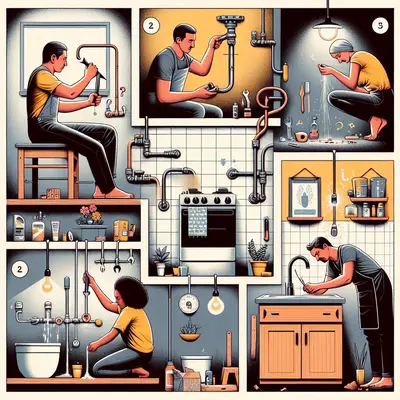
A lot of “DIY repair” advice assumes you own a workshop and love power tools. Most people don’t. This guide focuses on five common home problems you can fix with basic tools, a small budget, and clear steps—no contractor required. Each solution is designed to be realistic, safe, and doable in an evening or weekend.
Stop a Dripping Faucet (Without Replacing the Whole Thing)
A dripping faucet wastes water and quietly raises your bill. In most cases, you don’t need a new faucet—you just need to replace a worn internal part.
What you’ll need
- Adjustable wrench or small socket set
- Screwdriver (Phillips/flathead)
- Replacement cartridge or washers/O-rings (model-specific)
- Plumber’s grease (optional but helpful)
- Rag or towel
Step-by-step
Turn off the water supply
Look under the sink for two shutoff valves (hot and cold). Turn both clockwise until they stop. Open the faucet to relieve pressure and drain remaining water.
Identify your faucet type
- Single handle often uses a cartridge. - Two handles often use compression stems with rubber washers. Search your faucet brand + model (often on the faucet base) to see what part you need.
Remove the handle
Pry off the decorative cap (if present) with a small flathead screwdriver. Unscrew the handle screw underneath and lift or wiggle the handle off. Keep small parts in a bowl so nothing rolls away.
Access the cartridge or stem
You’ll likely see a nut holding the cartridge or stem in place. Use an adjustable wrench to loosen and remove it. Pull the cartridge/stem straight up. If it’s stuck, gently wiggle; avoid twisting hard, which can damage the fixture.
Match and replace the part
Take the old cartridge or stem (or washer/O-rings) to a hardware store and match it. Install the new part the same way the old one came out. For stems with washers, replace the rubber washer and any worn O-rings, adding a light coat of plumber’s grease.
Reassemble and test
Reinstall the nut, handle, and decorative cap. Turn the shutoff valves back on slowly and test the faucet. Check for drips at the spout and around the handle.
If it still drips after replacing the worn parts, the faucet body may be damaged or pitted—at that point, replacement is usually more cost-effective than more repairs.
Quiet a Running Toilet That Won’t Stop Filling
A toilet that runs long after flushing usually has a problem with the fill valve, flapper, or float. Fixing it will save water and noise.
What you’ll need
- Replacement flapper and/or fill valve (if required)
- Adjustable wrench
- Towel or small bucket
- Sponge or rag
Step-by-step
Take the tank lid off and observe
Flush the toilet with the lid off and watch what happens. Common issues: - Water flowing into overflow tube continuously - Flapper not sealing properly - Water level too high, spilling into the overflow tube
Check the flapper first
The flapper is the rubber piece at the bottom of the tank. If it’s warped, cracked, slimy, or doesn’t sit flat, it won’t seal. Turn off the water supply (valve behind the toilet), flush to drain most of the water, and unhook the flapper. Replace with a new one that matches the style (universal flappers work for most standard toilets).
Adjust the water level
Turn water back on briefly and see where the water level stops. It should be about 1 inch below the top of the overflow tube. - For older float-ball types: bend the metal rod slightly downward to lower the float. - For modern fill valves with sliding clips: pinch the clip and move the float down.
Replace the fill valve if it’s not shutting off
If water still flows into the overflow even at a lower float setting, the fill valve may be failing. Turn water off, flush to empty the tank, and sponge out remaining water. - Disconnect the refill tube and supply line from the bottom of the tank. - Unscrew the fill valve nut under the tank and remove the old valve. - Install the new valve per its instructions, ensuring the rubber gasket seats properly. - Reconnect everything and adjust the water level with the new float.
Final test
Turn the supply back on and let the tank fill. The water should stop before reaching the overflow tube, and you shouldn’t hear continuous hissing or trickling. Flush several times to confirm.
Fix a Door That Won’t Latch or Keeps Swinging Open
When a door won’t stay shut or keeps swinging by itself, the frame and hinges have likely shifted over time. A few simple adjustments often solve it.
What you’ll need
- Screwdriver
- Longer wood screws (2.5"–3")
- Wood filler or toothpicks + wood glue (for stripped holes)
- Utility knife (optional)
Step-by-step
Check for loose hinges
Open the door and inspect hinge screws in both the door and frame. Tighten all visible screws. Even 1–2 loose screws can cause misalignment.
Fix stripped screw holes
If a screw just spins and won’t tighten, the hole is stripped. Remove the screw, pack the hole with wood filler, or stuff 2–3 wood-glue-coated toothpicks in the hole and snap them flush. Let dry, then drive the screw back in.
Pull the door back into alignment
If the latch hits above or below the strike plate hole, the door has likely sagged. Try replacing one upper hinge screw (in the frame side) with a longer 2.5"–3" wood screw. Drive it in snugly to pull the door jamb closer to the wall stud, lifting the door slightly.
Adjust the strike plate (if needed)
If the latch hits the strike plate but doesn’t enter the hole cleanly, mark where it’s hitting using masking tape or a pencil. - Loosen the screws on the strike plate and slightly shift it up/down or in/out. - If necessary, use a utility knife or chisel to slightly enlarge the recess behind the plate so it can move.
Check for self-swinging doors
If the door swings open or closed on its own, the hinges may be slightly out of plumb. Try bending the hinge pin slightly: - Remove the hinge pin by tapping it up with a screwdriver and hammer. - Gently bend the pin a tiny amount by tapping it against a hard surface. - Reinsert it. This creates friction that helps the door stay put.
Re-test: the door should latch smoothly without slamming and stay where you leave it.
Patch a Small Drywall Hole So It Actually Blends In
Whether it’s from a doorknob or a misplaced wall anchor, small drywall holes (up to about 2 inches) are easy to repair cleanly.
What you’ll need
- Spackle or joint compound
- Putty knife (2"–4")
- Sanding sponge or fine sandpaper (120–220 grit)
- Self-adhesive patch (for holes over ~1")
- Primer and matching paint
- Damp cloth
Step-by-step
Prep the damaged area
Use the putty knife to remove any loose drywall or flaking paint. Wipe the area with a damp cloth to remove dust so the patch adheres well.
Repair nail or screw holes (small)
For holes about pencil-sized: - Press a small amount of spackle directly into the hole with the putty knife. - Scrape off excess so it’s flush with the wall. - Let it dry (follow container instructions) and lightly sand smooth.
Patch larger holes (up to ~2")
- Stick a self-adhesive mesh patch over the hole, centered. - Spread joint compound over the patch in thin layers, feathering outward a couple of inches beyond the patch. - Let dry completely, sand smooth, then apply a second thin coat if needed to blend edges. Sand again once dry.
Prime the repaired area
Bare joint compound absorbs paint differently from finished wall. Apply a thin coat of primer over the patched area. This helps prevent a “flashed” or dull spot later.
Paint to match
Use leftover wall paint if you have it. For best blending, paint slightly beyond the patch edges, ideally to the nearest natural break (corner, trim, or entire section of wall). Two light coats usually look better than one heavy one.
When done right, you shouldn’t notice the patch at normal viewing distance.
Restore Water Flow in a Slow or Clogged Bathroom Sink
A bathroom sink that drains slowly or smells musty often has a blockage in the pop-up assembly or P-trap. You can usually clear it without harsh chemicals.
What you’ll need
- Bucket or large bowl
- Channel-lock pliers or adjustable wrench
- Old toothbrush or small brush
- Rubber gloves
- Wire coat hanger or plastic drain tool (optional)
- Towel
Step-by-step
Try the simple flush first
Remove the sink stopper and run hot water for a few minutes. If water still pools, you likely have hair and buildup in the drain or trap.
Remove the stopper properly
- Look under the sink for the horizontal rod entering the drain pipe from the back. This rod holds the stopper in place. - Loosen the nut holding that rod, then gently pull the rod out. - Lift the stopper straight up from the sink.
Clean the stopper and drain opening
Wear gloves and remove hair and gunk from the stopper and the visible drain opening. Use an old toothbrush to scrub off buildup. If needed, use a straightened coat hanger or plastic drain tool to pull out clumps from just inside the drain.
Clean the P-trap if the clog persists
- Place a bucket under the curved section of pipe (the P-trap). - Loosen the slip nuts on both ends of the trap by hand or with pliers. - Remove the trap carefully and dump the water and debris into the bucket. - Clean the trap with a brush and rinse it out.
Reassemble and test
Reinstall the P-trap, making sure the washers sit correctly and the nuts are snug (hand-tight plus a gentle tweak with pliers). Reinsert the horizontal rod into the drain lever hole and retighten the nut, then reinstall the stopper so the rod catches the hole in the bottom of the stopper.
Run water and check for:
- Good flow down the drain
- No drips from any of the trap connections
Avoid over-tightening plastic fittings; snug is usually enough to prevent leaks.
Conclusion
You don’t need a workshop, specialized skills, or a huge toolbox to handle everyday home issues. By focusing on the right problems and following clear steps, you can stop a leak, silence a running toilet, get a door working properly, erase wall damage, and clear a sluggish sink—often in under an hour each.
Start with the problem that bothers you most. As you tackle a few of these, you’ll build confidence and a small set of go-to tools that make the next repair easier and cheaper than calling for help every time.
Sources
- [U.S. Environmental Protection Agency – Fixing Leaks at Home](https://www.epa.gov/watersense/fix-leak-week) - Explains how common household leaks like dripping faucets and running toilets waste water and why fixing them matters
- [This Old House – How to Fix a Leaky Faucet](https://www.thisoldhouse.com/plumbing/21015235/how-to-fix-a-leaky-faucet) - Detailed walkthroughs for different faucet types and internal parts
- [Family Handyman – How to Fix a Running Toilet](https://www.familyhandyman.com/project/how-to-fix-a-running-toilet/) - Step-by-step repair instructions with diagrams for flappers, fill valves, and floats
- [Lowe’s – How to Patch and Repair Drywall](https://www.lowes.com/n/how-to/patch-repair-drywall) - Visual guide to patching different sizes of wall damage, including tools and materials
- [Home Depot – How to Unclog a Bathroom Sink](https://www.homedepot.com/c/ah/how-to-unclog-a-bathroom-sink/9ba683603be9fa5395fab90cbf5ac5f) - Practical techniques for clearing bathroom sink clogs without harsh chemicals
Key Takeaway
The most important thing to remember from this article is that this information can change how you think about Household Repairs.