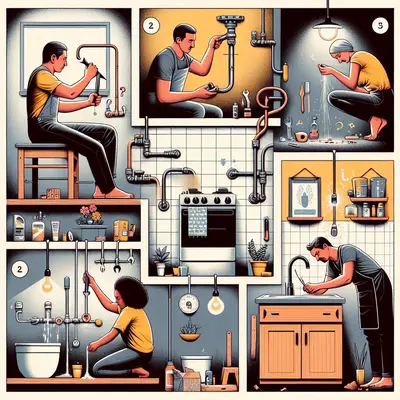
Household problems rarely show up at a “good” time—but most don’t actually need an emergency call to a pro. With a few basic tools and clear steps, you can knock out a surprising number of repairs yourself, save money, and prevent bigger damage later. This guide walks you through five practical fixes you can do in a typical afternoon, even if you don’t consider yourself “handy.”
Fix 1: A Dripping Faucet That Won’t Stop Wasting Water
A dripping faucet can waste gallons of water a day and drive up your bill. The good news: most drips come from worn internal parts that are cheap and simple to replace.
Tools & Materials
- Adjustable wrench or basin wrench
- Flat-head and Phillips screwdriver
- Replacement cartridge or washer/O-ring kit (match to your faucet brand/model)
- Towel and small container (to catch small parts)
Step-by-Step
Shut off the water supply
Look under the sink for the shutoff valves. Turn the hot and cold valves clockwise until they stop. Open the faucet to release any pressure and confirm the water is off.
Plug the drain
Use the sink plug or a rag to block the drain so small screws or parts don’t disappear.
Remove the handle
- Pop off any decorative cap on the handle with a flat screwdriver. - Unscrew the handle screw underneath. - Gently pull the handle off. If it’s stuck, wiggle or use a bit of penetrating oil and let it sit for a few minutes.
Identify your faucet type
Common types: - Cartridge (single or double handle) - Compression (older style with separate hot/cold, turns many times) - Ceramic disk Look for your brand name; search it online if you’re unsure. This helps you buy the right replacement part.
Remove the cartridge or stem
- Use the wrench to loosen the retaining nut. - Carefully pull out the cartridge/stem, noting its orientation. Take a quick photo before you remove it.
Replace worn parts
- For compression faucets, replace the rubber washer at the end of the stem and any O-rings. - For cartridge faucets, replace the cartridge with an identical new one. - Lightly coat O-rings with plumber’s grease if available (not petroleum jelly).
Reassemble in reverse order
- Reinsert the cartridge or stem in the same position as before. - Tighten the retaining nut snugly but don’t overtighten. - Reattach the handle and decorative cap.
Turn water back on and test
- Slowly open the shutoff valves. - Run the faucet and check for drips at the spout and around the base. - If it still drips, confirm the cartridge or washer matches your model and is fully seated.
Fix 2: A Toilet That Keeps Running After You Flush
A constantly running toilet wastes water and is usually caused by one of three parts: the flapper, fill valve, or float adjustment. These are all accessible in the tank—no need to touch the bowl.
Tools & Materials
- Adjustable wrench
- Replacement flapper (or full toilet repair kit if parts are very old)
- Towel or sponge
Step-by-Step
Remove the tank lid and observe
Flush the toilet and watch what happens inside: - Does the flapper not seal? - Is water flowing continuously into the overflow tube? - Is the water level too high?
Check and clean the flapper
- Turn off water at the shutoff valve behind the toilet. - Flush once to empty most of the water. - Feel the rubber flapper at the bottom. If it’s warped, cracked, or slimy, replace it. - To replace: unhook from the overflow tube and chain, attach the new one the same way, and adjust the chain so there’s a little slack (but not so much it can get caught).
Adjust the water level
- Turn water back on. - If water rises above the marked “fill line” or near the top of the overflow tube, adjust: - Float cup type: Turn the adjustment screw on top of the fill valve (clockwise to lower water level). - Float ball type: Bend the metal rod slightly downward so the ball shuts off the water sooner.
Inspect the fill valve
If adjusting the float doesn’t stop water flowing into the overflow: - Turn off the water and flush to empty. - If your toilet is older or you see corrosion/cracks, replacing the fill valve may be easiest. - Follow the instructions on a universal fill valve kit—usually involves disconnecting the supply line, removing the old valve from under the tank, inserting the new one, and adjusting height.
Final test
Turn water back on and let the tank fill. The toilet should: - Stop filling when water reaches the fill line. - Stay quiet (no constant trickling). - Hold water without the tank level dropping.
Fix 3: A Wall Crack That Makes Your Room Look Neglected
Hairline cracks from settling or temperature changes are common and usually cosmetic. Repairing them protects the wall and gives your space an instant visual upgrade.
Tools & Materials
- Utility knife
- Putty knife (2–4 inch)
- Pre-mixed joint compound or lightweight spackle
- Sanding sponge or fine sandpaper (120–220 grit)
- Primer and paint to match wall
- Damp cloth
Step-by-Step
Open up the crack slightly
- Use a utility knife to lightly score along the crack and remove any loose material. - Widening it a bit helps the compound bond better and prevents the crack from reappearing as quickly.
Clean the area
- Wipe with a damp cloth to remove dust and debris. - Let dry completely before applying compound.
Apply joint compound
- Use the putty knife to push compound firmly into the crack. - Smooth over the area, feathering the edges so it blends with the surrounding wall. - Remove excess material; thinner coats crack less and are easier to sand.
Let it dry
- Follow the drying time on the package (often several hours). - For deeper cracks, you may need two coats. Let the first coat dry fully before adding another.
Sand for a smooth finish
- Lightly sand the patched area until it’s flush with the wall. - Run your hand over it; it should feel smooth with no raised edges.
Prime and paint
- Apply primer over the patch to prevent flashing (a shiny or dull patch that shows through paint). - Once dry, paint the area, feathering into the surrounding wall. For best blending, paint the entire wall if your existing paint is older or faded.
Fix 4: A Sticky Interior Door That Won’t Close Smoothly
A door that rubs, sticks, or doesn’t latch properly is often caused by humidity, loose hinges, or slight frame movement. Fixing it early prevents damage to the door and frame.
Tools & Materials
- Screwdriver
- Pencil or painter’s tape
- Sandpaper or a hand plane
- Utility knife
- Wood filler (if needed)
Step-by-Step
Find the contact point
- Close the door slowly and see where it sticks or rubs. - Lightly mark the tight area with a pencil or a small piece of painter’s tape on the edge of the door or frame.
Tighten hinge screws
- Open the door fully. - Tighten all the hinge screws on both the door and frame. - If screws spin and don’t tighten, remove them and fill the holes with toothpicks dipped in wood glue or wood filler; let dry and reinsert the screws.
Adjust the position using hinge shims (optional)
- If the top corner of the door is hitting the frame on the latch side, slightly loosen the top hinge screws and insert a thin piece of cardboard behind the hinge on the frame side, then retighten. This pulls that corner of the door back.
Sand the sticking area
If tightening hinges isn’t enough: - Remove the door from the hinges (tap out hinge pins with a screwdriver if needed). - Place the door on a stable surface. - Sand the marked area along the edge, checking often so you don’t remove too much. - For very tight spots, lightly use a hand plane instead of sandpaper.
Seal exposed wood
- After sanding, lightly sand smooth and wipe off dust. - Touch up with paint or stain to seal the wood and prevent future swelling from moisture.
Rehang and test
- Reinstall the door on the hinges and insert hinge pins. - Open and close the door several times to confirm it moves freely and latches without force.
Fix 5: A Power Outlet That Feels Loose or Won’t Hold Plugs
A loose outlet is more than annoying—it can be a safety issue. If the outlet itself is damaged or the receptacle moves inside the box, address it promptly. If you’re not comfortable working around electricity, stop and call a licensed electrician.
Tools & Materials
- Flat-head and Phillips screwdriver
- Voltage tester (non-contact preferred)
- Replacement outlet (match type: standard, GFCI, etc.) if needed
- Outlet shims or small washers
Safety First
If anything is burnt, melted, or smells like burning plastic, stop and call a professional. Do not reuse that outlet.
Step-by-Step
Turn off power at the breaker
- Find your electrical panel and locate the breaker controlling that outlet. - Switch it to the OFF position. - Back at the outlet, plug in a lamp or use a voltage tester to confirm it’s dead.
Remove the cover plate
- Unscrew the plate and set it aside. - Keep screws in a small container so they don’t get lost.
Test for power again
- Before touching any wires, use the voltage tester around the outlet’s terminals to ensure no power is present.
Check for looseness
- Gently try moving the outlet. If it wiggles: - Tighten the mounting screws at the top and bottom of the outlet. - If the screws bottom out but the outlet still sits too far back, use outlet shims or washers between the outlet tabs and the electrical box to bring it flush with the wall.
Inspect for damage
- Look at the front of the outlet: if plug prongs slide out easily or the receptacle is cracked, replace it: - Note where each wire is attached (take a photo). - Disconnect one wire at a time and connect it to the same location on the new outlet (typically black/hot to brass, white/neutral to silver, ground to green). - Tighten screws securely; do not over-strip or leave exposed copper.
Reassemble and test
- Gently push wires back into the box, keeping bends smooth. - Secure the outlet to the box so it’s straight and snug. - Reinstall the cover plate. - Turn the breaker back on and test with a lamp or small device. The plug should fit snugly and stay in place.
Conclusion
You don’t need a workshop full of tools or years of experience to handle everyday home repairs. By learning to shut off utilities safely, working methodically, and tackling one problem at a time, you can stop small issues from turning into expensive headaches. Keep a basic tool kit on hand, take photos before disassembly, and when in doubt—especially with electrical or structural concerns—call a pro. But for drips, runs, cracks, sticky doors, and loose outlets, you’re now equipped to repair them yourself.
Sources
- U.S. Environmental Protection Agency – Fix a Leak Week - Explains how household leaks waste water and why fixing dripping faucets and running toilets matters
- Family Handyman – How to Fix a Leaky Faucet - Detailed guidance and illustrations for different faucet types and common repairs
- Kohler – Replacing the Toilet Fill Valve - Manufacturer instructions on diagnosing and replacing toilet fill valves
- U.S. Consumer Product Safety Commission – Outlet and Electrical Safety - Safety recommendations for working around electrical outlets and preventing hazards
- This Old House – Fixing Sticking Doors - Practical methods and visuals for diagnosing and correcting door alignment issues
Key Takeaway
The most important thing to remember from this article is that this information can change how you think about Household Repairs.