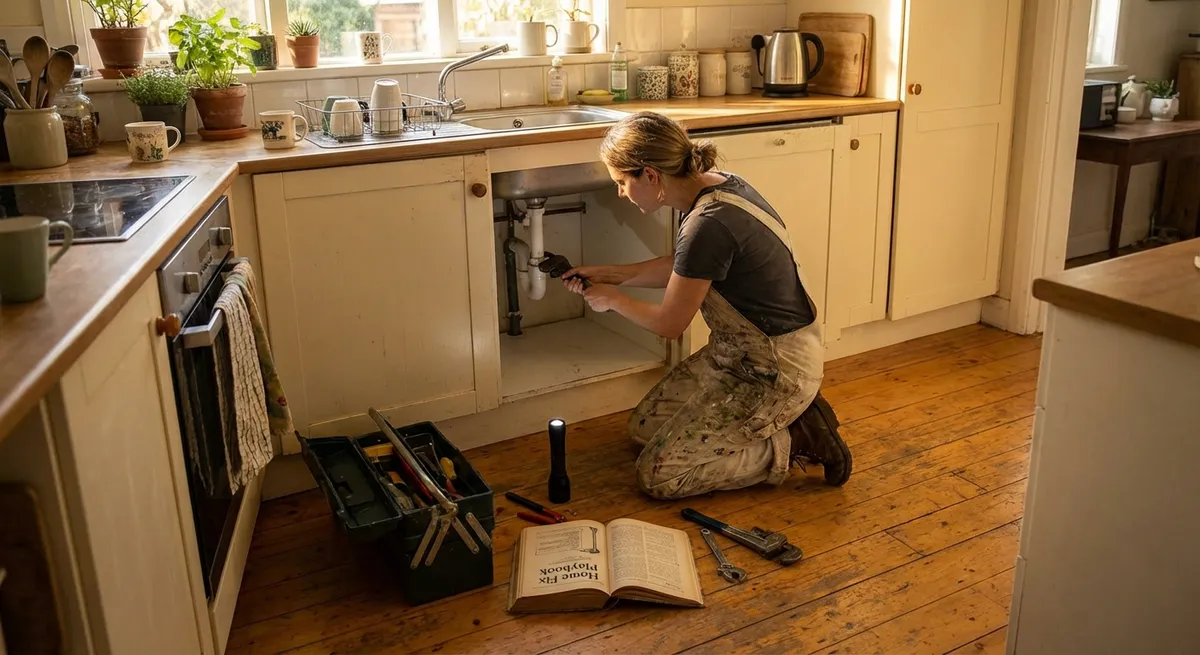
When something breaks or stops working at home, you don’t always need a pro or a new gadget. With a few basic tools and clear steps, you can solve a lot of everyday problems yourself—and save time, money, and frustration. This playbook walks you through five practical fixes most people can handle, even if you’re new to DIY.
1. Quiet a Running Toilet That Won’t Stop
A constantly running toilet wastes water and drives up your bill, but it’s usually easy to fix.
What you’ll need:
- Adjustable wrench (optional)
- Replacement flapper (if needed)
- Towel
Step-by-step:
Remove the tank lid
Place it gently on a towel so it doesn’t crack.
Identify where the water is going
Look inside the tank while it’s running. Common issues: - Water trickling into the overflow tube (tube in the middle) - Flapper not sealing properly - Float set too high so water overflows
Check and reseat the flapper
- Turn the water supply valve (behind/under the toilet) clockwise to shut it off. - Flush once to empty most of the water. - Inspect the rubber flapper at the bottom: - If it’s warped, cracked, or slimy, replace it. - If it’s just misaligned, reseat it so it covers the opening fully.
Replace the flapper if needed
- Unhook the old flapper from the overflow tube and chain. - Attach the new flapper to the same spots. - Adjust the chain so there’s a little slack (about ½ inch). Too tight and it won’t seal; too loose and it won’t lift.
Adjust the water level
- Turn water back on. - If water flows into the overflow tube, lower the float: - For a float arm: gently bend the metal arm down. - For a float cup: turn the adjustment screw or squeeze the clip and slide the float down the rod.
Test multiple flushes
Flush 3–4 times and watch the tank. The water should stop running once it reaches the fill line and the bowl should refill normally.
2. Reset a Dead Outlet Using the GFCI
If an outlet in your kitchen, bathroom, or garage suddenly dies, the problem might be a tripped GFCI, not a bad device.
What you’ll need:
- Small lamp or phone charger (for testing)
Step-by-step:
Find the GFCI outlet
Look for an outlet with “TEST” and “RESET” buttons in: - Bathrooms - Kitchen counters - Laundry area - Garage or basement Sometimes one GFCI protects several outlets.
Test your device
Plug your lamp/charger into a known working outlet. - If it doesn’t work there, the device is the problem. - If it works, move on.
Plug into the dead outlet
Confirm it has no power.
Press the RESET button on the GFCI
- Firmly press RESET until it clicks. - If it immediately trips again, unplug everything on that circuit and try once more.
Check power again
Move back to the dead outlet and plug in your tester device. - If it works now, the GFCI was the issue.
If GFCI won’t reset
- Check your main breaker panel for a tripped breaker; flip it fully OFF, then ON. - If it still trips or won’t reset, stop and call a licensed electrician—there may be a wiring or moisture issue that needs a pro.
3. Clear a Slow Bathroom Sink Drain Without Harsh Chemicals
A slow-draining sink is usually caused by hair and soap scum, not a deep pipe problem.
What you’ll need:
- Rubber gloves
- Small bucket or bowl
- Old toothbrush
- Zip-it style drain cleaning strip or straightened wire hanger
- Baking soda and vinegar (optional)
Step-by-step:
Remove anything in the basin
Clear cups, razors, or soap dishes so you can work safely.
Pull out the drain stopper
- If it lifts straight out, great. - If it doesn’t: - Look under the sink for a metal rod connected to the drain pipe with a small nut. - Place a bucket under the pipe. - Unscrew the nut (hand-tight or gently with pliers), slide out the rod, then pull the stopper up and out.
Clean the stopper
- Use gloves and an old toothbrush to scrub off hair and gunk. - Rinse thoroughly.
Clear the drain opening
- Insert a drain cleaning strip or bent hanger into the drain. - Gently pull out hair and buildup; repeat a few times. - Avoid forcing it deep or scraping aggressively to protect the pipes.
Optional: Flush with baking soda and vinegar
- Pour about ½ cup baking soda down the drain. - Follow with ½ cup white vinegar. - Let it fizz 10–15 minutes, then flush with hot (not boiling) water.
Reassemble the stopper
- Put the stopper back into the drain from above. - Under the sink, reinsert the rod so it connects to the hole at the bottom of the stopper. - Tighten the nut snugly, not overly tight. - Test by lifting and lowering the stopper.
Run water and check flow
Turn the faucet on full and let it run for 30–60 seconds. If it drains smoothly, you’re done.
4. Fix a Loose Cabinet Door That Won’t Line Up
Loose or crooked cabinet doors are usually just a hinge adjustment away from looking brand new.
What you’ll need:
- Phillips screwdriver
- Optional: toothpicks and wood glue (for stripped screw holes)
Step-by-step:
Check the hinge type
Most modern cabinets use “European” concealed hinges with two or three small screws on the hinge arm.
Tighten all visible screws
- Open the cabinet door. - Tighten the screws on the hinge plate that attaches to the cabinet frame. - Tighten the screws on the hinge arm attached to the door. Loose screws are a common cause of droop and misalignment.
Adjust side-to-side position
- On European hinges, one screw usually moves the door left/right. - Turn it a quarter-turn at a time, then close the door to see the change. - Aim to align the gap between doors so it’s even top to bottom.
Adjust up/down if needed
- Loosen (don’t remove) the mounting screws that hold the hinge plate to the cabinet. - Gently move the door up or down. - Hold in place and retighten.
Adjust in/out for flush fit
- Another screw typically moves the door closer to or away from the cabinet. - Adjust until the door sits flat and doesn’t rub against neighbors.
Fix stripped screw holes (if screws won’t tighten)
- Remove the loose screw. - Dip a wooden toothpick (or two) in wood glue and insert into the hole. Break off flush. - Let dry 15–30 minutes. - Reinsert and tighten the screw—now it has fresh wood to grip.
Final check
Open and close the door a dozen times. It should swing smoothly, line up with other doors, and stay closed.
5. Stop a Squeaky Interior Door Without Removing It
A squeaky door is annoying but usually easy to calm down in minutes.
What you’ll need:
- Lubricant:
- Best: silicone spray or dry Teflon lubricant
- Acceptable: petroleum jelly or a tiny amount of multipurpose oil
- Rag or paper towel
Step-by-step:
Identify the squeak
Slowly open and close the door and listen. - Most squeaks come from hinges, not the latch.
Protect surrounding surfaces
- Place a rag or paper towel under the hinges to catch drips. - If using spray lubricant, you can hold a piece of cardboard behind the hinge as a shield.
Apply lubricant to the hinge
- For spray: Short burst directly at the hinge pin and moving parts. - For jelly/oil: Use a cotton swab or fingertip to work a small amount into the hinge joint. Avoid overdoing it—too much attracts dust.
Work the door back and forth
- Open and close the door 15–20 times to pull the lubricant into the hinge pin area. - Wipe away any excess that drips out.
Check each hinge
- If the squeak remains, repeat on the other hinges. - Sometimes only one hinge is guilty, but it’s fine to lightly treat them all.
For stubborn squeaks: remove the hinge pin
- Support the door (have someone hold it or use a wedge). - Gently tap the bottom of the hinge pin upward with a screwdriver and hammer. - Pull the pin out, coat it lightly with lubricant, and reinsert. - Tap it back down firmly and test.
Clean up
Wipe down hinge area and nearby trim to remove any oily residue before it stains.
Conclusion
Most everyday household problems aren’t emergencies—they’re opportunities to build your own repair skills. By learning how to tackle a running toilet, dead outlet, slow drain, crooked cabinet door, or squeaky hinge, you cut down on service calls, extend the life of what you already own, and gain confidence every time something goes wrong.
Share this playbook with a friend or family member, pick one problem in your home, and fix it today. The more you practice, the more your home becomes a place you can maintain on your own terms.
Sources
- [U.S. Environmental Protection Agency – Fix a Leak](https://www.epa.gov/watersense/fix-leak-week) – Covers how leaks (including toilets) waste water and basic steps to find and fix them
- [Kohler – How to Adjust a Toilet Fill Valve](https://support.kohler.com/hc/en-us/articles/360001472033-How-to-Adjust-a-Toilet-Fill-Valve) – Official guidance on adjusting water level and components in common toilet tanks
- [U.S. Consumer Product Safety Commission – Ground-Fault Circuit Interrupters](https://www.cpsc.gov/safety-education/safety-guides/home/ground-fault-circuit-interrupters) – Explains what GFCIs are, how they protect you, and why proper use and testing matter
- [University of Georgia Extension – Household Water Conservation](https://extension.uga.edu/publications/detail.html?number=C964) – Practical advice on reducing water waste in the home, including plumbing fixtures and leaks
- [Family Handyman – How to Adjust Cabinet Hinges](https://www.familyhandyman.com/project/how-to-adjust-cabinet-hinges/) – Step-by-step instructions with visuals on fine-tuning common cabinet hinges for proper alignment
Key Takeaway
The most important thing to remember from this article is that this information can change how you think about DIY Solutions.