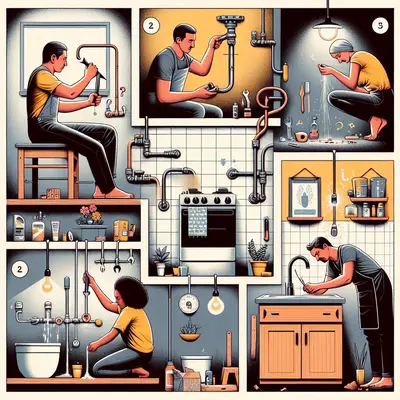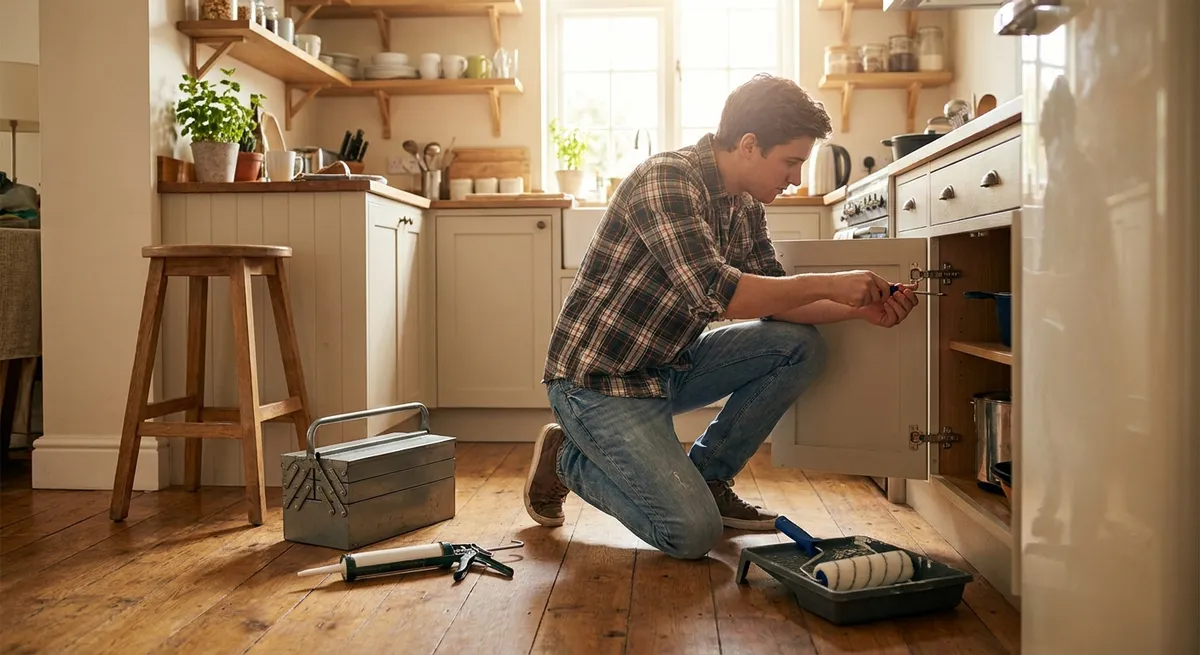
A lot of “small” problems around the house quietly steal your time, money, and patience—dripping faucets, doors that won’t close right, a toilet that never stops running. Most of these don’t actually need a pro; they just need a clear plan and 20–30 minutes of focused effort. This guide walks you, step by step, through five practical household repairs you can tackle safely with basic tools.
Stop a Dripping Faucet (Without Replacing the Whole Thing)
A steady drip is more than annoying—it can waste gallons of water a day and increase your bill. The most common cause is a worn-out washer or cartridge inside the faucet.
Tools & Materials
- Adjustable wrench
- Screwdriver (Phillips and flathead)
- Replacement washer or cartridge (match by brand/model if possible)
- Plumber’s tape (Teflon tape)
- Old towel or rag
Step-by-Step
Shut off the water supply
Look under the sink for two small valves (hot and cold). Turn both clockwise until they stop. Open the faucet to relieve pressure and confirm the water is off.
Block the drain
Use the sink stopper or a rag so you don’t lose screws or small parts down the drain.
Remove the faucet handle
- Pry off the decorative cap (if present) with a small flathead screwdriver. - Unscrew the screw underneath. - Gently pull the handle straight up or out.
Expose the valve/cartridge
You’ll see a nut or retaining clip holding the cartridge or stem in place. Use an adjustable wrench to loosen the nut, or pliers to remove the clip.
Take out the cartridge or stem
Pull it straight up. Note the orientation or take a quick photo so you can reinstall it correctly.
Inspect and replace worn parts
- For older compression faucets: replace the rubber washer and O-ring at the end of the stem. - For cartridge faucets: take the cartridge to a hardware store and match it by brand and shape. Install the new one in the same orientation.
Reassemble with plumber’s tape
Wrap plumber’s tape around threaded connections (1–2 turns). Reinstall the cartridge/stem, tighten the nut snugly (don’t overtighten), and put the handle back on.
Turn water back on and test
Slowly open the shutoff valves. Run the faucet and then turn it off. Check for drips after a few minutes. If it still drips, gently tighten the packing nut a bit more.
Fix a Toilet That Won’t Stop Running
A constantly running toilet is usually a simple tank problem, not a drain or clog issue. Most often, the flapper isn’t sealing or the float is set too high.
Tools & Materials
- Adjustable wrench (maybe)
- Replacement flapper (universal or match your brand)
- Old towel
Step-by-Step
Remove the tank lid
Set it aside on a flat, safe surface. Don’t drop it—these are heavy and fragile.
Identify the main parts
Inside the tank you’ll see: - The fill valve (tall piece on one side with the water line) - The float (ball or cup that rises with the water) - The flapper (rubber valve at the bottom, connected to the flush handle by a chain)
Test the flapper seal
Push down gently on the flapper with a stick or handle. If the running sound stops, the flapper isn’t sealing and likely needs replacement.
Replace the flapper
- Turn off the toilet’s shutoff valve (behind or beside the toilet). - Flush to empty most of the water from the tank. - Unhook the chain and unclip the flapper from the overflow tube. - Attach the new flapper to the overflow tube, then hook the chain so there’s just a bit of slack—not tight, not loose.
Adjust the water level
If water is flowing into the overflow tube, your float is set too high. - For a float arm: gently bend the metal arm down so the fill valve stops sooner. - For a float cup: use the side screw or plastic clip to lower the float position. Aim for the water line mark on the tank.
Turn water back on and test
Let the tank refill, then flush a few times. The toilet should fill, stop, and stay quiet. No water should be trickling into the bowl when it’s “at rest.”
Quiet a Squeaky or Hard-to-Close Interior Door
Squeaks and sticky doors are usually hinge problems or minor alignment issues, not a “door replacement” job.
Tools & Materials
- Phillips screwdriver or drill
- Hammer and nail set (or small nail)
- Lubricant (silicone spray or petroleum jelly)
- Wood toothpicks and wood glue (for stripped screw holes)
Step-by-Step
Locate the problem
Open and close the door slowly. Note: - Where it squeaks (usually hinges) - Where it rubs or sticks (top corner, side, or near latch)
Lubricate the hinges
- With the door closed, tap the hinge pin up from the bottom using a nail and hammer. - Pull the pin out halfway or fully. - Wipe it clean, then coat lightly with silicone spray or petroleum jelly. - Reinsert the pin and tap it back into place. - Do this for each hinge and test.
Tighten loose hinge screws
Use a screwdriver to tighten all screws on the door side and frame side. If a screw just spins and won’t tighten, the hole is stripped.
Fix stripped screw holes
- Remove the screw. - Fill the hole with wood glue and insert several broken toothpicks. - Snap them flush with the surface and let dry. - Reinsert the screw; it should now bite firmly.
Adjust a door that’s rubbing on top corner
If the top of the door hits the frame on the latch side: - Slightly loosen the top hinge screws on the frame. - Gently pull the door edge up toward the hinge side while retightening. - Alternatively, move the bottom hinge on the frame inward slightly (1–2 mm) to tilt the door.
Fine-tune the latch alignment
If the latch won’t catch: - Close the door slowly and see where the latch hits the strike plate. - If it’s too low or high, loosen the strike plate screws and adjust up or down slightly. - Retighten and test until the latch clicks smoothly.
Restore Suction to a Weak Vacuum Cleaner
When your vacuum loses suction, it’s often a simple airflow or filter issue, not a dead motor. Fixing it can extend its life by years.
Tools & Materials
- Scissors
- Small brush (old toothbrush works)
- Replacement bag or filters (model-specific)
- Mild dish soap and warm water (for washable filters)
Step-by-Step
Unplug the vacuum
Always disconnect power before working on it.
Empty the bag or canister
- For bagged vacuums: replace the bag if it’s more than 2/3 full. - For bagless: empty the canister and tap it gently to dislodge packed dust.
Check and clean filters
Most vacuums have: - A pre-motor filter (before air reaches the motor) - An exhaust or HEPA filter (after the motor) Remove filters one at a time, noting their orientation. - If washable: rinse with lukewarm water only (no soap unless manual says so) and let dry completely (24 hours) before reinstalling. - If non-washable and clogged: replace.
Clear the hose and attachments
- Detach the hose and check for clogs by looking through it or pushing a broom handle through gently. - Cut away hair and thread wrapped around brush heads using scissors. - Use a toothbrush to remove lint from small openings.
Inspect the brush roll (beater bar)
- Flip the vacuum over. - Remove the base plate (usually a few screws). - Cut and pull away hair, string, and debris wrapped around the brush roll and bearings. - Ensure the brush spins freely by hand.
Reassemble and test
Put all parts back in their original position. Plug in and test suction on a low-pile surface. If suction is still weak, double-check for hidden blockages in elbows or tight bends.
Patch a Small Hole or Dent in Drywall (So It Actually Disappears)
From doorknob dents to small picture-hook holes, you can make walls look new without calling a contractor.
Tools & Materials
- Spackle or lightweight joint compound
- Putty knife (2–4 inch)
- Fine-grit sandpaper (120–220 grit)
- Damp sponge or cloth
- Matching wall paint and brush or roller
- Self-adhesive patch (for holes bigger than a coin)
Step-by-Step
Clean and prep the area
- Remove loose paint or drywall around the hole with a putty knife. - Wipe away dust with a damp cloth and let dry.
Treat tiny nail and screw holes
- Apply a small amount of spackle on the tip of your putty knife. - Press firmly into the hole and scrape off excess, leaving it slightly proud (raised). - Let dry according to the product instructions.
Patch small-to-medium holes (up to a few inches)
- For holes larger than a dime but under a few inches, stick a self-adhesive mesh patch over the hole. - Spread joint compound over the patch, feathering edges outward to blend with the wall. - Allow to dry fully; apply a second thin coat if needed.
Sand smooth
- Lightly sand the patched area with fine-grit sandpaper until it’s flush with the surrounding wall. - Wipe with a damp cloth or sponge to remove dust.
Prime if needed
For larger patches or very porous areas, a quick coat of primer helps prevent “flashing” (a visible difference in sheen). Some spackles include primer; check the label.
Paint to match
- Use the same paint you used originally (or a carefully color-matched sample). - Feather the paint slightly beyond the patch so it blends with the existing wall. - Let dry and apply a second coat if necessary.
Conclusion
Most “annoying house problems” are small, repeatable issues with clear, fixable causes—not mysteries that require expensive service calls. Once you know where to look and what to adjust, you can stop leaks, silence doors, calm toilets, revive vacuums, and erase wall damage with basic tools and a bit of patience. Start with one repair from this list today, build your confidence, and you’ll find that keeping your home running smoothly is far more manageable (and affordable) than it looks from the outside.
Sources
- U.S. Environmental Protection Agency – Fix a Leak - Covers how small plumbing leaks waste water and basic steps to identify and fix them
- Kohler – How to Fix a Leaking Faucet - Manufacturer guidance on common faucet repairs and cartridge replacement
- U.S. Department of Energy – Saving on Water Heating Bills - Explains how leaks and inefficient fixtures affect household water and energy use
- Family Handyman – How to Fix a Running Toilet - Step-by-step visual reference for diagnosing and fixing toilet tank issues
- Lowe’s – How to Repair Drywall - Detailed instructions and diagrams for patching various sizes of drywall damage
Key Takeaway
The most important thing to remember from this article is that this information can change how you think about Household Repairs.