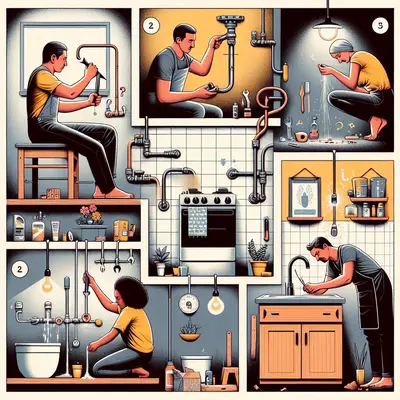
Tackling small household issues yourself can save money, prevent bigger damage, and give you more control over your space. You don’t need a workshop full of tools or a contractor on speed dial—just a clear process and a bit of patience. This guide walks you through five practical fixes that most people can handle in an afternoon, using basic tools and materials.
Stop a Dripping Faucet: From Annoying to Silent
A dripping faucet wastes water and slowly increases your bill, but most leaks come from worn internal parts you can replace yourself.
Step-by-step:
Shut off the water supply
Look under the sink for two valves (hot and cold). Turn them clockwise until they stop. Open the faucet to drain any remaining water.
Plug the drain
Use the sink stopper or a rag to block the drain. This prevents small screws or parts from falling in.
Identify your faucet type
Most household faucets are one of these: - Cartridge - Compression - Ball - Ceramic disc Take a quick photo of the faucet and inner parts as you disassemble; this helps you reassemble correctly.
Remove the handle
Pry off the decorative cap with a flathead screwdriver if there is one. Unscrew the handle screw with a screwdriver or Allen wrench, then lift off the handle.
Access the cartridge or valve
Under the handle, remove the retaining nut or clip with an adjustable wrench or pliers. Gently pull out the cartridge or stem. Note the orientation.
Inspect and replace O-rings and washers
Look for cracked, flattened, or brittle rubber parts (O-rings and washers). These are usually the source of the drip. Take them—and your cartridge or stem—to a hardware store and ask for matching replacements.
Reassemble in reverse order
Install the new parts, making sure they seat properly. Re-tighten the retaining nut (snug but not overly tight), reinstall the handle and screw, then pop the cap back on.
Turn the water back on slowly
Open the shut-off valves under the sink gradually while the faucet is in the "on" position. This helps avoid pressure shock to new components. Then close the faucet and check for leaks.
Quiet a Running Toilet and Cut Down on Water Waste
A toilet that won’t stop running can waste hundreds of gallons per day. Most of the time, the fix is in the tank and doesn’t require special skills.
Step-by-step:
Remove the tank lid and observe
Flush once with the lid off and watch what happens. Focus on three parts: - The flapper (rubber seal at the bottom) - The fill valve (tall assembly where water enters) - The float (controls water level)
Check the flapper first
If water keeps trickling into the bowl after the tank is "full," the flapper may be leaking. - Turn off the supply valve behind the toilet. - Disconnect the chain from the flush handle. - Pull the flapper off the two side pegs. - Compare the old flapper at the store and buy a replacement matched to your valve type.
Install the new flapper
Clip it onto the pegs, attach the chain with a little slack (but not so much that it tangles), then turn the water back on and test. If the chain is too tight, the flapper won’t seal; too loose, and it might not lift fully.
Adjust the float if water level is too high
If water rises to the overflow tube and spills in: - For a float cup style, squeeze the clip on the float and slide it down the rod. - For a float ball style, gently bend the rod downward so the ball sits lower on the water.
Replace a noisy or slow fill valve (if needed)
If the toilet hisses constantly, fills very slowly, or doesn’t shut off: - Turn off the water supply and flush to empty the tank. - Disconnect the water line from the bottom of the tank. - Unscrew the old fill valve nut, remove the valve, and install a universal replacement following the included diagram. - Reconnect the water line and set the float so the water line stops about 1 inch below the top of the overflow tube.
Final check
Flush several times, watching the fill level and listening for continuous running. Adjust the chain or float as needed until the toilet refills quietly and shuts off completely.
Fix a Door That Won’t Latch or Keeps Swinging Open
If a door won’t stay closed or drags, you usually don’t need a new door—just small adjustments to the hinges and latch.
Step-by-step:
Tighten loose hinge screws
Open the door and inspect all hinge screws (on both the door and frame). Tighten them with a screwdriver. Often, this alone realigns the door enough to latch properly.
Replace stripped screws with longer ones
If a screw spins without tightening, the wood is stripped: - Remove the loose screw. - Replace it with a longer screw (2–3 inches) of the same head style. - Angle it slightly toward the wall framing for better bite. This pulls the door snugly back toward the frame.
Check door alignment against the strike plate
Close the door slowly and see where the latch hits the strike plate. - If it hits above the opening, the door is sagging. - If it hits below, the top hinge may be too tight or misaligned.
Adjust the strike plate (small alignment issues)
For minor misalignment: - Loosen the two screws holding the strike plate slightly. - Tap the plate up, down, or sideways with a hammer and a wood block until the latch lines up. - Tighten the screws and test.
Deepen the strike plate recess (if the door won’t close fully)
If the latch doesn’t fully enter: - Remove the strike plate. - Use a sharp utility knife and chisel to slightly deepen the mortise (the recess in the frame). - Reinstall the strike plate and test again.
Stop a door from swinging open on its own
If your door swings because of slight settling: - Remove the top hinge pin. - Lay it flat and tap the middle of the pin with a hammer to create a very slight bend. - Reinsert the pin. The extra friction usually keeps the door where you put it.
Restore Power to a Dead Outlet Safely
When one outlet stops working, you don’t automatically need an electrician. Often, the issue is a tripped GFCI or breaker you can reset safely.
Step-by-step:
Unplug everything from the dead outlet
Overloaded outlets can trigger safety mechanisms. Remove lamps, chargers, and appliances before troubleshooting.
Check for other dead outlets nearby
Test outlets in the same room or adjacent rooms with a lamp or outlet tester. Multiple dead outlets usually point to: - A tripped GFCI (ground-fault circuit interrupter) outlet - A tripped breaker in your electrical panel
Find and reset GFCI outlets
GFCIs often protect bathrooms, kitchens, garages, and outdoor areas, and may control downstream outlets. - Look for outlets with “Test” and “Reset” buttons. - Press Reset firmly until it clicks. - Re-test the original dead outlet.
Check your breaker panel
Go to the service panel (often in a basement, garage, or utility room). - Look for a breaker that is in the middle position or slightly off compared to others. - Flip it fully to OFF, then back to ON. - Label the circuit if it isn’t already, so you know what it controls next time.
Inspect for obvious damage (do not touch bare wires)
At the outlet: - Look for burn marks, melted plastic, or a burning smell. - If you see any of these, stop and call a licensed electrician. Do not continue using that outlet.
Replace a worn outlet (for experienced DIYers only)
If you’re comfortable and local code allows: - Turn the breaker off for that circuit and verify with a non-contact voltage tester. - Remove the outlet cover and mounting screws. - Move wires one-by-one from the old outlet to a new, tamper-resistant outlet: black (hot) to brass screw, white (neutral) to silver, bare/green (ground) to green screw. - Reassemble and restore power. If you’re unsure at any point, stop and hire a pro—electrical work must be done safely and to code.
Seal a Drafty Window to Improve Comfort and Cut Bills
Drafts around windows can make your home feel colder and force your heating system to work harder. Basic sealing can significantly improve comfort.
Step-by-step:
Locate the drafts
On a cool or windy day: - Close all windows. - Hold your hand around the edges, especially at the bottom, sides, and where the sashes meet. - For a more precise test, move a lit incense stick or thin tissue around the frame and watch for movement in the smoke or paper.
Clean the window frame and surrounding area
Dust, old caulk, and peeling paint prevent new seals from sticking. - Use a putty knife to scrape away loose caulk or paint. - Wipe surfaces with a damp cloth and let them dry fully.
Apply weatherstripping to moving parts
For gaps where the window slides or closes: - Use adhesive foam weatherstripping or V-strip (tension seal). - Measure and cut to length. - Peel the backing and press firmly along the sides and top where the sash meets the frame. - Make sure the window still closes and locks smoothly; adjust thickness if needed.
Caulk stationary gaps
For cracks between the window frame and the wall: - Use a paintable exterior-grade acrylic latex caulk for indoors around the frame edges. - Cut the tip of the tube at a 45° angle for a thin bead. - Run a steady bead along the gap, then smooth with a wet finger or caulk tool. - Wipe excess with a damp cloth before it skins over.
Use shrink film for seasonal insulation (optional but effective)
For older, especially drafty windows in winter: - Clean the interior frame. - Apply double-sided tape from a window insulation kit around the frame. - Press the clear plastic film onto the tape, pulling it tight. - Use a hair dryer to gently shrink and tighten the film until it’s nearly invisible.
Recheck for drafts
After the caulk cures (follow label directions), re-test with your hand or tissue. Adjust or add weatherstripping where needed.
Conclusion
Small, nagging problems in your home rarely fix themselves. A dripping faucet, running toilet, misaligned door, dead outlet, or drafty window can feel like the start of bigger issues—but in many cases, they’re simple, contained repairs you can handle with basic tools. By working methodically, turning off water or power where appropriate, and knowing when to call a professional, you can keep your home comfortable, safe, and efficient without waiting weeks for a service call.
Sources
- U.S. Environmental Protection Agency – Fix a Leak - Explains how household leaks (like dripping faucets and running toilets) waste water and provides guidance on finding and fixing them
- Family Handyman – How to Fix a Leaky Faucet - Step-by-step instructions and diagrams for repairing common faucet types
- U.S. Department of Energy – Air Sealing Your Home - Details why sealing drafts around windows and doors matters and recommended materials and methods
- U.S. Consumer Product Safety Commission – Ground-Fault Circuit Interrupters - Overview of GFCI outlets, how they work, and why they’re critical for electrical safety
- Yale University – Residential Door Hardware Basics - Background on door hardware components, useful for understanding latches, strikes, and alignment issues
Key Takeaway
The most important thing to remember from this article is that this information can change how you think about Household Repairs.