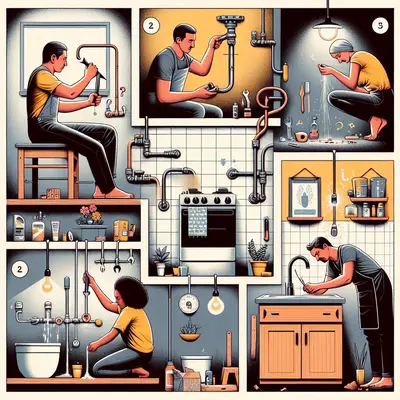
Minor home problems have a habit of showing up at the worst possible time—right before guests arrive, on a busy morning, or when you’re already stressed. The good news: a lot of those “call a pro” moments are completely manageable with basic tools and a clear plan. This guide walks you through five practical, step‑by‑step household repairs you can safely handle yourself and finish in a single session.
1. Silencing a Squeaky Interior Door
A squeaky door is annoying but usually simple to fix. In most cases, the issue is friction or light rust on the hinges.
Tools & Materials
- Old towel or rag
- Flathead screwdriver or utility knife (optional)
- Paper towel or small brush
- Lubricant: silicone spray, dry Teflon spray, or petroleum jelly
Step‑By‑Step
Confirm the source of the squeak
Slowly open and close the door and listen. The sound almost always comes from the hinge pins rubbing inside the hinge barrels.
Protect surrounding surfaces
Lay an old towel under the door to catch drips. If using spray lubricant, you can hold a piece of cardboard behind the hinge to shield the wall.
Try lubricating in place first
- Open the door. - Apply a small amount of lubricant directly onto the top of each hinge pin and the moving joints. - Open and close the door 10–15 times to work the lubricant in. Often this is enough to stop the squeak.
If it still squeaks, remove one hinge pin at a time
- Support the door slightly by lifting under the doorknob with your hand or a wedge. - Use a flathead screwdriver under the bottom of the pin (or tap from below if accessible) and gently pry it upward. - Pull out the pin completely.
Clean the hinge pin
- Wipe off old grease, dust, or rust with a rag. - If there’s rust, lightly scrape with a utility knife or fine steel wool (if you have it). - Wipe clean.
Lubricate the hinge pin thoroughly
- Apply a thin, even coat of lubricant along the pin. - Avoid overdoing it; excess will drip and attract dust.
Reinstall the pin and work the door
- Slide the pin back into the hinge from the top. - Tap gently if necessary to seat it fully. - Open and close the door several times. - Repeat the clean‑and‑lube process for the remaining hinges if needed.
Check for alignment issues
If the door still squeaks or binds, sight down the edge of the door. If it’s rubbing the frame, you may need to tighten hinge screws or slightly reposition one hinge—usually just tightening loose screws fixes it.
2. Stopping a Slowly Dripping Bathroom Faucet
A slow drip wastes water and money but is often fixable by replacing a worn washer or cartridge.
Tools & Materials
- Adjustable wrench
- Phillips and flathead screwdrivers
- Replacement washer or cartridge (model‑specific)
- Towel
- Small bowl or tray for parts
Step‑By‑Step
Turn off the water supply
- Look under the sink for two shutoff valves (hot and cold). - Turn both clockwise until fully closed. - Open the faucet to confirm water is off.
Plug the drain
Use the sink stopper or a rag so small screws or parts don’t disappear down the drain.
Remove the handle
- Pry off the decorative cap (if present) with a flathead screwdriver or fingernail. - Unscrew the handle screw underneath. - Pull the handle straight up or off; wiggle gently if stuck.
Identify your faucet type
- Compression faucet (separate hot/cold, turns more than 1/4 turn): usually uses rubber washers. - Cartridge, ball, or ceramic disc faucet: often uses a cartridge or specialized mechanism. Take a clear photo of the exposed parts for reference.
Disassemble the valve
- Use the adjustable wrench to loosen the packing nut or retaining nut. - Gently pull out the stem or cartridge. - Keep parts in order in your small tray so they go back the same way.
Inspect and replace worn parts
- For compression faucets: - Check the rubber washer at the bottom of the stem. If it’s hardened, cracked, or misshapen, replace it with a matching washer. - Inspect the O‑ring along the stem; replace if deteriorated. - For cartridge faucets: - Inspect the cartridge for cracks or mineral buildup. - In many cases, replacing the entire cartridge is the practical solution. Bring it or a clear photo to a hardware store to match.
Clean the faucet seat and parts
Wipe away any debris or mineral buildup with a rag. Avoid scratching metal surfaces.
Reassemble and test
- Reinsert the stem or cartridge, aligning it as before. - Tighten the retaining nut snugly but don’t overtighten. - Reattach the handle and decorative cap. - Open the shutoff valves slowly. - Turn on the faucet and check for leaks at the handle and spout.
If it still drips after replacing the washer or cartridge, the valve seat may be damaged—this is when calling a plumber begins to make sense.
3. Fixing a Running Toilet That Won’t Stop Refilling
A constantly running toilet is usually a problem with the flapper, float, or fill valve. The repair is straightforward once you understand what you’re looking at inside the tank.
Tools & Materials
- Adjustable wrench (often optional)
- Replacement flapper (most common)
- Rag or sponge
Step‑By‑Step
Remove the tank lid and observe
Flush once and watch what happens. Notice: - Does water keep flowing into the bowl? - Does the water level rise too high? - Does the flapper fail to seal?
Check the flapper seal
- The flapper is the rubber piece at the bottom of the tank connected to the handle chain. - Push the flapper down gently by hand. If the running stops, the flapper likely isn’t sealing properly and needs cleaning or replacement.
Adjust or replace the flapper chain first
- If the chain is too tight, it holds the flapper open slightly. - You want a little slack: enough that the flapper can fully close, but not so much that it can’t lift when flushed. - Adjust by moving the clip on the lever arm.
Clean the flapper and seat
- Turn off the water at the supply valve behind the toilet. - Flush to lower the water level so you can access the flapper easily. - Wipe the flapper and the seat (the ring it rests on) with a rag to remove slime or mineral buildup. - Turn water back on and test.
Replace the flapper if cleaning doesn’t help
- Turn water off again and flush to empty most of the tank. - Unhook the flapper from the overflow tube and chain. - Take the old flapper with you to the store to match size and style. - Attach the new flapper to the overflow tube and reconnect the chain with slight slack. - Turn water back on and test several flushes.
Adjust the water level (float adjustment)
If water rises too high and spills into the overflow tube, adjust the float: - For a float ball on an arm: - Bend the arm slightly downward so the fill valve shuts off earlier. - For a vertical float cup: - Use the adjustment screw or clip on the side of the fill valve to lower the float’s stopping point. Aim for a water level about 1 inch below the top of the overflow tube.
Consider replacing the fill valve if noise persists
If you hear hissing even when the water level is correct, the fill valve may be worn. Modern replacement kits include clear instructions and usually require only basic tools.
4. Resetting a Tripped Breaker After a Circuit Overload
When half a room suddenly goes dark or several outlets stop working, you might be dealing with a tripped circuit breaker. Knowing how to safely reset it—and what to check first—prevents repeat problems.
Tools & Materials
- Flashlight (if the area is dark)
Safety First
If you smell burning, see scorch marks at an outlet, or the breaker immediately trips again after reset, stop and call a licensed electrician.
Step‑By‑Step
Unplug or switch off suspect devices
Before touching the panel, unplug appliances or turn off devices that were running when power went out on that circuit. This reduces the load when you restore power.
Locate your electrical panel
Common locations: basement, garage, utility room, or a hallway closet. Open the panel door.
Identify the tripped breaker
- Look for a breaker in a middle position (neither fully ON nor fully OFF), or with an orange/red indicator. - Some panels label circuits (e.g., “Kitchen outlets,” “Living room”). Use labels to confirm.
Fully switch the breaker OFF first
- Using one hand, push the tripped breaker firmly to the OFF position. - This resets the internal mechanism so it can turn back ON.
Switch the breaker back ON
- Push the breaker firmly back to the ON position until it clicks. - If it immediately snaps back to OFF, don’t force it. Something is wrong on the circuit—call an electrician.
Gradually plug devices back in
- Return to the affected area. - Plug devices back in one at a time, especially high‑demand items (space heaters, microwaves, hair dryers). - If the breaker trips again when a specific device is plugged in or turned on, that device or its load is the likely culprit.
Reduce future overloads
- Avoid running multiple high‑wattage appliances on the same circuit. - Consider moving some devices to a different outlet on another circuit. - For frequent trips in normal use, have an electrician evaluate whether the circuit is undersized or needs upgrading.
5. Patching a Small Hole in Drywall (Nail, Screw, or Anchor Holes)
Whether you’re moving out of a rental or freshening up a room, patching small wall holes is a high‑impact repair that doesn’t require special skills.
Tools & Materials
- Lightweight spackling compound (for small holes)
- Putty knife or old plastic card
- Fine‑grit sandpaper (around 220)
- Damp cloth
- Matching paint and small brush or roller
Step‑By‑Step
Prepare the hole
- Remove any loose drywall crumbs or protruding anchor pieces. - For small nail or screw holes, that’s usually enough. - For slightly larger holes (from wall anchors), use the putty knife to gently scrape away loose edges.
Clean the area
Wipe the area around the hole with a damp cloth to remove dust. Let it dry before applying spackle.
Apply the first layer of spackle
- Scoop a small amount of spackle onto your putty knife. - Press it firmly into the hole, then smooth the surface with the knife at a slight angle. - Feather the edges outward so the patch blends with the wall. For deep or wider holes, it’s better to do two thin layers than one thick glob.
Let it dry completely
Drying time varies (often 30 minutes to a few hours). Check the product instructions. The patch should look uniform and feel solid, not cool or tacky.
Lightly sand the patch
- Use fine‑grit sandpaper to smooth any ridges or raised areas. - Sand in small, circular motions. - Don’t oversand—just enough to make the area flush with the wall.
Wipe off dust and inspect
- Wipe with a damp cloth to remove sanding dust. - If you still see a small depression, apply a second thin layer of spackle, let dry, and sand again.
Prime if needed, then paint
- For very small holes and color‑matched paint, you can often paint directly. - For larger patches or glossy walls, a quick coat of primer over the patch helps prevent “flashing” (the patch showing through). - Apply matching paint with a small brush or roller, feathering the edges. A second coat may be needed for full coverage.
Conclusion
Being able to handle basic household repairs puts you back in control when the small stuff goes wrong. Silencing a squeaky door, stopping a drip, taming a running toilet, resetting a breaker safely, and patching wall holes are all realistic projects for a careful beginner—with clear steps and a bit of patience. Start with the simplest issue you’re facing right now, follow the process slowly, and you’ll build skills and confidence for whatever your home throws at you next.
Sources
- [U.S. Department of Energy – Leaks and Drips](https://www.energy.gov/energysaver/fixing-water-leaks) – Explains the impact of leaking fixtures on water and energy use and why timely repair matters
- [EPA WaterSense – Fix a Leak Week Resources](https://www.epa.gov/watersense/fix-leak-week) – Government guidance on common household leaks, including faucets and toilets
- [Family Handyman – How to Fix a Leaky Faucet](https://www.familyhandyman.com/project/how-to-repair-a-compression-faucet/) – Step‑by‑step visuals and additional faucet‑repair tips
- [Lowe’s – How to Fix a Running Toilet](https://www.lowes.com/n/how-to/fix-a-running-toilet) – Illustrations and explanations of toilet components and typical fixes
- [The Spruce – How to Patch and Repair Drywall](https://www.thespruce.com/patch-and-repair-drywall-4587789) – Detailed drywall repair techniques for small to larger holes
Key Takeaway
The most important thing to remember from this article is that this information can change how you think about Household Repairs.