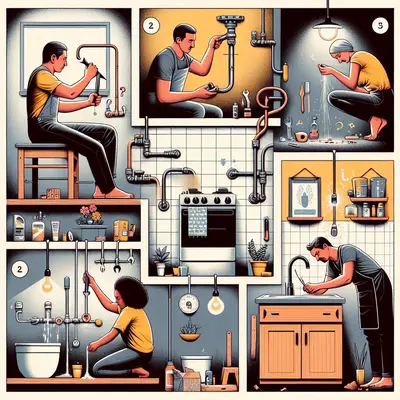
Small problems around the house rarely stay small. A dripping tap, a loose cabinet door, or a running toilet quietly waste money and create daily frustration. The good news: you can tackle many of these issues yourself with basic tools, a bit of patience, and clear instructions. This guide walks you through five practical household repairs step by step, so you can restore order, save cash, and feel more in control of your home.
Stop a Dripping Faucet (Without Replacing the Whole Thing)
A dripping faucet can waste gallons of water a day and drive you nuts at night. Most modern faucets leak because of worn internal parts, not because the whole unit is bad.
Tools & supplies: Adjustable wrench, screwdriver, replacement cartridge or washers/O‑rings (match your faucet brand/model), plumber’s grease, rag.
Step‑by‑step:
Shut off the water supply
Look under the sink for two shutoff valves (hot and cold). Turn them clockwise until they stop. Open the faucet to confirm water is off and relieve pressure.
Plug the drain
Use a sink plug or a rag so you don’t lose screws or small parts down the drain.
Remove the handle
- Pry off any decorative cap with a flat screwdriver. - Unscrew the handle screw and lift the handle off. - If it’s stuck, wiggle gently—don’t force it with excessive pressure that could crack it.
Access the cartridge or stem
Under the handle, you’ll see a nut or clip holding the cartridge or stem in place. - Use an adjustable wrench to loosen the nut. - Pull the cartridge/stem straight up. Note the orientation or take a photo for reference.
Inspect and replace parts
- For cartridge faucets: replace the cartridge with an identical one. - For compression faucets (older style with separate hot/cold knobs): replace the rubber washer and any worn O‑rings. Lightly coat new O‑rings with plumber’s grease before installing.
Reassemble in reverse order
Fit the cartridge/stem back in the same orientation, tighten the nut (snug, not overtight), reinstall the handle and screw, then the decorative cap.
Turn water back on slowly
Open the shutoff valves gradually while watching for leaks under the sink and at the faucet. Test hot and cold. If the drip persists, double‑check that the new part matches your faucet model and is seated correctly.
Quiet a Running Toilet and Cut Water Waste
A toilet that keeps running after you flush is usually a sign of a worn flapper, misadjusted float, or leaky fill valve. Most fixes are simple and don’t require removing the toilet.
Tools & supplies: Replacement flapper (universal or brand-specific), possibly a fill valve kit, adjustable wrench, towel.
Step‑by‑step:
Remove the tank lid and observe
Flush the toilet with the lid off and watch what happens. Is water continuing to flow into the bowl? Is it pouring into the overflow tube? This tells you what’s failing.
Check the flapper first
- Turn off the water valve behind the toilet (clockwise). - Flush to empty most of the water from the tank. - Examine the rubber flapper at the bottom of the tank. If it’s warped, stiff, or covered in buildup, it won’t seal well.
Replace the flapper
- Unhook the old flapper from the overflow tube and disconnect the chain from the flush lever. - Attach the new flapper to the same hooks on the overflow tube. - Connect the chain to the lever, leaving a slight slack. Too tight, and the flapper won’t close; too loose, and it won’t open fully.
Adjust the tank water level
- Turn the water back on. - The water should stop about 1 inch below the top of the overflow tube. - For float‑cup valves, turn the adjustment screw or move the clip on the rod. - For float‑ball valves, gently bend the rod down to lower the water level.
Test for silent, complete shutoff
Flush several times. The toilet should refill, then stop with no hissing or trickling. If it still runs and the flapper is sealing, your fill valve may need replacing (most modern fill valve kits include clear instructions and can be swapped with basic tools).
Fix a Loose Cabinet Door That Won’t Stay Aligned
Loose, sagging, or misaligned cabinet doors make kitchens and bathrooms look tired and can cause hinges to fail sooner. Most hinge issues are solved by tightening and adjusting what’s already there.
Tools & supplies: Phillips screwdriver, toothpicks or wooden matchsticks, wood glue (optional), small level (optional).
Step‑by‑step:
Tighten hinge screws first
Open the cabinet door and tighten all visible screws on both the door and cabinet side of the hinge. Often, this alone fixes minor sagging.
Re‑seat stripped screw holes
If a screw just spins and won’t tighten, the screw hole is stripped. - Remove the screw. - Insert 2–3 wood toothpicks or matchsticks with a dab of wood glue into the hole. - Break them off flush with the surface. - Reinsert the screw and tighten gently. The wood fills the gap and gives the screw something to bite into.
Use hinge adjustments (European/concealed hinges)
For modern concealed hinges (common in kitchen cabinets), there are usually two small adjustment screws: - One moves the door left/right. - One moves it in/out from the cabinet. Turn these in small increments, checking the alignment with adjacent doors as you go.
Check vertical alignment
If the door is too high or low, you may need to loosen the mounting screws slightly and shift the hinge up or down on the cabinet frame, then retighten.
Test closure and gaps
Close the door several times. Look at the gap around the edges; it should be even, and the door should close without rubbing. Make micro‑adjustments until you’re satisfied.
Seal a Drafty Window or Door to Improve Comfort
Drafts around windows and doors make your home uncomfortable and increase heating and cooling costs. Sealing air leaks is a high‑impact, low‑skill repair.
Tools & supplies: Weatherstripping (foam, rubber, or vinyl), exterior‑grade caulk (silicone or paintable acrylic latex), caulk gun, utility knife, soapy water, rag.
Step‑by‑step:
Find the leaks
On a windy day, move your hand slowly around window and door frames. Feeling cold air? That’s a leak. You can also use a lit incense stick or candle (carefully) and watch for the smoke to move.
Weatherstrip around moving parts
- For doors: Add adhesive foam or rubber weatherstripping along the door jamb where the door makes contact. Ensure the door still closes easily. - For windows: Apply weatherstripping where the sashes meet and along sliding surfaces.
Caulk around fixed joints
- Clean the area with a damp cloth and let dry. - Cut the caulk tube tip at a 45° angle with a small opening. - Use a steady motion to apply a continuous bead along gaps between the window/door frame and the wall (interior and/or exterior where accessible).
Smooth and clean up
- Use a dampened finger or a caulk‑smoothing tool to press the caulk into the gap and smooth it out. - Wipe away excess with a damp rag. - Allow the caulk to cure as directed (usually 24 hours).
Recheck for drafts
After curing, test again with your hand or incense. A properly sealed frame should feel significantly less drafty and help stabilize room temperature.
Restore Power to a Dead Outlet Safely
A “dead” outlet doesn’t always mean serious electrical trouble. Often, the issue is a tripped breaker, a GFCI outlet, or a loose connection you can safely identify.
Important safety note: If you ever smell burning, see scorch marks, or feel heat from an outlet or panel, stop and call a licensed electrician immediately.
Tools & supplies: Non‑contact voltage tester (recommended), flat and Phillips screwdrivers, flashlight.
Step‑by‑step:
Check other outlets and devices
Plug a working lamp or phone charger into the outlet. If it doesn’t work, test nearby outlets. If multiple outlets are dead, the issue may be at the breaker or a GFCI.
Look for a tripped GFCI outlet
Kitchens, bathrooms, garages, and outdoor areas often have GFCI (test/reset) outlets that protect several downstream outlets. - Find any GFCI outlets on the same circuit. - Press the “RESET” button firmly. - Re‑test the dead outlet.
Check the breaker panel
- Open your electrical panel door. - Look for any breaker that’s between ON and OFF or looks slightly out of line. - Turn it fully OFF, then back ON. - If it trips again immediately, unplug devices on that circuit and try once more. Persistent tripping means it’s time for an electrician.
Test the outlet (if you’re comfortable)
If the breaker isn’t tripped and no GFCI is the issue: - Turn off power to that circuit at the breaker as a precaution. - Use a non‑contact voltage tester at the outlet to confirm it’s dead. - Remove the cover plate and gently pull the outlet forward to inspect wiring (without touching bare wires). Look for loose or disconnected wires.
Tighten screw‑terminal connections
If you see wires slipped under “backstab” holes (pushed into the back of the outlet), that can be a weak connection. - With power OFF and confirmed dead: remove each wire from the backstab (usually by inserting a small screwdriver into the release slot). - Reattach each wire to the screw terminals (hot/black to brass, neutral/white to silver, ground/green or bare to green screw) and tighten firmly. - Reassemble the outlet and cover, restore power, and test with a lamp or tester.
If you’re unsure at any point, stop and call a licensed electrician—electrical safety is non‑negotiable.
Conclusion
Most everyday home problems don’t need to turn into expensive emergencies. By learning a handful of straightforward repairs—like stopping leaks, silencing a running toilet, realigning a cabinet door, sealing drafts, and reviving a dead outlet—you cut waste, improve comfort, and avoid unnecessary service calls. Start with one fix, gather your basic tools, and work methodically. Each successful repair builds your skills and confidence, making your home easier and cheaper to maintain over time.
Sources
- [U.S. Environmental Protection Agency – Fix a Leak](https://www.epa.gov/watersense/fix-leak-week) - Details on how household leaks waste water and basic guidance on fixing common plumbing leaks
- [Energy.gov – Air Sealing Your Home](https://www.energy.gov/energysaver/air-sealing-your-home) - U.S. Department of Energy guide to finding and sealing drafty areas for better efficiency
- [This Old House – How to Fix a Running Toilet](https://www.thisoldhouse.com/toilets/21016247/how-to-fix-a-running-toilet) - Step-by-step instructions and diagrams for common toilet repairs
- [Family Handyman – How to Fix Loose Cabinet Doors](https://www.familyhandyman.com/project/how-to-fix-kitchen-cabinet-doors/) - Practical tips for adjusting and tightening cabinet hinges
- [Electrical Safety Foundation International (ESFI) – Home Electrical Safety](https://www.esfi.org/resource/home-electrical-safety-checklist/) - Safety guidelines and checklists for working around home electrical systems
Key Takeaway
The most important thing to remember from this article is that this information can change how you think about Household Repairs.