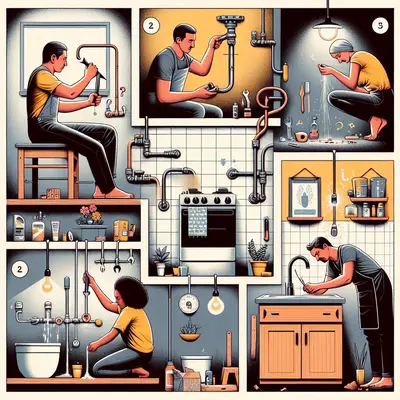
Small problems around the house add up fast—stuck doors, dripping faucets, or outlets that stop working. Instead of waiting weeks for a handyman, you can safely tackle many of these yourself with a few basic tools and a calm, step‑by‑step approach.
This guide walks you through five practical, common household repairs you can realistically handle today, even if you’re not “handy.”
1. Stop a Dripping Faucet (Compression or Cartridge Type)
A dripping faucet wastes water and quietly raises your bill. Most leaks come from worn internal parts, not from anything serious in your plumbing.
What you’ll need
- Adjustable wrench or basin wrench
- Phillips and flathead screwdrivers
- Replacement washer or cartridge (bring the old part to the store to match)
- Plumber’s tape (Teflon tape)
- Towel or rag
Step-by-step
Turn off the water supply
Look under the sink for two shutoff valves (hot and cold). Turn them clockwise until they stop. Open the faucet to relieve pressure.
Plug the drain
Use a sink plug or a rag so you don’t lose screws or small parts.
Remove the handle
- Pry off any decorative cap with a flathead screwdriver. - Unscrew the handle screw underneath. - Gently pull the handle off the stem.
Identify your faucet type
- Compression faucet: Has separate hot/cold handles that turn several times. - Cartridge faucet: Handle usually moves up/down and side-to-side.
For compression faucets (replace washer and seat if needed)
- Use your wrench to remove the packing nut and pull out the stem. - At the end of the stem is a rubber washer—unscrew and replace it. - Inspect the valve seat down inside the faucet body. If it’s pitted or damaged, replace it using a seat wrench (many hardware stores can help identify the size).
For cartridge faucets (replace the cartridge)
- Remove the retaining clip (if present) with pliers. - Pull the cartridge straight out (you may need a special puller for some brands). - Match the cartridge at the hardware store and install the new one in the same orientation.
Reassemble and test
- Wrap threads with plumber’s tape if needed. - Reinstall the stem/cartidge, packing nut, and handle. - Turn the shutoff valves back on slowly and test the faucet.
When to call a pro: If the shutoff valves don’t work, the faucet body is cracked, or you see corrosion on nearby pipes.
2. Quiet a Running Toilet That Won’t Stop
A toilet that keeps running is usually wasting water due to a worn flapper, incorrect float level, or a misaligned chain. Fixing it is often quick and tool‑light.
What you’ll need
- Replacement flapper (universal or brand-specific)
- Adjustable wrench (sometimes optional)
- Towel or sponge
Step-by-step
Remove the tank lid and observe
Don’t flush yet. Look inside: you’ll see the fill valve, float, flapper, and chain. Set the lid aside safely.
Check the flapper first
- Gently press the flapper (rubber piece at bottom of tank) down with your hand. - If the running stops, it’s not sealing properly and likely needs replacement.
Turn off the water supply
Turn the valve behind the toilet clockwise until tight. Flush once to mostly empty the tank.
Replace the flapper
- Disconnect the chain from the flush handle arm. - Unhook the flapper from the overflow tube tabs. - Install the new flapper onto the same tabs. - Reattach the chain, leaving just a little slack (not too tight, not too loose).
Adjust the water level
- Turn water back on. - Adjust float height so the water level sits about 1 inch below the top of the overflow tube. - For a float cup: turn the adjustment screw on the fill valve. - For a float ball: gently bend the metal arm downward to lower the level.
Test several flushes
Flush 3–4 times, making sure the flapper opens fully and then seals, and the tank stops filling.
When to call a pro: If water leaks around the base of the toilet, the tank is cracked, or the shutoff valve is frozen or leaks when you move it.
3. Fix a Door That Sticks or Won’t Latch Properly
A sticking or misaligned door is usually caused by humidity, loose hinges, or a slightly shifted frame. Often you can fix it without replacing the door.
What you’ll need
- Phillips screwdriver
- Wood shims or thin cardboard
- Sandpaper or a hand plane (for tight spots)
- Pencil
Step-by-step
Find the problem area
Close the door slowly and note where it rubs, sticks, or fails to latch. Look at the gap all around the door—uneven gaps are clues.
Tighten hinge screws
- Open the door fully. - Tighten all hinge screws on both the door and the frame. - If screws spin without tightening, the holes may be stripped.
Fix stripped hinge holes
- Remove one problem screw. - Insert wooden toothpicks or a short wood dowel coated in wood glue into the hole. Break off flush. - Reinsert the screw so it bites into the new material.
Use shims to adjust hinge position (if needed)
- If the door is rubbing at the top near the latch side, you often need to move the top hinge slightly inward. - Loosen (don’t remove) the top hinge screws on the frame. - Insert a thin shim or folded cardboard behind the hinge on the frame side. - Retighten screws. Test the door.
Lightly sand tight spots
- Mark the rubbing area with a pencil. - Remove the door from hinges if needed (pull hinge pins). - Sand or plane a small amount from the sticking edge. - Rehang the door and test again. Take off as little material as possible.
Adjust the strike plate if the latch misses
- If the latch doesn’t enter the strike plate opening, mark where it actually hits. - Slightly enlarge or reposition the strike plate: loosen screws, nudge the plate up/down or in/out, then retighten.
When to call a pro: If the frame is visibly warped, the wall is cracked, or you need major planing on a fire-rated or metal door.
4. Reset a “Dead” Outlet Safely (GFCI and Circuit Check)
An outlet that suddenly stops working may not be “broken”—it might be protected by a GFCI (ground‑fault circuit interrupter) or a tripped breaker. You can often restore power without touching any wiring.
Safety first
- If you see scorch marks, smell burning, or feel heat on the outlet or wall, do not use it. Turn off power at the breaker and call an electrician.
- Small lamp or plug‑in tester
- Flashlight
- Access to your electrical panel
What you’ll need
Step-by-step
Test the outlet with a known working device
Plug in a lamp or phone charger you know works. If it doesn’t power on, continue; don’t assume the outlet itself is fried yet.
Look for GFCI outlets on the same circuit
- Check nearby outlets in the same room, bathroom, kitchen, garage, or exterior wall. - GFCI outlets have TEST and RESET buttons in the middle.
Reset the GFCI
- Press the RESET button firmly until it clicks. - Test your “dead” outlet again. - If it now works, the GFCI was protecting the circuit from a previous ground fault.
Check your breaker panel
- Find your electrical panel (often in a basement, garage, or utility area). - Look for any breaker that is not fully ON—many will sit between ON and OFF when tripped. - Turn that breaker fully OFF, then back ON.
Test all related outlets
- Plug your tester or lamp into several outlets on that circuit. - Confirm they work consistently and don’t trip again immediately.
Unplug suspect devices
If a particular appliance seems to trip the GFCI or breaker every time, unplug it and avoid using it until it can be inspected or replaced.
When to call a pro:
- Breaker trips repeatedly with no clear cause
- Outlet feels hot, looks burned, or crackling noises are present
- You’re uncomfortable working in the panel at all
5. Patch a Small Hole in Drywall (Up to About 6 Inches)
Picture hooks, doorknob dings, and small accidents leave walls looking rough. Patching drywall is a straightforward job if you follow the right steps and allow for proper drying time.
What you’ll need
- Spackling paste or joint compound
- Putty knife (2–4 inch and optionally 6–8 inch)
- Sanding sponge or fine-grit sandpaper (120–220 grit)
- Self-adhesive mesh patch (for larger holes)
- Primer and matching paint
For nail/screw holes and small dents
Clean the area
Wipe off dust and loose paint. For slightly larger holes, gently scrape around the edges to remove loose material.
Apply spackle
- Use the putty knife to press spackle into the hole. - Scrape excess off so it’s level with the wall. - Allow it to dry fully (check package instructions).
Sand smooth
- Lightly sand the patch until it’s flush with the surrounding wall. - Wipe away dust with a dry cloth.
Prime and paint
- Spot-prime the patched area to prevent flashing (shiny or dull spots). - Once dry, apply matching paint, feathering the edges into the surrounding area.
For holes up to about 6 inches
Prep the hole
Trim loose edges around the hole so the surface is relatively flat.
Apply a self-adhesive mesh patch
- Stick the patch over the hole, centering it. - Press firmly so it adheres to clean, dry drywall.
First coat of joint compound
- Use a wider knife to spread compound over the patch, covering the mesh completely. - Feather the edges outward to blend with the wall. - Let dry fully.
Second (and possibly third) coat
- Lightly sand bumps and ridges, then wipe dust. - Apply a thinner, wider coat extending beyond the first to smooth the transition. - Let dry and sand again if needed.
Prime and paint
Once smooth and dust-free, prime the repaired area and then paint to match.
When to call a pro:
- Holes larger than a dinner plate
- Cracks that keep reappearing or spreading
- Structural movement or water damage behind the drywall
Conclusion
Most everyday home problems aren’t emergencies; they’re patterns—drips, squeaks, sticking, or things that suddenly “stop working.” With a few basic tools and clear steps, you can safely handle many of these yourself, save money, and learn what’s truly a DIY job versus a call‑a‑pro situation.
Start with one repair from this list that matches an issue in your home. Work slowly, follow each step, and stop if anything seems unsafe or unclear. Over time, you’ll build a small, reliable toolkit—and the confidence to keep your home running smoothly without waiting on someone else’s schedule.
Sources
- U.S. Environmental Protection Agency – Fix a Leak Week - Explains the impact of household leaks like dripping faucets and how to spot them
- U.S. Department of Energy – Reducing Water Use - Covers how simple plumbing fixes can reduce water and energy consumption
- Family Handyman – How to Fix a Running Toilet - Step-by-step illustrations for common toilet repair tasks
- Occupational Safety and Health Administration (OSHA) – Home Electrical Safety - Guidance on staying safe when dealing with outlets and electrical panels
- Lowe’s – How to Patch and Repair Drywall - Visual guide to repairing small to medium drywall holes and dents
Key Takeaway
The most important thing to remember from this article is that this information can change how you think about Household Repairs.