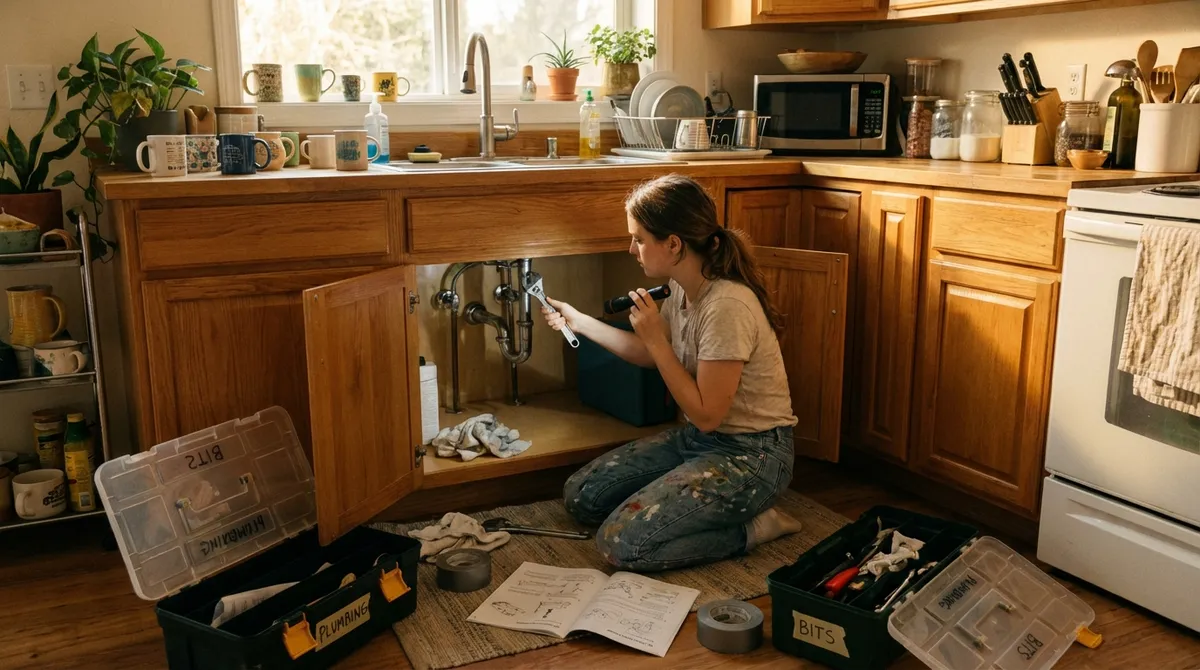
Everyday problems around the house rarely need a professional right away. With a few tools and a clear plan, you can safely solve a lot of small issues yourself—and save time and money doing it. This guide walks you through five common problems with straightforward, step‑by‑step solutions you can try today.
1. Stop a Running Toilet (Without Calling a Plumber)
A running toilet wastes water and quietly increases your bill. In most cases, the fix is inside the tank and takes less than 15 minutes.
What you’ll need:
- Adjustable wrench (optional)
- Replacement flapper or fill valve (if needed)
- Towel or sponge
Steps:
- Lift the tank lid and inspect.
Carefully remove the lid and set it on a towel. Look inside while the toilet is running. You’ll usually see one of three issues: a stuck flapper, a chain problem, or water overflowing into the overflow tube.
- Check the flapper.
The rubber flapper sits at the bottom of the tank. Press it down with a stick or the handle of a tool.
- If the toilet stops running: the flapper is likely worn or not sealing properly.
- If nothing changes: move on to the fill valve and float.
- Adjust or replace the flapper chain.
- Aim for a little slack in the chain—about ½ inch.
- Reattach the chain so the flapper can close fully without tension.
- Set the water level correctly.
- For a float cup: turn the adjustment screw on top of the fill valve clockwise to lower the level.
- For a float ball: gently bend the rod downward so the float sits lower in the tank.
If the chain is too tight, the flapper can’t fully close; too loose, and it may not open or close properly.
If water is pouring into the overflow tube, the water level is too high.
The water should stop about 1 inch below the top of the overflow tube.
- Replace worn parts if needed.
If the flapper feels brittle, warped, or doesn’t seal even after adjustment, replace it.
- Turn off the shutoff valve behind the toilet.
- Flush to empty the tank.
- Unhook the old flapper, clip the new one in place, reconnect the chain, and turn the water back on.
- Test your work.
Flush, wait a minute, and listen. If you don’t hear continuous running, you’ve fixed it. Put the lid back on and you’re done.
2. Revive a Slow or Clogged Sink Without Harsh Chemicals
A slow or clogged sink often comes from hair, soap scum, or grease buildup—not a broken pipe. You can usually clear it yourself with basic tools.
What you’ll need:
- Rubber gloves
- Cup plunger (for sinks, not toilets)
- Baking soda and white vinegar
- Bucket and old toothbrush
- Drain snake or plastic drain cleaning strip (optional but helpful)
Steps:
- Remove visible debris.
Take off the drain stopper or strainer. Pull out hair or gunk with a paper towel or gloved hand. Rinse the area with hot water.
- Try the baking soda and vinegar method.
- Pour about ½ cup of baking soda into the drain.
- Follow with ½–1 cup of white vinegar.
- Let the mixture fizz for 10–15 minutes.
- Flush with a full kettle or pot of hot (not boiling on porcelain) water.
- Plunge the sink (if it’s still slow).
- Block any overflow hole with a damp cloth to create a seal.
- Fill the sink with enough water to cover the plunger cup.
- Place the plunger over the drain and plunge firmly 10–15 times.
- Lift the plunger and see if water drains faster. Repeat if needed.
- Use a drain snake for stubborn clogs.
- Insert the snake or plastic strip into the drain as far as it will go.
- Twist and pull back slowly to bring debris out.
- Repeat until the snake comes back mostly clean.
- Clean the P‑trap (if necessary and accessible).
- Place a bucket under the curved pipe beneath the sink.
- Loosen the plastic nuts by hand or with an adjustable wrench.
- Remove the P‑trap and clear out debris with an old toothbrush.
- Reinstall the trap, hand‑tightening the nuts, and run water to check for leaks.
- Know when to stop.
If water still doesn’t drain or backs up in other fixtures, you may have a deeper blockage. At that point, call a plumber to avoid pipe damage.
3. Fix a Door That Won’t Latch or Keeps Swinging Open
A door that doesn’t stay closed or keeps drifting open is usually a small alignment issue, not a structural problem. Most fixes take a screwdriver and a few minutes.
What you’ll need:
- Phillips or flathead screwdriver
- Wood toothpicks or wooden matchsticks
- Wood glue (optional but helpful)
- Hammer (optional)
- Utility knife or chisel (for stubborn latch issues)
Steps (for a door that won’t latch):
- Check the hinges first.
Open the door halfway and gently lift up on the handle. If it moves up and down, the hinges may be loose.
- Tighten all hinge screws.
Use a screwdriver to firmly tighten each screw on both the door and the frame. Avoid over‑tightening and stripping the screws.
- Fix stripped screw holes.
If a screw just spins and won’t tighten:
- Remove the screw.
- Fill the hole with wood glue and push in a few broken toothpicks or matchsticks.
- Snap off the excess flush with the wood.
- Reinsert the screw and tighten. The wood filler gives it fresh material to grip.
- Test the latch alignment.
- If the latch hits above or below the opening, the door has sagged or shifted.
- If it hits dead‑center but doesn’t catch, the strike plate may need minor adjustment.
- Adjust the strike plate.
- Slight misalignment: loosen the screws holding the strike plate, shift it slightly, and retighten.
- Larger misalignment: remove the plate, carefully file or chisel the opening a bit higher or lower, then reattach.
Close the door slowly and watch where the latch meets the strike plate on the frame.
Steps (for a door that swings open by itself):
- Identify the problem hinge.
The issue is usually a slightly out‑of‑plumb frame. Pick the top hinge first.
- Use the hinge pin trick.
- Tap the hinge pin out slightly with a hammer and screwdriver or nail set.
- Lay the pin on a hard surface and give it a slight bend with a firm tap from the hammer.
- Reinsert the bent pin. The added friction often keeps the door from drifting open.
- Recheck the door.
Open it halfway and see if it stays put. Repeat on another hinge if needed, but avoid bending pins too much or you could damage the hinge.
4. Quiet a Squeaky Floor Without Ripping It Up
Squeaky floors are usually about wood rubbing against wood or loose fasteners—annoying, but often fixable from above with minimal tools.
What you’ll need:
- Powdered graphite, talcum powder, or powdered soapstone (for minor squeaks)
- Drill and wood screws (for more serious squeaks)
- Stud finder (optional but helpful)
- Squeak repair kit (optional, for finished floors)
Steps (for minor squeaks in hardwood):
- Locate the exact squeak.
Walk slowly over the area to find the precise spot that creaks. Mark it lightly with painter’s tape.
- Apply a dry lubricant.
- Sprinkle a small amount of powdered graphite or talcum powder into the gaps between boards where the noise is loudest.
- Work it in by walking on the area or using a soft brush.
- Wipe excess.
Clean up extra powder so it doesn’t spread or stain. Test the spot again by walking over it.
Steps (for squeaks over a subfloor, like carpeted rooms):
- Find the joist.
Use a stud finder set to deep scan or tap along the floor to locate floor joists beneath. Mark them with painter’s tape or chalk.
- Secure the subfloor.
If accessible from below (like a basement):
- Have someone walk above while you listen from underneath.
- Drive wood screws up through the subfloor into the joists (not through the finished floor).
- Use a squeak repair kit designed for carpeted floors, which uses special breakaway screws that secure the subfloor without leaving visible hardware.
- Test as you go.
If only accessible from above and you’re comfortable:
After each few screws, walk the area again. Stop once the squeak is gone to avoid over‑fastening.
- Know when to live with it.
If the squeak is mild and securing the subfloor doesn’t help, the noise may be built into the structure. At that point, focus on safety (no spongy or soft spots) rather than total silence.
5. Reset a Dead Outlet Safely (Before Assuming It’s Broken)
When an outlet suddenly stops working, you might not need an electrician right away. Often, a tripped GFCI or breaker is to blame.
What you’ll need:
- Small lamp or phone charger (to test outlet)
- Flashlight (if the power is out)
- Access to your electrical panel
- Outlet tester (optional but useful)
Steps:
- Confirm the outlet is actually dead.
Plug in a device that you know works (like a lamp or charger). If it doesn’t power on, try another device to be sure.
- Check nearby GFCI outlets.
Ground‑fault circuit interrupter (GFCI) outlets have “TEST” and “RESET” buttons and are usually in kitchens, bathrooms, garages, and basements.
- Look around in the same room and nearby rooms.
- Press the “RESET” button firmly on any GFCI you find.
- Test your dead outlet again.
- Inspect your breaker panel.
- Open your electrical panel door.
- Look for any breakers that are in a middle position—not fully ON or OFF—or that have a small colored indicator.
- To reset: push the breaker fully to OFF, then firmly to ON.
- Retest the outlet.
If it now works, monitor it. If the breaker or GFCI trips again soon after normal use, there may be a deeper issue.
- Use an outlet tester (if available).
Plug it in to check for common wiring issues like reversed polarity or open ground. This doesn’t fix problems, but it gives you information to share with an electrician if needed.
- Stop if you see or smell anything unsafe.
If you notice scorch marks, buzzing, burning smells, or warm outlet covers, do not keep resetting breakers or using the outlet. Turn the breaker off for that circuit and call a licensed electrician.
Conclusion
Most everyday home problems start small—and that’s your best chance to fix them quickly, safely, and cheaply. With a few basic tools and a careful, step‑by‑step approach, you can stop a running toilet, clear a slow sink, get doors working properly, quiet squeaky floors, and revive “dead” outlets without jumping straight to a service call. Tackle issues early, work methodically, and know when to stop and bring in a professional. That balance is how you stay in control of repairs instead of letting them control you.
Sources
- [U.S. Environmental Protection Agency – WaterSense: Fixing Leaks](https://www.epa.gov/watersense/fix-leak-week) - Covers how running toilets and other leaks waste water and offers basic repair guidance
- [Family Handyman – How to Fix a Running Toilet](https://www.familyhandyman.com/project/how-to-fix-a-running-toilet/) - Step‑by‑step instructions and diagrams for common toilet tank repairs
- [This Old House – How to Clear Any Clogged Drain](https://www.thisoldhouse.com/plumbing/21017630/how-to-clear-any-clogged-drain) - Practical methods for clearing sink and tub drains with and without chemicals
- [National Fire Protection Association – Electrical Safety in the Home](https://www.nfpa.org/education-and-research/home-fire-safety/electrical) - Safety guidance related to outlets, circuits, and when to call an electrician
- [The Spruce – How to Fix Door Latch Problems](https://www.thespruce.com/how-to-fix-door-latch-problems-1821549) - Explains common door latch and alignment issues with repair options
Key Takeaway
The most important thing to remember from this article is that this information can change how you think about DIY Solutions.