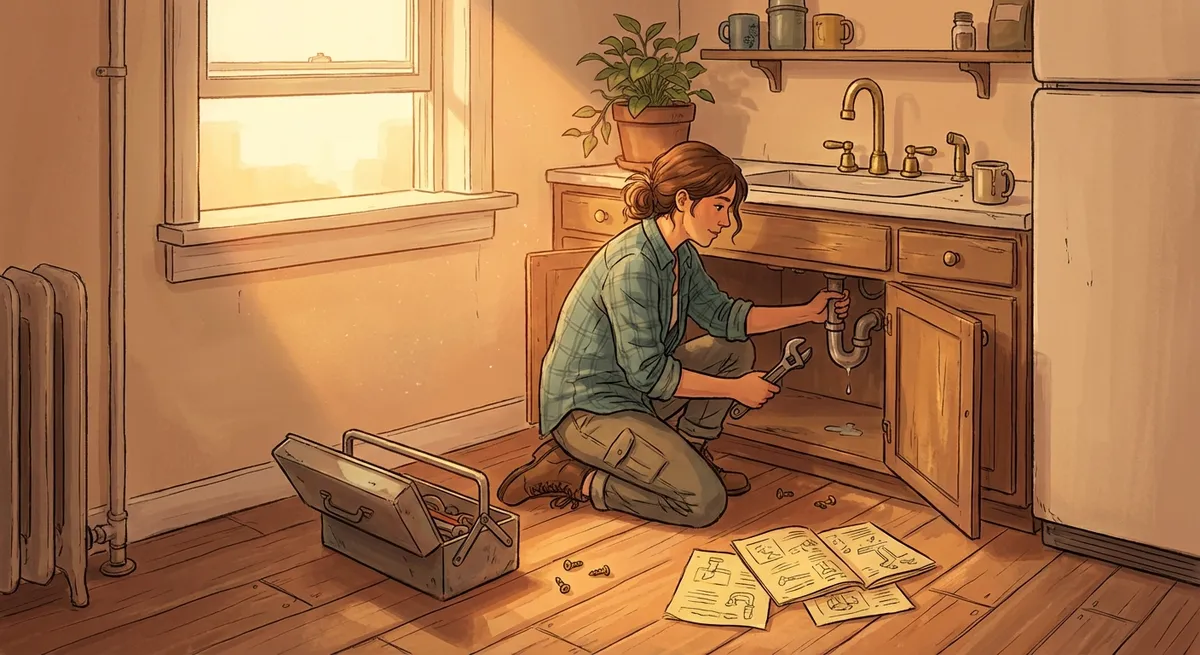
Everyday problems don’t always need a professional—and they definitely don’t need to ruin your day. With a few basic tools and some clear instructions, you can safely handle many household issues on your own. This guide walks you through five practical DIY solutions that solve real problems you’re likely to run into, with steps that are easy to follow even if you’re not “handy.”
Stop a Running Toilet and Save Water
A running toilet wastes water and quietly raises your bill. Most of the time, the fix is simple and doesn’t require special tools.
Step 1 – Remove the tank lid and look inside
Carefully lift off the tank lid and set it on a towel or flat surface. Inside you’ll see the fill valve, float, flapper, and chain. Flush once and watch how everything moves so you understand what’s happening.
Step 2 – Check the flapper
The rubber flapper at the bottom of the tank should seal tightly over the flush valve opening.
- If it’s warped, cracked, or doesn’t sit flat, it’s likely the problem.
- Turn off the water supply (the valve near the wall) and flush to empty the tank.
- Unhook the old flapper and take it with you to a hardware store to match the size.
- Install the new one by hooking it onto the overflow tube and reattaching the chain.
Step 3 – Adjust the chain
If the chain is too tight, the flapper can’t close fully; too loose and it won’t lift enough to flush properly.
- With the water back on, ensure the chain has a little slack—about ¼ inch.
- Test flush several times and make small adjustments until the flapper opens and closes cleanly.
Step 4 – Adjust the water level
If water keeps flowing into the overflow tube, your tank level is too high.
- Most modern floats have a screw or slider—turn or slide to lower the float.
- Aim for the water line marked in the tank or about 1 inch below the top of the overflow tube.
- Flush and watch to confirm the fill stops at the new level.
Step 5 – Check for silent leaks
Add a few drops of food coloring to the tank and wait 10–15 minutes without flushing. If color appears in the bowl, your flapper still isn’t sealing. Re-seat or replace it again as needed.
Unclog a Slow Sink Without Harsh Chemicals
Slow drains are usually caused by hair, soap scum, and grease buildup. You can often clear them quickly and safely without pouring harsh chemicals down your pipes.
Step 1 – Remove visible debris
- For bathroom sinks: Pull out the stopper. Clean off hair and gunk using a paper towel or disposable glove.
- For kitchen sinks: Remove strainers and rinse them thoroughly.
Step 2 – Use a zip tool or small drain snake
Hardware stores sell thin plastic “zip” tools with small barbs.
- Insert the tool into the drain as far as it will go.
- Pull it out slowly, allowing it to snag hair and buildup.
- Repeat until you stop pulling up debris.
Step 3 – Clean the P-trap (if needed)
If the drain is still slow:
- Place a bucket under the curved pipe (P-trap) beneath the sink.
- Unscrew the slip nuts by hand or with channel-lock pliers.
- Remove the trap, dump debris into the bucket, and rinse it out.
- Reinstall, hand-tightening first, then snug slightly with pliers (don’t over-tighten).
Step 4 – Flush with hot water and a mild cleaning mix
- Run hot (not boiling) water for several minutes.
- You can follow with a 1:1 mix of hot water and vinegar to help break down soap scum.
- Avoid frequent use of chemical drain cleaners—they can damage older pipes and are hazardous if misused.
Step 5 – Prevent future clogs
- Use drain screens for hair and food scraps.
- Never pour grease or oil down the sink—let it cool and throw it away.
- Once a month, flush drains with hot water to help keep buildup down.
Quiet a Squeaky Door the Right Way
That door squeak that drives you crazy is usually friction or minor rust on the hinges. You don’t need to replace the door—just maintain the moving parts properly.
Step 1 – Identify the noisy hinge
Open and close the door slowly to pinpoint which hinge is squeaking. Often it’s the top hinge, where most of the weight pulls.
Step 2 – Protect the surrounding area
Place a rag or paper towel under the hinge to catch excess lubricant. If you’re using spray lubricant, you can tape around the hinge to protect the door and frame.
Step 3 – Apply lubricant correctly
Use a silicone spray, light machine oil, or a dedicated hinge lubricant. Avoid cooking oils—they attract dust and can gum up.
- For a quick fix:
- Spray or drip a small amount directly on the hinge pin and moving joints.
- Open and close the door repeatedly to work it in.
- For a deeper fix:
- Tap the hinge pin up and out using a small nail and hammer.
- Wipe off rust or dirt with a cloth.
- Apply a thin coat of lubricant to the pin.
- Reinsert and tap gently into place.
Step 4 – Wipe off excess
Too much lubricant attracts dust. Wipe away any drips and leave only a thin film on the hinge.
Step 5 – Check alignment
If the squeak returns quickly or the door sticks:
- Inspect screws on the hinge plates—tighten any that are loose.
- If screws spin without tightening, use a slightly longer screw to bite into fresh wood.
- In stubborn cases, fill the hole with wood glue and a wooden toothpick, then reinsert the screw after it dries.
Fix a Loose Cabinet Door That Won’t Stay Aligned
Loose or sagging cabinet doors make a kitchen look worn and can get worse over time. Most modern cabinets have adjustable hinges you can correct with a screwdriver.
Step 1 – Identify the type of hinge
Most kitchen cabinets use “European” concealed hinges with two or three adjustment screws. Open the door and look for:
- A screw that moves the door left/right
- A screw that moves the door in/out (toward or away from the cabinet)
- Sometimes a screw for up/down adjustment
Step 2 – Tighten the mounting screws first
- Use a manual screwdriver to gently tighten the screws that attach the hinge to the door and the cabinet frame.
- Don’t overtighten; snug is enough. Loose mounting screws often cause sagging.
Step 3 – Adjust side-to-side alignment
If the door rubs another door or isn’t centered:
- Turn the side adjustment screw a quarter-turn at a time.
- Close the door and check alignment after each small adjustment.
- Repeat for the upper and lower hinges until the door is straight.
Step 4 – Adjust depth (in/out)
If the door sits too far in or out compared to neighbors:
- Use the depth adjustment screw to bring the door closer to or farther from the cabinet.
- Make small changes and compare with adjacent doors so they line up neatly.
Step 5 – Address door sag
If the top of the door droops:
- Slightly loosen the mounting screws on the hinge plate attached to the cabinet.
- Lift the door gently into the desired position.
- Tighten the screws while holding the door in place.
- Check the gap above and below to ensure it’s even.
Patch a Small Drywall Hole for a Clean Finish
Small drywall damage—from door handles, furniture bumps, or wall anchors—can be repaired neatly without calling a contractor.
Step 1 – Assess the hole size
- Up to about ½ inch (nail/screw holes): simple spackle is enough.
- Up to about 2–3 inches: use a patch or mesh tape for strength.
Larger holes usually benefit from a backing piece of drywall or a pre-made repair patch.
Step 2 – Prep the area
- Use a utility knife to clean up loose paper or crumbling edges.
- Lightly sand the area around the hole so the patching compound adheres well.
- Wipe away dust with a slightly damp cloth and let dry.
Step 3 – Apply patch or tape (for larger small holes)
- For holes around 1–3 inches, use a self-adhesive mesh patch or tape.
- Center it over the hole, pressing firmly so it bonds to the wall.
Step 4 – Apply joint compound or spackle
- Use a putty knife to spread compound over the hole or patch, feathering the edges out several inches.
- Scrape off excess so the surface is slightly raised but mostly smooth.
- Let it dry completely (follow product directions).
Step 5 – Sand and repeat if needed
- Lightly sand the area with fine-grit sandpaper until smooth and level with the surrounding wall.
- If you can still see the outline of the patch, apply a second thin coat, feather it wider, let dry, and sand again.
Step 6 – Prime and paint
- Apply a primer over the repair to seal the compound and prevent flashing (a noticeable patch under paint).
- Once dry, paint the area with matching wall paint.
- For best blending, paint corner-to-corner of that wall section if the color match isn’t perfect.
Conclusion
You don’t need a full toolbox or years of experience to handle everyday problems around your home. By breaking each issue into small, clear steps—like stopping a running toilet, clearing a slow sink, silencing a squeaky door, realigning cabinet doors, or patching drywall—you can solve issues quickly, safely, and with confidence. Start with one problem that’s bothering you right now, follow the steps, and you’ll see how manageable DIY repairs can be.
Sources
- [U.S. Environmental Protection Agency – Fix a Leak](https://www.epa.gov/watersense/fix-leak-week) – Explains how small leaks (like running toilets) waste water and why fixing them matters
- [Family Handyman – How to Fix a Running Toilet](https://www.familyhandyman.com/project/how-to-fix-a-running-toilet/) – Step-by-step guidance and diagrams for toilet repairs
- [Lowe’s – How to Unclog a Sink](https://www.lowes.com/n/how-to/unclog-a-sink) – Covers safe methods and tools for clearing sink drains
- [This Old House – How to Repair Drywall](https://www.thisoldhouse.com/walls/21016795/how-to-repair-drywall) – Detailed instructions on patching different sizes of drywall holes
- [Rockler – Adjusting European Cabinet Hinges](https://www.rockler.com/learn/adjusting-european-style-cabinet-hinges) – Explains hinge adjustment screws and how to align cabinet doors
Key Takeaway
The most important thing to remember from this article is that this information can change how you think about DIY Solutions.