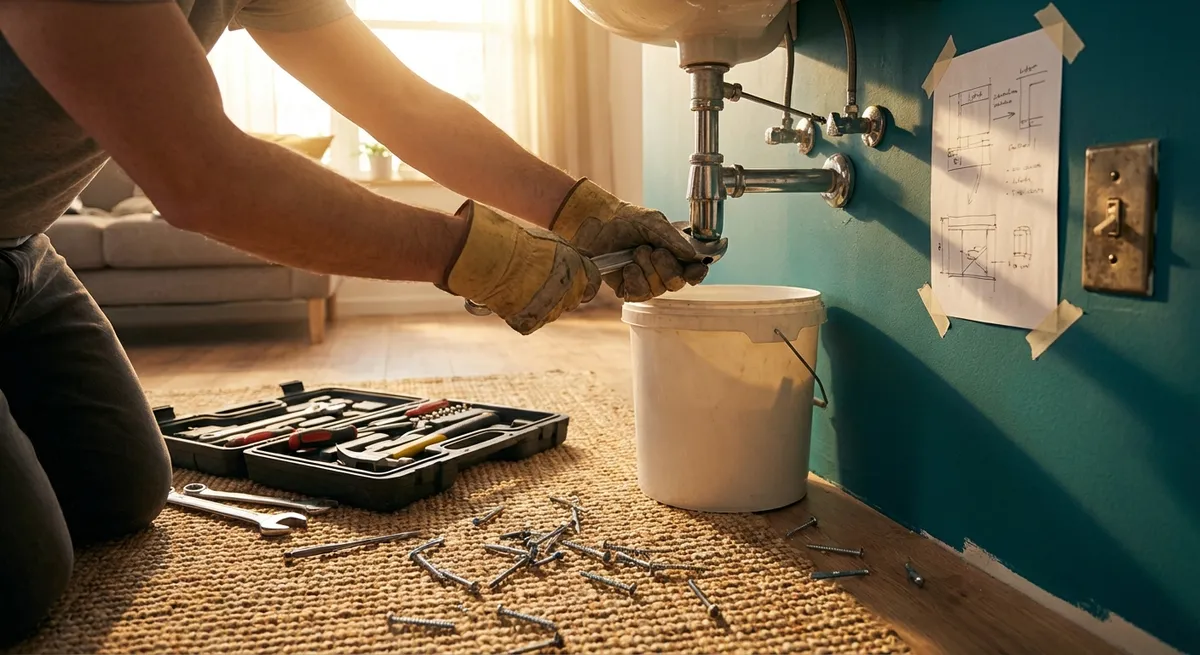
Small problems around the house have a bad habit of getting worse when you ignore them. The good news: many of the most common issues are simple, low‑cost fixes you can handle in under an hour with basic tools. This guide walks you through five practical, step‑by‑step solutions you can safely tackle yourself before reaching for your wallet or your phone.
1. Stop a Dripping Faucet (Basic Cartridge Faucet Fix)
A dripping faucet wastes water and slowly raises your utility bill, but the fix is usually straightforward. Most modern faucets use a cartridge that wears out over time. Replacing or reseating it is a manageable DIY job if you go slowly and stay organized.
What you’ll need
- Adjustable wrench or basin wrench
- Phillips and flathead screwdrivers
- Allen (hex) wrench set (for some handles)
- Replacement cartridge or O‑rings (matched to your faucet model)
- Small towel and bowl
- Plumber’s grease (optional but helpful)
Step-by-step
Shut off the water supply
Look under the sink for two shutoff valves (hot and cold). Turn them clockwise until they stop. Open the faucet to relieve pressure and confirm water is off.
Plug the drain
Use the sink stopper or a rag so you don’t lose small screws or parts down the drain.
Remove the handle
- Look for a decorative cap or small set screw. - Pry off the cap with a flathead screwdriver or remove the set screw with an Allen key. - Lift off the handle carefully.
Expose and remove the cartridge
- You’ll usually see a retaining nut or clip. - Use an adjustable wrench to loosen the nut or pliers to pull the clip. - Gently pull the cartridge straight up. Take note of its orientation.
Inspect and replace
- Compare the old cartridge to the new one. It should match exactly. - If only O‑rings are damaged, you may replace those instead and apply a thin layer of plumber’s grease. - Insert the new (or rebuilt) cartridge in the same orientation.
Reassemble the faucet
Replace the retaining nut or clip, then reinstall the handle and any caps or screws.
Turn the water back on slowly
Open the shutoff valves gradually while the faucet is in the “on” position to release air. Close the faucet and check for drips.
When to stop and call a pro
- Corroded valves you can’t safely turn
- Evidence of leaks inside the cabinet or wall
- Unclear faucet model and parts that don’t match
2. Reset a Tripped Circuit Breaker Safely
If half your outlets or lights suddenly stop working, a tripped breaker is often the cause. Resetting it correctly—and understanding why it tripped—can restore power and help you avoid repeat problems.
What you’ll need
- Flashlight (if lights are out)
- Knowledge of which areas each breaker controls (labels help)
Step-by-step
Turn off and unplug devices on the affected circuit
Lamps, small appliances, space heaters, and power strips should all be turned off or unplugged. This reduces the load when you reset the breaker.
Find your electrical panel
Common locations: basement, garage, utility room, or hallway closet. Use a flashlight if needed.
Identify the tripped breaker
- Look for a breaker that’s in the middle position or slightly out of line with the rest. - Some panels have an indicator window that shows red or orange when tripped.
Reset properly
- First push the breaker firmly to the OFF position. - Then push it to the ON position until it clicks. - If it immediately flips back, do not keep forcing it—there may be a fault.
Test outlets and lights
Turn devices back on one by one. If the breaker trips again when a specific appliance is used, that device or the circuit may be overloaded.
Reduce load on the circuit
- Avoid running multiple high‑demand devices (space heaters, hairdryers, microwaves) on the same circuit. - Use other circuits if possible or stagger use.
When to stop and call a pro or your utility
- Breaker trips immediately with nothing plugged in
- You smell burning or see scorch marks at the panel or outlets
- Panel is warm or hot to the touch
- You hear buzzing or crackling from the panel
3. Fix a Running Toilet That Won’t Stop Refill Cycling
A constantly running toilet can waste hundreds of gallons of water a day. The fix usually involves adjusting or replacing simple parts inside the tank—no special plumbing skills required.
What you’ll need
- Adjustable wrench or pliers
- Replacement flapper (and possibly fill valve, if needed)
- Towel or sponge
- Bucket (optional)
Step-by-step
Remove the tank lid carefully
Set it somewhere safe; porcelain chips easily.
Identify the problem area
With the water running, look for: - A worn or warped flapper not sealing properly - A chain that’s too short or tangled - A float set too high, letting water run into the overflow tube
Check the flapper first
- Push down gently on the flapper while the tank is full. - If the sound of running water stops, the flapper is likely the issue.
Replace the flapper
- Turn off the water supply valve near the floor behind the toilet. - Flush and hold the handle to empty most of the tank. - Disconnect the old flapper from the overflow tube and the handle chain. - Install the new flapper, adjusting the chain so there’s a little slack but no tangling.
Adjust the water level
- Turn the water back on and let the tank fill. - If the water rises above the manufacturer’s line or spills into the overflow tube, lower the float. - On modern fill valves, you usually turn a screw or slide a clip to adjust float height.
Test the flush
Flush two or three times, confirming the flapper seals and the water stops at the correct level.
When to stop and call a pro
- Cracked tank or persistent leaks around the base
- Corroded metal parts you can’t safely remove
- Sewer smells or backup issues beyond one toilet
4. Clear a Slow Bathroom Sink Drain Without Harsh Chemicals
Slow drains are usually caused by hair, soap scum, and buildup near the stopper—not deep in the plumbing. You can often restore normal flow with simple tools and a bit of patience, avoiding corrosive chemicals that can damage pipes over time.
What you’ll need
- Bucket or bowl
- Old toothbrush or small nylon brush
- Adjustable pliers
- Drain hair removal tool (plastic barbed strip) or long zip tie
- Rubber gloves
- Baking soda and vinegar (optional)
Step-by-step
Remove the stopper
- Try lifting and twisting the stopper from above first.
- If it doesn’t come out, look under the sink:
- Locate the horizontal rod going into the drainpipe behind the sink.
- Use pliers to loosen the retaining nut holding the rod.
- Gently pull the rod out; the stopper should now lift free from the top.
Clean the stopper thoroughly
- Remove hair and grime by hand (wear gloves). - Scrub with an old toothbrush and warm, soapy water.
Clear the drain opening
- Insert a plastic hair removal tool or long zip tie into the drain. - Wiggle and twist, then pull out any hair clumps or buildup. - Repeat until you’re no longer pulling up debris.
Flush with hot water (and optional baking soda/vinegar)
- Pour very hot (not boiling) water down the drain. - For extra cleaning: - Add ½ cup baking soda, then ½ cup vinegar. - Let it fizz for 10–15 minutes, then flush with hot water again.
Reassemble the stopper mechanism
- Drop the stopper back into the drain from above. - From below, reinsert the horizontal rod so it catches the bottom of the stopper. - Tighten the retaining nut snugly (hand‑tight plus a small turn with pliers).
Test the drain
Run water for 30–60 seconds. It should drain smoothly without backing up.
When to stop and call a pro
- Standing water that won’t drain at all despite cleaning
- Multiple fixtures in the same area draining slowly (possible main line issue)
- Sewage smells or gurgling from other drains when you run water
5. Quiet a Squeaky Interior Door
A squeaky door is annoying but usually easy to fix in minutes. The noise almost always comes from friction in the hinges, not from the door itself. Lubricating and, if needed, resetting the hinge pins can restore smooth, silent movement.
What you’ll need
- Lubricant (dry lubricant, silicone spray, or petroleum jelly; avoid cooking oils)
- Hammer and small nail, awl, or thin screwdriver
- Old towel or cardboard (to protect the floor)
- Paper towels or rag
Step-by-step
Identify the squeaky hinge
Slowly open and close the door while listening closely. Often only one hinge is noisy.
Protect the area
Place a towel or cardboard under the hinge to catch any drips.
Loosen the hinge pin
- Close the door. - From the bottom of the hinge, gently tap the hinge pin upward with a nail or awl and hammer. - Once it rises enough, pull it out by hand or with pliers. - Do one hinge at a time so the door stays in place.
Clean and lubricate the pin
- Wipe off old dirt and rust with a rag. - Apply a thin layer of lubricant along the pin. For petroleum jelly, coat lightly; for sprays, apply to the rag first, then wipe onto the pin.
Reinstall the pin
- Insert the pin back into the hinge from the top. - Tap it gently with the hammer until fully seated.
Open and close the door repeatedly
Move the door through its full range 10–15 times to work the lubricant into the hinge.
Repeat for other squeaky hinges
If the noise isn’t gone, move on to the next hinge and repeat the process.
When to stop and call a pro
- Door frame is visibly shifting or misaligned
- Door sticks hard or scrapes the floor even after hinge adjustment
- Cracks around the frame suggest structural movement
Conclusion
Most everyday home issues are less about special skills and more about having a clear plan, simple tools, and the confidence to start. By tackling a dripping faucet, a tripped breaker, a running toilet, a slow drain, or a squeaky door yourself, you can cut costs, prevent bigger problems, and keep your home running smoothly.
Before you call a professional, walk through these steps calmly and methodically. If at any point something looks unsafe, damaged beyond your comfort level, or not as described, stop and bring in a qualified pro. The more you practice these small fixes, the more control you’ll have over your space—and the more money you’ll keep in your pocket.
Sources
- [U.S. Environmental Protection Agency – Fix a Leak](https://www.epa.gov/watersense/fix-leak-week) - Details how small leaks (like dripping faucets and running toilets) waste water and why timely repairs matter
- [The Family Handyman – How to Fix a Leaky Faucet](https://www.familyhandyman.com/project/how-to-fix-a-leaky-faucet/) - Practical, illustrated guidance on identifying faucet types and replacing cartridges or washers
- [U.S. Consumer Product Safety Commission – Electrical Safety in the Home](https://www.cpsc.gov/safety-education/safety-guides/home/electrical-safety-in-the-home) - Authoritative safety advice on handling circuit breakers and electrical issues
- [Energy.gov – Electrical Safety](https://www.energy.gov/ehss/electrical-safety) - Federal guidelines on basic electrical safety and when to involve professionals
- [University of Illinois Extension – Household Water Conservation](https://extension.illinois.edu/water/household-water-conservation) - Educational overview of how fixing toilets and faucets contributes to water savings
Key Takeaway
The most important thing to remember from this article is that this information can change how you think about DIY Solutions.