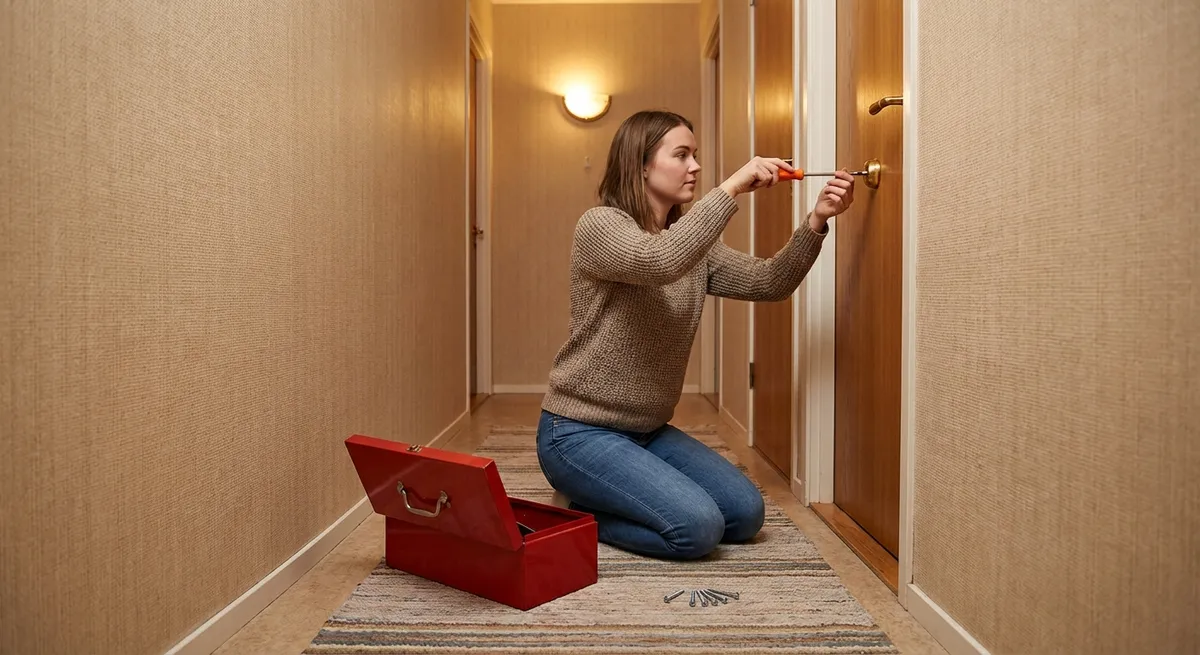
Most everyday problems don’t need a toolbox explosion or a pricey service call. With a calm approach and a few basic tools, you can solve a lot of “uh-oh” moments yourself—fast. Below are five clear, step-by-step fixes that save time, money, and frustration, all in under 10 minutes each.
---
1. Silencing a Squeaky Door Hinge
A squeaky door is annoying, but it’s also one of the easiest home fixes.
What you’ll need:
- Paper towel or old rag
- Lubricant: petroleum jelly, silicone spray, or cooking oil in a pinch
- Small flathead screwdriver (optional)
Step-by-step:
- **Open and close the door** to confirm which hinge is squeaking.
- **Wipe the hinge area** with a paper towel to remove visible dust and grime.
- **Apply a small amount of lubricant** directly to the hinge pin and the moving parts. Don’t overdo it—too much attracts dirt.
- **Work the lubricant in** by opening and closing the door 10–15 times.
- **Wipe away any excess** so it doesn’t drip on walls or floors.
- If the squeak persists, **gently pry up the hinge pin** with a flathead screwdriver, coat it lightly with lubricant, then tap it back in and test again.
---
2. Reviving a Slow or Non‑Flushing Toilet
If your toilet is weak when flushing but not clogged, the issue is often in the tank—not the pipes.
What you’ll need:
- Rubber gloves
- Old toothbrush or small scrub brush
- White vinegar (optional)
Step-by-step:
- **Remove the tank lid carefully** and set it somewhere safe and flat.
- **Check the chain** connected to the flapper (rubber valve at the bottom of the tank).
- If it’s too loose, the flapper won’t open fully.
- If it’s too tight, the flapper can’t seal.
- **Adjust the chain length** so there’s just a slight slack when the flapper is closed.
- **Inspect the flapper** for warping or buildup. If it looks warped or brittle, it should be replaced (an easy, low-cost part from any hardware store).
- **Clean mineral buildup** on the flapper, overflow tube, and other moving parts using vinegar and a brush.
- **Flush and observe**: make sure the flapper lifts fully, then closes securely.
- **Replace the tank lid** and test a few more flushes to confirm a stronger, more complete flush.
---
3. Fixing a Wobbly Chair or Table Without Power Tools
Wobbly furniture is usually a simple issue: loose joints or uneven floor contact.
What you’ll need:
- Screwdriver or Allen (hex) key (whichever matches your furniture)
- Wood glue (for wooden chairs/tables)
- Thin cardboard or adhesive furniture pads (for floor-level wobble)
Step-by-step:
- **Place the chair/table on a flat surface** and gently rock it to find where it’s unstable.
- **Check all visible screws and bolts** at joints and legs.
- **Tighten each screw or bolt firmly**, but don’t overtighten (you can strip the threads).
If the joint is still loose in wooden furniture:
- **Separate the joint slightly**, apply a small amount of wood glue, then reassemble and wipe off excess. - Let it sit under normal pressure (or with some weight on it) until the glue cures according to the bottle instructions.
If the wobble is from **uneven legs**, use:
- **Adhesive furniture pads** on the shortest leg, or - **Folded cardboard** as a temporary shim under the short leg. 6. **Retest stability** by sitting or pressing gently on different corners. Adjust padding as needed.
---
4. Getting a Non‑Charging Phone Cable Working (Safely)
A “dead” charging cable or port is often just a contact or debris issue.
What you’ll need:
- Soft, dry toothbrush or small, soft brush
- Wooden toothpick
- Isopropyl alcohol (at least 70%) and cotton swab (optional)
Step-by-step:
- **Unplug everything**: Disconnect the cable from the charger brick, outlet, and phone. Never work on a connected cable.
- **Inspect the cable ends** for bent or broken metal pins. If pins are missing or obviously damaged, **retire the cable**—don’t try to fix that one.
- **Check your phone’s charging port** with a flashlight. Look for lint, dust, or pocket debris.
- **Gently loosen debris** using a wooden toothpick. Work slowly; do not use metal tools that can damage contacts.
- **Brush out the port** with a soft toothbrush. Tilt your phone so debris falls out rather than deeper in.
- If contacts look grimy, **lightly moisten a cotton swab with isopropyl alcohol**, dab around the port edges, and let it fully dry.
- **Reconnect with a known-good charger brick and outlet** and test the cable.
- If it still fails but another cable works fine, **replace the faulty cable**—it’s not worth risking your device or a short circuit.
---
5. Clearing a Slow Draining Bathroom Sink (Without Harsh Chemicals)
A sluggish bathroom sink is usually clogged hair and soap scum close to the drain.
What you’ll need:
- Rubber gloves
- Cup or small container
- Zip-it style drain tool or straightened wire hanger (with a small hook)
- Baking soda and vinegar (optional)
Step-by-step:
- **Remove standing water** with a cup or container so you can see the drain.
- **Locate the stopper**: if you have a pop-up stopper, lift it out if possible. For some, you may need to unscrew a small nut under the sink to release the rod that holds the stopper.
- **Put on gloves** and **pull out any visible hair and gunk** from around the stopper and top of the drain.
- **Insert a drain-cleaning tool or bent hanger** into the drain.
- Push down gently, twist, and pull up to grab hair and sludge.
- Repeat several times until you’re pulling up less debris.
- **Flush with hot water** for 30–60 seconds to help clear remaining soap build-up.
- If it’s still slow, **pour ½ cup baking soda into the drain**, followed by **½ cup vinegar**. Let it fizz for 10–15 minutes, then flush with very hot (not boiling) water.
- **Reinstall the stopper** and check for smooth draining by running the tap at full flow.
---
Conclusion
Quick fixes don’t have to be intimidating or time-consuming. With a few basic tools, a clear plan, and a calm step-by-step approach, you can handle squeaks, wobbles, sluggish drains, slow toilets, and charging hiccups on your own—often in less time than it takes to schedule a repair visit. Start with these small wins, build your confidence, and you’ll be ready the next time something around the house decides not to cooperate.
---
Sources
- [U.S. Department of Energy – Home Maintenance Tips](https://www.energy.gov/energysaver/articles/spring-and-summer-energy-saving-tips) - General guidance on simple home maintenance that can prevent common issues.
- [Family Handyman – How to Fix Noisy Door Hinges](https://www.familyhandyman.com/project/how-to-fix-squeaky-door-hinges/) - Practical hinge lubrication and adjustment tips.
- [Los Angeles County Sanitation Districts – Don’t Flush That](https://www.lacsd.org/services/wastewater/dontflush) - Explains what should and shouldn’t go down toilets and drains, helping prevent clogs.
- [American Cleaning Institute – Safe Use of Cleaning Products](https://www.cleaninginstitute.org/cleaning-tips/cleaning-products/safe-use-cleaning-products) - Safety advice when using household cleaning solutions like vinegar and other products.
- [Apple Support – If your iPhone or iPad won’t charge](https://support.apple.com/en-us/HT208383) - Official guidance on cleaning charging ports and troubleshooting charging issues.
Key Takeaway
The most important thing to remember from this article is that this information can change how you think about Quick Fixes.