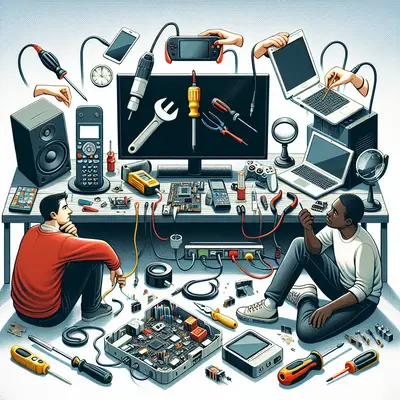
Electronics rarely fail all at once—they get glitchy, slow, or unreliable first. Before you assume your device is “dead,” there are several practical checks and fixes you can safely try at home. This guide walks you step-by-step through five common problems, focusing on simple actions, clear decisions (fix vs. replace), and how to avoid making the issue worse.
---
1. When Your Device Won’t Turn On
A “dead” device is often a power or connection problem, not a fatal failure. Work through these steps slowly—don’t skip ahead.
Step-by-step fix:
- **Verify the power source (wall outlet or strip).**
- Plug in a lamp or phone charger you know works.
- If that doesn’t power on, try another outlet.
- Check if a surge protector or power strip has a reset switch—press it once.
- **Inspect the power cable and adapter.**
- Look for kinks, exposed copper, burn marks, or a loose connector.
- Gently wiggle the plug at the device and at the outlet. If power cuts in and out, the cable may be failing.
- If available, test with a compatible spare cable/adapter.
- **Try a basic power reset.**
- **Laptops / Some TVs / Consoles:** Unplug power, hold the power button for 10–15 seconds, then reconnect and try again.
- **Battery devices (phones, tablets):**
- Plug into a known-good charger for at least 15–20 minutes.
- Then press and hold the power button for 10–30 seconds (varies by brand).
- **Check for charging indicators.**
- Look for LEDs, charging icons, or screen backlight flickers.
- If the device shows charging but never powers on, suspect a battery or internal hardware issue.
- **Use manufacturer-specific recovery (when available).**
- Many phones, laptops, and gaming consoles have special button combinations for recovery or safe mode.
- Search “[device model] won’t turn on recovery mode” on the official brand site and follow their steps exactly.
Stop and call a pro if:
---
2. Fixing Overheating Laptops and Consoles
Overheating causes random shutdowns, loud fans, and sluggish performance. If you can feel your laptop or console getting hot to the touch, deal with it quickly to avoid permanent damage.
Step-by-step fix:
- **Give it breathing room.**
- Move the device to a hard, flat surface (no beds, couches, or carpets).
- Ensure vents are not pressed against a wall or inside a closed cabinet.
- For consoles, allow at least a few inches of clearance on all sides.
- **Clean vents and fans safely.**
- Power off and unplug the device.
- Use short bursts of compressed air at an angle into the vents (don’t spin fans wildly—hold the fan still with a toothpick if accessible).
- Do not use a vacuum directly on vents; it can generate static.
- **Check for background overload.**
- On **Windows**: press `Ctrl + Shift + Esc` and check Task Manager for apps using high CPU. Close what you don’t need.
- On **macOS**: open Activity Monitor and quit resource-heavy apps.
- On consoles, fully close games and apps instead of leaving them suspended.
- **Update software and firmware.**
- Install OS updates and device firmware; manufacturers often tweak fan curves and power usage.
- Update graphics drivers (laptops/desktops) from the official GPU or laptop maker website.
- **Improve long-term cooling.**
- For laptops: consider a cooling pad (USB-powered stand with fans).
- Avoid running high-performance tasks (games, video editing) while the device is sitting in direct sunlight or in a hot car.
- For desktops: ensure case fans are spinning and oriented correctly (intake at front/bottom, exhaust at rear/top).
Stop and call a pro if:
---
3. Restoring Wi‑Fi When Everything Feels “Slow or Broken”
Random disconnections, buffering, or sluggish browsing are often network issues, not device failures. Before replacing your router, stabilize your setup.
Step-by-step fix:
- **Confirm the scope of the problem.**
- Test at least two devices (phone + laptop, for example).
- If both are slow, the issue is likely the router, modem, or internet provider.
- If only one device is slow, focus on that device.
- **Power-cycle in the right order.**
- Unplug the **modem** and **router** (or combo unit) from power.
- Wait 30–60 seconds.
- Plug in the modem first, wait until all relevant lights stabilize.
- Then plug in the router and wait a few minutes.
- **Move closer and reduce interference.**
- Stand near the router with the device. If speed improves, distance or obstacles are the main issue.
- Keep routers away from microwaves, thick concrete walls, and metal cabinets.
- If your router has both 2.4 GHz and 5 GHz networks, try the 5 GHz network for higher speeds (shorter range) or 2.4 GHz for longer range (slower but more penetrating).
- **Forget and rejoin the network.**
- On the problem device, “Forget” the Wi‑Fi network, then reconnect and re-enter the password.
- Ensure you’re not accidentally connected to a guest network with restrictions.
- **Optimize router settings.**
- Log into your router’s admin page (check the label on the router for address and login).
- Update firmware if an update is offered.
- Change the Wi‑Fi channel if your area is crowded (auto-select often works, but you can try different channels if performance is poor).
- Disable unnecessary “smart” QoS features temporarily if they seem to slow traffic.
Stop and call your ISP or a pro if:
---
4. Solving “No Sound” Problems on TVs, Laptops, and Speakers
No audio is often a configuration or connection issue, not a blown speaker. Work from the simplest checks to slightly more involved ones.
Step-by-step fix:
- **Check physical volume and mute.**
- Use both the device’s physical buttons and the remote/keyboard.
- Look for a muted icon on the screen or in the taskbar/system tray.
- **Confirm the correct audio output.**
- **TVs:** In audio settings, make sure output is set to “TV Speakers” if you’re not using a soundbar, or the correct HDMI/optical output if you are.
- **Computers:**
- On Windows, click the speaker icon → select output device.
- On macOS, go to System Settings → Sound → Output, and choose the right device.
- **Inspect cables and connections.**
- HDMI: Reseat both ends, try another HDMI port, and test with a spare cable if possible.
- 3.5mm audio jack: Ensure it’s fully inserted (you should feel it click).
- Optical (TOSLINK): Check for red light at the end of the cable when unplugged from the destination device.
- **Test with a different source.**
- For TVs: Try a streaming app on the TV itself vs. an external box or console.
- For laptops: Play a local audio file vs. streaming from the internet.
- If one source has sound but others don’t, adjust that source’s audio settings.
- **Reinstall or reset audio settings (computers).**
- On Windows:
- Right-click Start → Device Manager → Sound → your audio device → Uninstall device, then restart.
- Windows usually reinstalls the correct driver automatically.
- On macOS:
- Reset NVRAM/PRAM or run software updates, which often refresh audio components.
Stop and call a pro if:
---
5. Handling Unresponsive Touchscreens and Sticky Buttons
Touchscreens that only respond sometimes, or physical buttons that require extra force, can often be rehabilitated with careful cleaning and recalibration.
Step-by-step fix (touchscreens):
- **Clean the screen properly.**
- Power off the device.
- Use a soft, lint-free cloth lightly dampened with water or 70% isopropyl alcohol.
- Wipe in straight lines; avoid excessive rubbing on edges.
- Never spray liquid directly onto the device.
- **Remove screen protectors or cases temporarily.**
- Poorly installed protectors or tight cases can create pressure points.
- Remove them, test the touchscreen, then replace with higher-quality accessories if the problem improves.
- **Restart and update the device.**
- Soft reset: power off and back on.
- Install available OS and firmware updates; some include touchscreen driver fixes.
- **Check for app-specific issues.**
- If the problem appears only in one app, reinstall or update that app.
- Test touch response in system menus to rule out a hardware-only problem.
- **Run built-in diagnostics if available.**
- Many phones and tablets have hidden diagnostic menus (often documented on the official support site).
- Follow brand instructions only—avoid risky “secret codes” from random forums.
Step-by-step fix (sticky or unresponsive buttons):
- **Isolate the issue.**
- Verify whether the button works intermittently, only under certain angles/pressure, or not at all.
- On computers, test keyboard keys in a simple text editor.
- **Surface-level cleaning.**
- Power off or disconnect the device.
- For keyboards:
- Turn upside down and gently shake to dislodge debris.
- Use compressed air between keys.
- For remotes and controllers:
- Use a cotton swab lightly dampened with isopropyl alcohol around the button edges.
- **Check software settings.**
- Some devices allow remapping or disabling buttons (e.g., accessibility settings or custom controller settings).
- Reset button mappings to default.
- **Consider keycap removal (keyboards only, and with care).**
- For many mechanical or desktop keyboards, you can gently lever off a keycap and clean underneath with air and a soft brush.
- Avoid doing this on laptop keyboards unless the manufacturer explicitly supports it; many are fragile.
Stop and call a pro if:
---
Conclusion
Most everyday electronics problems come down to power, heat, connections, or basic configuration—areas you can safely troubleshoot at home with a calm, step-by-step approach. Start with the simplest checks, change one thing at a time, and watch for clear patterns (only one device, only one room, only one type of connection). When you hit clear signs of internal damage, burning smells, or liquid exposure, stop and hand it to a professional.
By understanding these core troubleshooting steps, you’re not just fixing one glitch—you’re building a repeatable method you can apply to almost any device in your home.
---
Sources
- [U.S. Consumer Product Safety Commission – Home Electrical Safety](https://www.cpsc.gov/Safety-Education/Safety-Guides/electrical) – Guidance on safe practices around power, outlets, cords, and overheating risks.
- [Microsoft Support – Troubleshoot blue screen errors and performance issues](https://support.microsoft.com/en-us/windows/troubleshoot-blue-screen-errors-98dfb190-cfba-3a45-2e50-ff16ff4c68bf) – Official steps for diagnosing Windows performance and hardware-related problems.
- [Apple Support – If your Mac, iPhone, or iPad won’t turn on or start up](https://support.apple.com/en-us/HT204267) – Manufacturer-approved procedures for power and startup issues on Apple devices.
- [Federal Communications Commission (FCC) – Wi-Fi Interference and Solutions](https://www.fcc.gov/consumers/guides/interference-your-wireless-network) – Explains common Wi‑Fi interference sources and mitigation strategies.
- [Harvard University – Ergonomics and Laptop Use](https://ehs.harvard.edu/laptop-ergonomics) – Background on laptop positioning and heat/ventilation considerations that affect device longevity.
Key Takeaway
The most important thing to remember from this article is that this information can change how you think about Electronics.