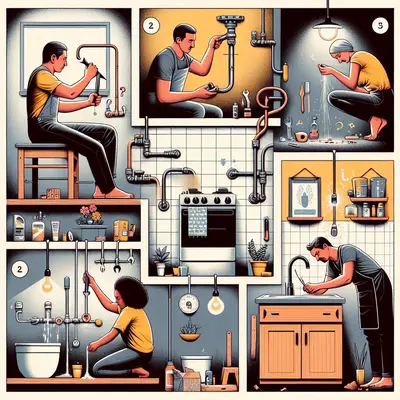
Most household issues don’t need a service call, a special tool, or a full weekend. You just need clear steps, a little patience, and a basic toolkit. This guide walks you through five common home problems—each with a simple, repeatable process you can handle without prior DIY experience.
---
1. Dripping Faucet: How to Stop the Constant Drip
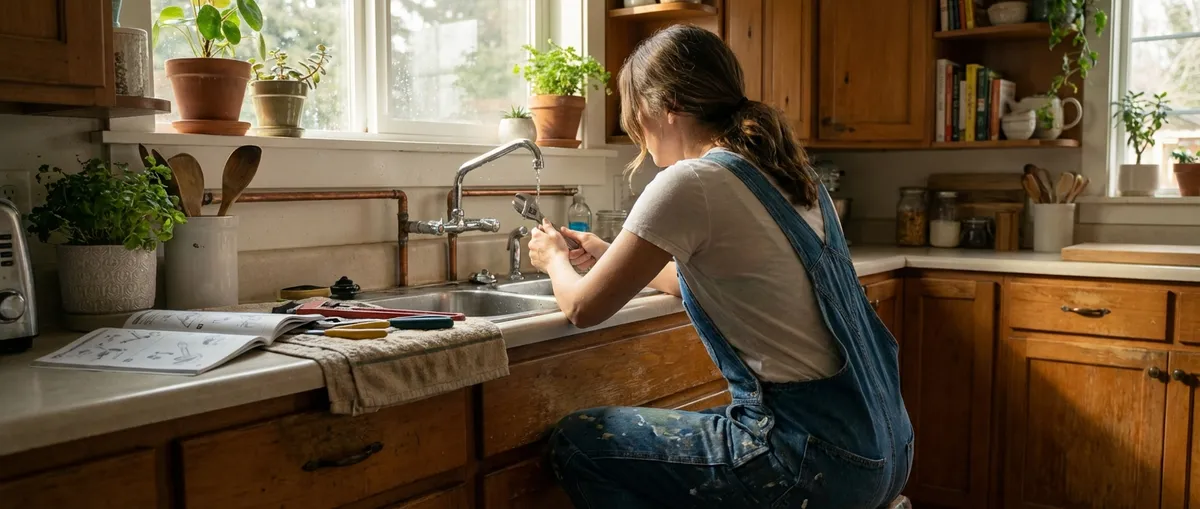
A dripping faucet wastes water, money, and your sanity. In most cases, the fix is replacing a worn cartridge, washer, or O‑ring.
What you’ll need:
Adjustable wrench, screwdriver, replacement cartridge/washer/O-rings (bring the old part to the store to match it), towel, small container.
Step-by-step:
**Shut off the water supply**
Look under the sink for the shutoff valves. Turn them clockwise until they stop. Open the faucet to relieve pressure and make sure water is off.
**Plug the drain**
Use a sink stopper or a cloth to cover the drain. This prevents tiny screws or parts from falling in.
**Remove the handle**
- Pry off any decorative cap with a small flat screwdriver. - Unscrew the handle screw and pull the handle off. - Set the parts in a container so you don’t lose anything.
**Access the cartridge or stem**
- Use an adjustable wrench to loosen the retaining nut or collar. - Gently pull out the cartridge or stem (for compression faucets). - Take note of the orientation or snap a photo for reassembly.
**Inspect and replace worn parts**
Look for cracked, flattened, or brittle rubber washers and O-rings. Replace them or swap in a new cartridge that matches your old one.
**Reassemble the faucet**
- Reinsert the cartridge/stem in the same orientation. - Tighten the retaining nut (snug, not overtight). - Reattach the handle and decorative cap.
**Turn water back on and test**
Slowly open the shutoff valves. Turn on the faucet and then turn it off. Check for dripping at the spout and around the base.
If it still drips:
The seat inside the faucet body may be worn, or you may need the correct OEM cartridge. Bring the entire cartridge and faucet model number to a plumbing supply store for a better match.
---
2. Running Toilet: How to Stop the Endless Refilling
A running toilet usually means the tank components aren’t sealing or filling correctly. It’s annoying—but usually a 20–30 minute fix.
What you’ll need:
Replacement flapper and/or fill valve kit, sponge or towel, bucket, adjustable wrench.
Step-by-step:
**Turn off water to the toilet**
Turn the valve on the wall behind the toilet clockwise until it stops. Flush the toilet to drain the tank. Use a sponge or towel to soak up remaining water if needed.
**Remove the tank lid and inspect**
Look for: - A warped or deteriorated flapper - A misaligned chain (too tight or tangled) - Water flowing into the overflow tube constantly
**Test the flapper seal**
Push the flapper down with your hand. If the water stops running, the flapper is the problem. Replace it.
**Replace the flapper**
- Unhook the chain from the flush handle arm. - Remove the flapper from the overflow tube pegs. - Install the new flapper onto the pegs. - Adjust the chain: it should have a small amount of slack (not pulling flapper up, not so loose it tangles).
**Check the fill valve and water level**
If water is entering the overflow tube even with a new flapper: - Adjust the float (on older ball-float types, bend the arm downward slightly; on newer column floats, adjust the clip up/down). - The water level should be about 1 inch below the top of the overflow tube.
**Replace the fill valve (if adjustment fails)**
- Turn off water and drain tank again. - Disconnect the water supply line at the bottom of the tank. - Unscrew the fill valve retaining nut, remove the old valve. - Insert the new valve per instructions, secure the nut, and reconnect the supply line.
**Turn water back on and test**
Let the tank fill. Verify that: - The toilet stops running after a flush. - The water line is at the mark inside the tank or just below the overflow tube.
If it’s still running:
Check for hairline cracks in the overflow tube or tank, or mineral buildup preventing a good flapper seal. Severe cracks usually mean replacing the tank or entire toilet.
---
3. Wall Anchor Pulling Out: How to Fix Loose Shelves or Towel Bars
Towel bars, hooks, and light shelves often loosen because the wrong wall anchor was used—or none at all. Fixing this correctly prevents repeat damage.
What you’ll need:
New appropriate wall anchors (toggle, molly, or heavy-duty plastic), drill, drill bits, screwdriver, utility knife, stud finder (optional), spackle or joint compound, putty knife, sandpaper.
Step-by-step:
**Remove the loose hardware**
Unscrew the bracket or hook. Gently pull it off the wall. If the old anchor is crumbling, remove debris with a utility knife or small screwdriver.
**Decide: stud or anchor?**
- Use a stud finder to check for a stud behind the mounting area. - If you can, **move the bracket slightly** to hit a stud; screws into wood studs hold far better than anchors in drywall. - If you must reuse the same location, you’ll need a stronger anchor.
**Patch an oversized or damaged hole**
If the hole is larger than your new anchor: - Fill it with spackle or joint compound. - Let it dry, sand smooth, and then drill a fresh pilot hole slightly smaller than your new anchor’s recommended size.
**Choose the right anchor type**
- **Light objects (small hooks, pictures):** standard plastic expansion anchors. - **Medium (towel bars, small shelves):** threaded drywall anchors or molly bolts. - **Heavy (large shelves, mirrors):** toggle bolts or, preferably, direct-to-stud mounting.
**Drill and install the anchor**
- Drill a hole to the anchor manufacturer’s suggested diameter. - Insert the anchor flush with the wall: - For toggle bolts: insert folded toggle through the hole, then pull back to engage. - For molly bolts: tighten the screw to expand the sleeve, then remove the screw to mount your bracket.
**Reattach hardware**
Mount the bracket or hook using the screws provided, tightening until snug. Don’t overtighten—you can strip drywall or crush weaker anchors.
**Test the strength**
Apply slow, steady pressure in the direction of expected use (pull on the towel bar, lightly load the shelf). If it holds firm, you’re good to go.
Prevent repeat failures:
Don’t hang heavy items on basic plastic anchors. Either locate a stud or upgrade to stronger anchors rated for the weight.
---
4. Outlet That Doesn’t Work: Basic Check Before Calling an Electrician
When an outlet dies, it’s often a tripped GFCI or breaker—not a full electrical failure. You can safely perform basic checks without opening any wiring.
What you’ll need:
Small plug-in device (lamp/phone charger), non-contact voltage tester (optional but useful), flashlight.
Safety first:
If you see sparks, burn marks, or smell burning plastic, stop and call an electrician.
Step-by-step:
**Test the outlet with a known working device**
Plug in a lamp or charger you know works. Confirm it doesn’t power on.
**Check nearby outlets for a GFCI**
Look in: - Bathrooms - Kitchen countertops - Garage, basement, laundry room - Exterior outlets
A GFCI outlet has “TEST” and “RESET” buttons. The dead outlet may be downstream of a tripped GFCI.
**Reset GFCI outlets**
- Press the “RESET” button firmly until it clicks. - Recheck your dead outlet with your device. - If it still doesn’t work, try **all** nearby GFCI outlets; sometimes one GFCI protects multiple rooms.
**Check the breaker panel**
- Look for a breaker that is slightly out of line with the others or partially tripped. - Turn it fully OFF, then firmly back ON. - Test your outlet again.
**Inspect for obvious damage**
- Look at the outlet cover for cracks, burn marks, or melted areas. - Listen for buzzing when you plug something in—this is a warning sign.
**Use a non-contact voltage tester (optional)**
- Turn off the breaker for that circuit. - Test the outlet face with the tester; it should show no voltage. - Turn breaker on and test again; if the tester shows live power but the device doesn’t work, the outlet itself may be faulty.
**Decide when to stop**
If: - Breakers and GFCIs are fine, - The outlet still doesn’t work, or - You see/smell signs of damage,
it’s time to call a licensed electrician. Replacing outlets and tracing dead circuits involves wiring knowledge and should meet your local code.
---
5. Door That Won’t Latch or Keeps Swinging Open
A door that won’t stay shut or latch properly can usually be fixed by adjusting hinges, the strike plate, or both—no new door required.
What you’ll need:
Screwdriver, wood toothpicks or wood shims, wood glue (optional), hammer, chisel (optional), pencil.
A. If the latch doesn’t line up with the strike plate
**Identify the problem**
Close the door slowly and watch where the latch hits: - **Too high or low** compared to the strike plate opening. - **Too far in or out** (door hitting frame or leaving a gap).
**Try hinge screw tightening first**
- Open the door and tighten all hinge screws on both the door and the frame. - This can lift or lower the door just enough to align the latch.
**Lift a sagging door with longer screws**
If the door sags on the handle side: - Replace one top hinge screw (in the frame side) with a 2.5–3" wood screw. - Angle it slightly toward the stud behind the jamb. - Tighten to pull the door up and back toward the hinge side.
**Adjust the strike plate (vertical misalignment)**
If the latch is still hitting too high or low: - Mark the correct latch position with a pencil. - Remove the strike plate and chisel the mortise slightly higher or lower. - Reinstall the plate matching your pencil marks.
**Bend the strike plate lip (small misalignment)**
For slight binding: - Remove the strike plate. - Gently bend the lip outward with pliers. - Reinstall so the latch has a smoother entry path.
B. If the door swings open on its own
**Determine swing direction**
Open the door halfway and let go. If it slowly swings, the frame is a bit out of plumb.
**Use the hinge-pin trick**
- Close the door. - Tap out the top hinge pin partway with a nail and hammer. - Slightly bend the pin (just a small curve) by tapping it in the middle against a hard surface. - Reinsert the pin. The added friction helps the door stay put.
**Repeat with the middle hinge if needed**
If one hinge doesn’t solve it, slightly bend the pin from the middle hinge as well. Avoid over-bending; you just want a bit of resistance.
**Tighten loose screw holes**
- If hinge screws just spin, remove them. - Insert wood toothpicks dipped in glue into the hole, break them flush, then reinstall the screws. - This gives the screw something solid to bite into.
Result:
Your door should latch cleanly and stay where you leave it—closed when you want privacy, open when you don’t.
---
Conclusion
Most “call a pro” moments start as small, fixable problems: a drip, a run, a wobble, a dead outlet, a door that misbehaves. With clear steps and a few basic tools, you can handle these five repairs safely and confidently.
Bookmark this guide, share it with someone who’s just moved into a new place, and tackle issues as they appear instead of waiting for them to grow into bigger, more expensive headaches. The more problems you solve yourself, the more your home (and budget) work in your favor.
---
Sources
- [U.S. Environmental Protection Agency – Fix a Leak](https://www.epa.gov/watersense/fix-leak-week) - Details on how small leaks (like dripping faucets and running toilets) waste water and why fixing them matters
- [The Family Handyman – How to Fix a Leaky Faucet](https://www.familyhandyman.com/project/how-to-fix-a-leaky-faucet/) - Step-by-step visual instructions for repairing common faucet types
- [Kohler – Toilet Troubleshooting & Repair Guides](https://support.kohler.com/hc/en-us/categories/360000021493-Toilets) - Official manufacturer guides for diagnosing and repairing toilet issues
- [U.S. Consumer Product Safety Commission – Electrical Safety Checklist](https://www.cpsc.gov/s3fs-public/electrical_safety_in_the_home.pdf) - Safety best practices for working around outlets, circuits, and home wiring
- [This Old House – How to Fix a Sticky Door](https://www.thisoldhouse.com/doors/21017609/how-to-fix-a-sticky-door) - Practical advice on adjusting doors, hinges, and strike plates for proper operation
Key Takeaway
The most important thing to remember from this article is that this information can change how you think about Household Repairs.