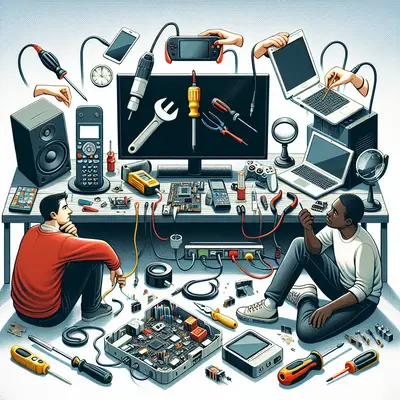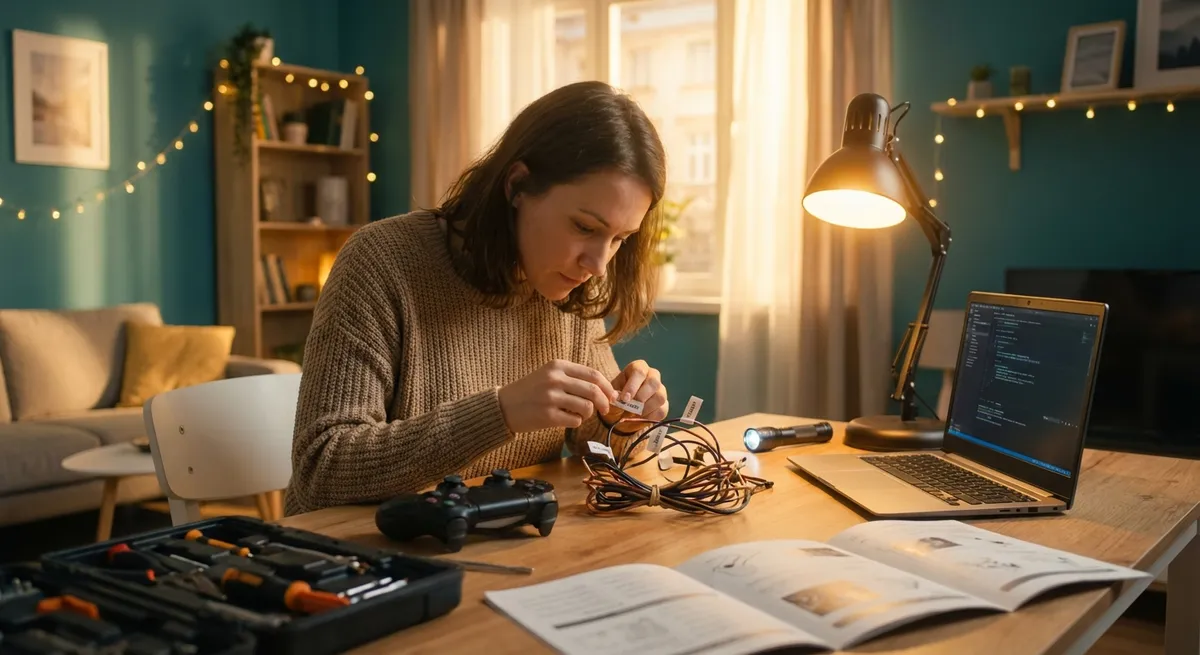
Electronics fail at the worst possible moments—right before a meeting, during a movie, or when you finally sit down to relax. You don’t always need a repair shop or new device; in many cases, a few targeted checks can bring your gear back to life. This guide walks you through five practical, step‑by‑step solutions for common electronics problems so you can get your devices working again with confidence.
---
1. Laptop That Won’t Turn On
A “dead” laptop isn’t always dead. Often, the issue is power delivery, a stuck state, or a simple hardware glitch.
Step‑by‑step fix
**Check the basics first**
- Verify the outlet works by plugging in another device. - Inspect the charger for frayed cables, bent connectors, or burn marks. - If you have a removable power cord on the adapter brick, reseat both ends firmly.
**Look for life signs**
- Plug in the charger and watch for charging indicators (LED on the laptop or power adapter). - Listen closely for fan noise or drive activity. Any sign of life means it’s likely not totally dead.
**Try a hard reset (power drain)**
- Disconnect charger and peripherals (mouse, USB drives, external displays). - If the battery is removable, take it out. - Hold the power button down for 15–30 seconds (this discharges residual electricity). - Reinstall the battery (if removable), plug in the charger, and try turning it on again.
**Test with minimal hardware**
- Remove all nonessential devices: USB drives, SD card, docking station, external monitors. - If your laptop has user‑accessible RAM or storage you recently upgraded, reseat those components according to the manufacturer’s guide.
**Try safe boot options (if it powers on partially)**
- On Windows, repeatedly tap **F8** or **Shift + F8** (older systems) or **Shift + Restart** from the login screen to enter recovery options. - On macOS, turn on and hold **Shift** to start in Safe Mode. - If it boots in Safe Mode, the problem can be a driver, startup app, or recent software change.
**When to stop DIY**
- No lights, no sounds, and no response even after hard reset and charger swap: likely motherboard or power circuitry. - Liquid damage, burning smell, or visible scorch marks: unplug immediately and contact a professional.
---
2. Phone That Won’t Charge or Charges Very Slowly
When your phone refuses to charge, it might not be the battery’s fault. Ports, cables, chargers, and software all play a role.
Step‑by‑step fix
**Inspect and clean the charging port**
- Power off the phone. - Use a flashlight to look inside the port. Dust and lint often pack in and block contact. - Gently use a wooden toothpick or soft brush to loosen debris—do **not** use metal pins that can damage pins or cause a short. - Blow carefully (or use compressed air in short bursts) to clear it.
**Test with known‑good charger and cable**
- Use an original or certified charger and cable (e.g., MFi‑certified for Apple). - Try a different wall outlet. - Avoid USB ports on computers for testing—they may not supply enough power.
**Check the charging icon and behavior**
- Confirm the charging icon appears on the screen. - If it keeps connecting/disconnecting, the port may be loose or cable damaged.
**Rule out software issues**
- Restart the phone and try charging again. - Close background apps and switch to Airplane mode to see if it charges faster. - Check for software updates in **Settings**; some updates include power management fixes.
**Inspect for overheating**
- If the phone is very warm, unplug it and let it cool. Many phones slow or stop charging to protect the battery. - Remove thick or insulated cases while charging.
**Decide on next steps**
- If multiple known‑good chargers and cables fail but wireless charging still works, the wired port likely needs professional service. - If the battery drops quickly even after proper charging, you may need a battery replacement.
---
3. TV With No Picture (But Sound Works)
Hearing audio but seeing a black or flickering screen is a common TV issue that often looks worse than it is.
Step‑by‑step fix
**Confirm the basics**
- Make sure the TV is powered on (indicator light and on‑screen logo at startup). - Press the **Menu** button on the TV (not the remote). - If the on‑screen menu appears, the TV panel is likely fine and the issue is input or signal.
**Check the input source**
- Press the **Input** or **Source** button on the remote and cycle through HDMI, AV, etc. - Ensure your streaming box, console, or cable box is powered on. - Try a different HDMI port on the TV.
**Inspect and reseat cables**
- Turn off TV and connected devices. - Unplug and firmly reconnect HDMI or AV cables on both ends. - Try a different HDMI cable—damaged cables frequently cause no‑signal or intermittent picture issues.
**Test with a different device**
- Plug in another device (laptop, game console, or streaming stick) to the TV. - If the new device works, the original device (not the TV) is the problem. - If nothing works on any HDMI port, the TV’s input board may be faulty.
**Check for backlight failure**
- In a dark room, turn the TV on. - Shine a flashlight at an angle close to the screen. - If you can faintly see images or menus, the backlight or power to the backlight has likely failed and requires professional repair.
**Reset your TV settings**
- Unplug the TV from the wall for 1–2 minutes, then plug it back in. - Use the manufacturer’s menu option for “Reset to factory settings” if the menu is visible. - Note: This will erase some custom settings (picture modes, Wi‑Fi, etc.), but can fix misconfigurations.
---
4. Wi‑Fi Router Dropping Connection
A flaky Wi‑Fi connection is often due to interference, overheating, or misconfiguration—fixable without any advanced networking skills.
Step‑by‑step fix
**Power cycle the network**
- Turn off your modem and router (or combined gateway). - Wait 30–60 seconds. - Turn on the modem first, wait until all lights stabilize, then turn on the router. - Test the connection again.
**Check physical setup**
- Place the router in a central, elevated location away from thick walls, metal cabinets, and microwaves. - Ensure it has ventilation on all sides; overheating can cause dropouts. - Avoid stacking it on other heat‑generating electronics.
**Reduce interference and congestion**
- Log into your router’s admin page (address is usually printed on the router, e.g., `192.168.1.1`). - Change the Wi‑Fi channel on 2.4 GHz to 1, 6, or 11—these are typically less overlapping. - If your devices support 5 GHz, make sure it’s enabled; this band is less crowded but has shorter range.
**Update firmware and reboot**
- In the router settings, look for **Firmware Update** or **Software Update**. - Apply any available updates, then reboot the router. - Updated firmware often improves stability and security.
**Test wired vs wireless**
- Connect a laptop directly to the router with an Ethernet cable. - If wired speeds are stable but Wi‑Fi is not, the radios/antennas or Wi‑Fi settings are the issue. - If wired is also unstable, the problem may be the modem or your internet provider.
**Secure your network**
- Set a strong Wi‑Fi password to prevent neighbors or unknown devices from overloading your bandwidth. - Use WPA2 or WPA3 encryption; avoid outdated WEP or open networks.
**When to call the ISP or replace hardware**
- If daily resets are needed despite all the above, your router may be failing. - If the modem loses signal (WAN/Internet light goes out), contact your internet provider to check line quality or replace the modem.
---
5. Bluetooth Devices Not Pairing or Disconnecting
From wireless headphones to speakers and keyboards, Bluetooth issues are frustrating but usually solvable with a clean pairing process and a bit of troubleshooting.
Step‑by‑step fix
**Clear old connections**
- On your phone/computer, go to **Bluetooth settings**. - Find the problematic device and choose **Forget** or **Remove**. - Turn Bluetooth off and back on.
**Reset the Bluetooth device**
- Turn the device off. - For many headphones, holding the power button for 5–10 seconds triggers pairing or reset mode (check the manual or brand website for specifics). - Look for a flashing LED that indicates it’s in pairing mode.
**Check distance and obstacles**
- Move the device and phone/computer within 1–2 meters. - Remove or turn off other nearby Bluetooth audio devices to reduce confusion and interference. - Avoid barriers like thick walls, metal shelves, or appliances between devices.
**Pair in the correct order**
- Put the Bluetooth device into pairing mode **before** enabling discovery on your phone/computer. - On the phone/computer, scan for devices and select the correct name. - Confirm any on‑screen pairing codes match.
**Address interference and battery issues**
- Ensure both devices have sufficient battery; low power can cause dropouts. - Turn off Wi‑Fi temporarily to see if 2.4 GHz interference is causing issues on older devices. - Keep devices away from USB 3.0 hubs or cables, which can cause radio noise.
**Update drivers or OS**
- On computers, update Bluetooth drivers via Device Manager (Windows) or system updates (macOS). - On phones, install the latest OS updates. - Some devices have companion apps (e.g., for headphones); open them and install firmware updates if available.
**When to suspect hardware failure**
- If the Bluetooth device won’t enter pairing mode, doesn’t show up on any phone/computer, or only works when bent/held in a certain way, the internal radio or antenna may be damaged and require professional repair or replacement.
---
Conclusion
Most electronics problems look complicated but come down to a few recurring issues: power, connections, software glitches, and interference. By working through these step‑by‑step checks—starting with the simplest, least risky actions—you can often revive your devices without a repair shop visit or a new purchase. When you do hit a hard limit, you’ll at least know exactly what’s wrong and what to tell a technician, saving time, money, and frustration.
---
Sources
- [Apple Support – If your Mac won’t turn on](https://support.apple.com/en-us/HT204267) - Official troubleshooting steps for non‑booting Macs that parallel many laptop power diagnostics
- [Samsung – Smartphone not charging? Here’s what to do](https://www.samsung.com/us/support/troubleshooting/TSG01001398/) - Practical checks for charging issues, ports, and cables on mobile devices
- [FCC – Interference with Wi‑Fi networks](https://www.fcc.gov/consumers/guides/interference-your-wireless-network) - Explains common causes of wireless interference that affect routers and Bluetooth devices
- [Microsoft – Improve your Wi‑Fi connection](https://support.microsoft.com/en-us/windows/fix-wi-fi-connection-issues-in-windows-11-8c3f4e0a-11b8-43bb-8d80-8ec4a27c19bb) - Guidance on router and PC troubleshooting for unstable wireless connections
- [Sony – No picture or black screen on TV](https://www.sony.com/electronics/support/articles/00023957) - Manufacturer’s checklist for diagnosing TVs with sound but no image
Key Takeaway
The most important thing to remember from this article is that this information can change how you think about Electronics.