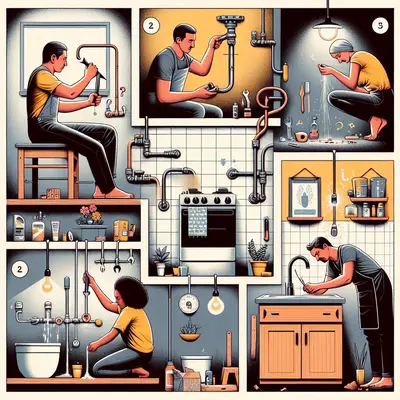
Some home problems feel small enough to ignore but big enough to be annoying every single day. A dripping faucet, a door that won’t stop squeaking, or a loose cabinet handle can slowly drive you up the wall—and you don’t need a contractor to deal with them.
This guide walks through five practical, beginner‑friendly fixes you can do with basic tools. Follow the steps in order, take your time, and you’ll turn daily irritations into quick wins.
---
Silence a Dripping Faucet
A slow drip wastes water and money and can stain your sink over time. Most drippy faucets are caused by worn-out washers or cartridges, not by “bad plumbing.” You can usually fix this in under an hour with a wrench and a $10 replacement part.
What you’ll need: Adjustable wrench, flat/Phillips screwdriver, replacement washer or cartridge (match your faucet brand/model), towel.
Step-by-step:
- **Shut off the water.**
Look under the sink for two small shutoff valves (hot and cold). Turn them clockwise until they stop. Open the faucet handle to confirm the water is off and to relieve pressure.
- **Plug the drain.**
Use the sink stopper or a rag. This prevents tiny screws or parts from falling into the drain.
- **Remove the handle.**
Look for a small cap or screw on the handle (often hidden under a decorative plug). Pry off the cap with a flat screwdriver if needed, then remove the screw and lift off the handle.
- **Expose the cartridge or stem.**
You may see a decorative collar or retaining nut. Unscrew it carefully with the adjustable wrench. Pay attention to the order things come off; take a quick photo with your phone as a reference.
- **Take the old part to the store.**
Pull out the cartridge or stem and bring it to a hardware store to get an exact match. A correct match matters—similar isn’t good enough.
- **Install the new part.**
Slide the new cartridge/stem in the same orientation as the old one. Tighten the retaining nut snugly but don’t overtighten (you can crack the fixture).
- **Reassemble the faucet.**
Put the trim pieces and handle back in reverse order. Tighten the handle screw and replace any decorative caps.
- **Turn the water back on slowly.**
Open the shutoff valves under the sink a little at a time. Check for leaks while the water runs. If it still drips, gently snug the retaining nut a bit more.
---
Fix a Squeaky Door the Right Way
Squeaky doors are almost always a hinge problem, not a “bad door.” The squeak comes from metal rubbing on metal with poor lubrication or accumulated dust and rust. Fixing it properly makes your door quieter and smoother.
What you’ll need: Hammer, small nail or hinge pin removal tool, rag, multipurpose oil or white lithium grease, paper towel or cardboard.
Step-by-step:
- **Identify the squeaky hinge.**
Slowly open and close the door and listen carefully. Touch each hinge lightly as you move the door; you’ll usually feel which hinge vibrates the most.
- **Protect the floor.**
Place a piece of cardboard or a towel under the door’s bottom area to catch any drips.
- **Loosen the hinge pin.**
For a standard pin‑style hinge, place a small nail or punch at the bottom of the hinge pin (the part that sticks out slightly). Tap gently upward with a hammer until the pin starts to rise out of the top.
- **Remove the pin.**
Once it’s partway out, pull it the rest of the way by hand or with pliers. You don’t always need to remove all pins at once; doing one hinge at a time keeps the door in place.
- **Clean the pin and hinge barrel.**
Wipe the pin with a rag to remove old grease, dust, and rust. Wipe inside the hinge barrel (the round part) as far as you can reach.
- **Lubricate properly.**
Apply a small amount of multipurpose oil or white lithium grease to the pin and inside the hinge barrel. Don’t drown it—too much attracts dust.
- **Reinsert the pin.**
Slide the pin back in from the top and tap lightly with the hammer until it’s fully seated. Wipe away any excess lubricant that squeezes out.
- **Test the door.**
Open and close it several times. If it still squeaks, repeat the process on the other hinges until the noise is gone.
---
Secure a Wobbly Chair or Table
Loose furniture is more than annoying—it can fail suddenly and cause injury. The wobble usually comes from loose screws, worn screw holes, or joints that have separated slightly over time. You can usually tighten things up with a few simple steps.
What you’ll need: Screwdrivers, wood glue, small wood shims or toothpicks, wood clamps or strong tape, rag.
Step-by-step:
- **Flip and inspect.**
Turn the chair or table upside down on a soft surface (like a rug or blanket) to avoid scratches. Gently push and pull on legs and joints to see what moves.
- **Tighten all screws first.**
Use the correct screwdriver size (to avoid stripping). Tighten every visible screw, not just the ones near the wobbly area. Test for wobble again—it may already be fixed.
- **Identify stripped holes.**
If a screw keeps turning without grabbing, the wood hole may be stripped. Remove that screw completely so you can repair the hole.
- **Fill the stripped hole.**
Dip wooden toothpicks or thin wood shims in wood glue and pack them into the stripped hole. Fill it snugly but not so tightly that you split the wood.
- **Trim flush.**
Snap or cut off any toothpick or shim pieces sticking out, so the surface is flat with the wood.
- **Reinstall the screw.**
Put the screw back into the now‑filled hole. As it goes in, it will bite into the glued wood pieces and hold firmly. Wipe off any glue squeeze‑out with a damp rag.
- **Strengthen loose joints.**
For joints that are separating (like chair legs where they meet the seat), gently pull them apart just enough to squeeze wood glue into the gap. Push the parts back together firmly.
- **Clamp while drying.**
Use wood clamps or wrap the area tightly with strong tape to hold it in place while the glue dries (usually at least a few hours; overnight is better). Don’t use the furniture until it’s fully set.
---
Stop a Running Toilet
A toilet that won’t stop running wastes a surprising amount of water. The problem is usually inside the tank: either the flapper isn’t sealing, the float is set too high, or the fill valve is misbehaving. You can fix most issues without touching the main plumbing.
What you’ll need: Adjustable wrench (maybe), replacement flapper if needed, towel.
Step-by-step:
- **Remove the tank lid carefully.**
Place it gently on a towel to avoid chips or cracks. Don’t lean it where it can slip and fall.
- **Identify what’s happening.**
If water is spilling into the small overflow tube, the water level is set too high or the fill valve is faulty. If the tank slowly drains and then refills, the flapper probably isn’t sealing.
- **Test the flapper seal.**
Push down gently on the rubber flapper at the bottom of the tank. If the running stops while you’re pressing, the flapper is the problem.
- **Replace the flapper if needed.**
Turn off the shutoff valve behind the toilet (clockwise) and flush once to empty most of the water. Unhook the old flapper from the overflow tube and the chain. Take it to a hardware store to match the size and style, then hook the new one in place.
- **Adjust the chain length.**
The chain from the handle to the flapper should have a tiny bit of slack, but not so much that it gets caught under the flapper. Adjust by moving the hook up or down the chain.
- **Set the water level.**
Look for a “water line” mark inside the tank. Adjust the float so the water stops at that line. For a float on an arm, bend the metal arm slightly downward. For modern vertical floats, turn the adjustment screw or slide mechanism per the arrows.
- **Check the fill valve.**
Turn the water back on and let the tank refill. If water still flows into the overflow tube even with a proper float setting, the fill valve may need replacement. Many kits come with clear instructions and only need basic tools.
- **Final test.**
Flush the toilet several times. Confirm the tank refills, stops at the right level, and stays quiet with no continuous trickling sound.
---
Re-Caulk a Moldy or Cracked Bathtub Edge
Old caulk around a tub or shower can crack, peel, or turn black with mold. This doesn’t just look bad; it can let water seep behind the walls and cause real damage. Removing the old bead and applying a new one is straightforward if you work slowly and neatly.
What you’ll need: Caulk remover (optional but helpful), utility knife or caulk scraper, painter’s tape, bathroom/kitchen silicone or tub-and-tile caulk, caulk gun, paper towels, spray bottle with soapy water.
Step-by-step:
- **Choose the right caulk.**
Look for “bathroom” or “kitchen and bath” silicone or tub-and-tile caulk with mold/mildew resistance. Make sure it’s labeled for wet areas. Avoid plain painter’s caulk—it won’t last in a shower.
- **Remove old caulk completely.**
Use a caulk remover tool or utility knife to slice and peel away the old bead. Take your time. Any old caulk left behind will prevent the new caulk from sticking properly.
- **Clean and dry the area.**
Scrub the gap and surrounding area with a bathroom cleaner and a brush to remove soap scum and mildew. Rinse, then dry thoroughly with a towel. Let it air dry for at least an hour; moisture under the caulk will cause problems.
- **Use painter’s tape for clean lines.**
Apply painter’s tape on both sides of where the new caulk will go, leaving a small gap (about 1/4 inch) for the bead. This makes it much easier to get a professional-looking straight line.
- **Prepare the caulk tube.**
Cut the nozzle at a 45‑degree angle, not straight across. Start with a small opening; you can always cut it larger. Puncture the inner seal if needed (many caulk guns have a built-in puncture tool).
- **Apply a steady bead.**
Hold the gun at a consistent angle and pull it toward you while lightly squeezing the trigger. Move slowly enough to fill the gap in one smooth pass without stopping and starting if possible.
- **Smooth the bead.**
Lightly spray the bead with soapy water. Wet your finger or use a caulk finishing tool and run it along the bead with gentle pressure to smooth it and push it into the gap. Wipe excess caulk off your finger or tool on paper towels.
- **Remove tape and let it cure.**
Peel off the painter’s tape right away, before the caulk skins over, pulling away from the caulk line. Let the caulk cure according to the package directions (often 24 hours) before using the shower or tub.
---
Conclusion
Most “everyday” household problems don’t require a toolbox the size of a car or a contractor on speed dial—just a clear plan and a bit of patience. By shutting off water before you work, protecting surfaces, taking photos as you disassemble, and matching parts carefully, you can safely handle a surprising amount of basic repair work yourself.
Share this playbook with someone who keeps saying, “I really need to fix that someday.” One focused weekend and a few basic tools can turn that list of small annoyances into a set of quick wins—and make your home noticeably more comfortable and reliable.
Key Takeaway
The most important thing to remember from this article is that this information can change how you think about Household Repairs.