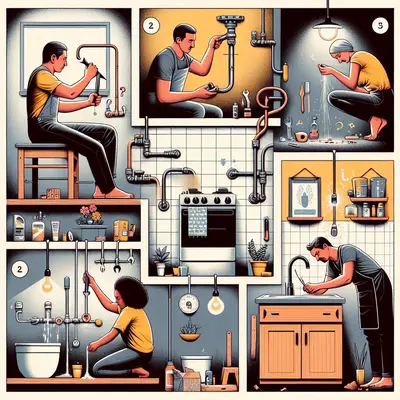
Most household problems don’t need a contractor, a weekend, or a huge budget. With a basic toolkit and a clear plan, you can solve a surprising number of issues yourself—and avoid letting “small annoyances” turn into expensive damage.
This guide walks you through five common problems with step‑by‑step fixes you can safely tackle today.
---
Stop a Dripping Faucet (Without Replacing the Whole Thing)
A dripping faucet wastes water and money, but in many cases you only need a washer or cartridge swap—not a new tap.
What you’ll need
- Adjustable wrench or basin wrench
- Flathead and Phillips screwdrivers
- Replacement washer or cartridge (match to your faucet brand/model)
- Plumber’s grease or silicone grease
- Towel or rag
Step‑by‑step
**Shut off the water**
- Look under the sink for two shutoff valves (hot and cold). - Turn both clockwise until they stop. - Open the faucet to relieve pressure and confirm water is off.
**Plug the drain**
- Use the sink stopper or a rag so small screws or parts don’t disappear.
**Remove the handle**
- Pry off any decorative cap with a small flathead screwdriver. - Unscrew the handle screw beneath and gently pull the handle off. - If it’s stuck, wiggle it side to side instead of forcing it straight up.
**Access the cartridge or stem**
- Remove any retaining nut with your wrench. - Pull out the cartridge (single‑handle) or stem (two‑handle). - Note the orientation—take a photo so you can reassemble correctly.
**Inspect and replace parts**
- Look for worn rubber washers, cracked O‑rings, or mineral buildup. - Replace washers/O‑rings with identical sizes. - For cartridge faucets, replace the entire cartridge with a matching one. - Lightly coat O‑rings with plumber’s grease.
**Reassemble carefully**
- Insert the cartridge or stem in the same orientation as before. - Tighten the retaining nut snugly, but don’t overtighten. - Reattach the handle and decorative cap.
**Turn water back on and test**
- Slowly open the shutoff valves. - Run the faucet and check for leaks at the base and handle. - Turn the faucet off and confirm the drip is gone.
If it still drips, the seat inside the faucet body may be damaged. At that point, replacing the faucet or calling a plumber is usually the most efficient next step.
---
Silence a Running Toilet Before It Wastes More Water
A toilet that keeps running is one of the most common—and most ignored—household leaks. Usually, either the flapper, fill valve, or float is misbehaving.
What you’ll need
- Adjustable wrench
- Replacement flapper (universal or brand‑specific)
- Optional: replacement fill valve kit
- Towel or sponge
Step‑by‑step
**Remove the tank lid and observe**
- Flush the toilet and watch what happens. - Does water keep flowing into the bowl? Does the tank overfill and spill into the overflow tube?
**Check the flapper first**
- Push down gently on the flapper (rubber piece at the bottom of the tank). - If the running sound stops, the flapper is likely worn or not sealing.
**Adjust or replace the flapper**
- Turn off the water supply valve behind the toilet (clockwise). - Flush to empty most of the water from the tank. - Unhook the flapper from the overflow tube and chain. - Attach the new flapper, adjusting chain length so there’s a slight slack—not so tight that it holds the flapper open.
**Test the fill level**
- Turn the water back on and let the tank refill. - The water level should stop about 1 inch below the top of the overflow tube. - If it’s too high, adjust the float: - For a float arm: gently bend the metal arm downward. - For a float on the fill valve: turn the adjustment screw or slide mechanism down.
**Replace the fill valve if needed**
- If water continues to run into the overflow tube, the fill valve might be faulty. - Turn off the water and drain the tank. - Disconnect the water supply line under the tank with a wrench. - Unscrew the locknut holding the fill valve in place, then lift out the old valve. - Install the new fill valve per manufacturer instructions, set the recommended height, and reconnect everything.
**Final checks**
- Turn on the water, let the tank fill, then flush. - Listen for continuous running and confirm the water stops at the correct level. - Replace the tank lid.
A properly tuned toilet should fill, then go completely silent—no hissing, no trickling.
---
Fix a Loose Door That Won’t Latch Properly
A door that doesn’t latch or sags in the frame is more than an annoyance; it can damage hinges and hardware over time. Usually, you can correct it with basic hinge and strike plate adjustments.
What you’ll need
- Phillips screwdriver
- Wood toothpicks or wooden matchsticks
- Wood glue (optional but helpful)
- Chisel (for advanced strike plate adjustments)
- Pencil
Step‑by‑step
**Identify the problem**
- Close the door slowly and watch where it sticks or misses the latch. - If the latch doesn’t align with the strike plate hole, note if it hits high or low.
**Tighten hinge screws**
- Open the door fully. - Tighten all screws on the door side and frame side of the hinges. - Loose top hinge: door usually sags, causing the latch to hit low. - Loose bottom hinge: latch may hit high or drag on the floor.
**Reinforce stripped screw holes**
- If any hinge screw just spins without tightening, the hole is stripped. - Remove that screw. - Insert wood toothpicks (or matchsticks with the tips removed) dipped in wood glue into the hole. - Snap them off flush with the surface. - Reinsert the screw and tighten. The wood filler gives it new grip.
**Check latch alignment again**
- Close the door to see if it now latches cleanly. - If it still misses slightly, mark where the latch hits the strike plate with a pencil or a bit of lipstick on the latch.
**Adjust the strike plate (simple method)**
- Loosen the strike plate screws slightly. - Shift the plate a millimeter or two up, down, or inward as needed. - Retighten and test. - If the door closes but feels too tight, shifting the plate slightly outward can help.
**Deep adjustment (if needed)**
- If you have to move the strike plate more than a couple of millimeters, you may need to chisel a slightly larger mortise (recess) in the frame. - Trace the new position with a pencil. - Carefully remove a thin layer of wood within the outline using a chisel. - Reinstall the plate and test.
This small fix can transform a stubborn door into one that closes with a clean, satisfying click.
---
Restore Power to a Dead Outlet or Light (Safely)
When an outlet, switch, or light suddenly stops working, the issue is often a tripped breaker or GFCI outlet—not a major wiring failure. Basic checks can restore power and help you decide if you need an electrician.
> Important: If you see sparks, smell burning, or feel heat at an outlet/switch, stop and call a licensed electrician.
What you’ll need
- Flashlight
- Access to your electrical service panel
- Non‑contact voltage tester (recommended but optional)
Step‑by‑step
**Check other devices in the area**
- Try a lamp or phone charger in the same outlet. - Test another outlet on the same wall or nearby. - This helps determine whether the problem is isolated or part of a larger circuit failure.
**Look for a tripped GFCI outlet**
- Kitchens, bathrooms, garages, basements, and outdoor areas often have Ground Fault Circuit Interrupter (GFCI) outlets. - Find any nearby outlets with “TEST” and “RESET” buttons. - Press the RESET button firmly. - Test your dead outlet or light again.
**Inspect the breaker panel**
- Locate your home’s main electrical panel (often in a basement, garage, or utility closet). - Open the door and look for any breakers that appear in the middle position or slightly off from the rest. - To reset a tripped breaker: - Push it firmly to the OFF position first. - Then push it back to ON.
**Retest the outlet or light**
- Flip the light switch or plug in a known working device. - If it works, you’ve solved it. - If the breaker trips again immediately, unplug or turn off all devices on that circuit and retry. If it still trips, call an electrician—there may be a wiring fault.
**Use a non‑contact voltage tester (optional but helpful)**
- Verify if power is reaching the outlet or switch without removing it. - If the tester doesn’t detect power at the device but the breaker and GFCI are fine, the problem may be in the wiring or connections—this is time to bring in a professional.
Never work on live wiring or open junction boxes unless you’re confident and know how to safely shut off and verify power. Your role as a homeowner is safe troubleshooting, not risky rewiring.
---
Seal a Drafty Window to Cut Energy Loss
Drafty windows make your home uncomfortable and inflate heating and cooling bills. You don’t need full window replacement to see real improvement—simple sealing and weatherproofing go a long way.
What you’ll need
- Weatherstripping (foam tape or V‑strip)
- Caulk (exterior‑grade for outside, paintable latex or silicone for inside)
- Caulk gun
- Utility knife or scissors
- Mild cleaner and cloth
Step‑by‑step
**Find the draft points**
- On a windy day, feel around the window frame with the back of your hand. - Look for visible gaps between the frame and wall, or between the sash and frame. - Note which areas are worst: top, bottom, sides, or where the two sashes meet.
**Clean the surfaces**
- Wipe down the window frame and surrounding wall area with a mild cleaner. - Let surfaces dry fully; caulk and adhesive need clean, dry surfaces to stick.
**Apply weatherstripping to moving parts**
- For sliding or double‑hung windows, measure the sides where the sash meets the frame. - Cut weatherstripping to length. - Peel off the backing and press firmly along the frame where the sash closes. - Test the window to be sure it still opens and closes smoothly.
**Caulk fixed gaps**
- For gaps between the window frame and wall (inside): - Use paintable latex caulk. - Cut the tip at a 45° angle for a small bead. - Run a continuous line of caulk along the gap. - Smooth with a damp finger or caulk tool. - For exterior gaps: - Use exterior‑grade silicone or polyurethane caulk. - Focus on cracks where the frame meets the siding or trim (avoid weep holes designed for drainage).
**Improve the meeting rail (where sashes meet)**
- For very drafty double‑hung windows, consider a V‑strip weatherseal along the meeting rail. - Install according to package directions so it compresses when the window is closed.
**Check after curing**
- Let caulk cure as directed (usually 24 hours). - Recheck for drafts. - If needed, add a temporary window film kit in very cold seasons for additional insulation.
These upgrades are low‑cost and often pay for themselves through reduced energy use and improved comfort.
---
Conclusion
Most everyday home issues don’t require specialized skills—just a clear process, the right basic tools, and a willingness to slow down and troubleshoot.
By:
- Rebuilding a dripping faucet instead of replacing it,
- Tuning a running toilet,
- Realigning a stubborn door,
- Safely resetting power to a dead outlet or light, and
- Sealing up drafty windows,
you’re not just fixing annoyances—you’re protecting your home, lowering your bills, and building real repair confidence.
When in doubt, prioritize safety: shut off water and power, use the right tools, and call a professional if something feels beyond your comfort zone. The more you practice these manageable repairs, the more your home becomes a place you maintain proactively, not react to when things go wrong.
---
Sources
- [U.S. Environmental Protection Agency – Fixing Leaks at Home](https://www.epa.gov/watersense/fix-leak-week) - Covers the impact of common household leaks like faucets and toilets and why fixing them saves water and money
- [Energy.gov – Air Sealing Your Home](https://www.energy.gov/energysaver/air-sealing-your-home) - Government guidance on sealing windows and doors to improve energy efficiency
- [Family Handyman – How to Fix a Running Toilet](https://www.familyhandyman.com/project/how-to-fix-a-running-toilet/) - Step‑by‑step visual reference for diagnosing and repairing common toilet problems
- [Lowe’s – How to Repair a Leaky Faucet](https://www.lowes.com/n/how-to/repair-a-leaky-faucet) - Retailer guide that details different faucet types and the parts typically replaced
- [Electrical Safety Foundation International (ESFI)](https://www.esfi.org/resource/home-electrical-safety-checklist-119) - Checklist and safety advice for handling basic home electrical issues and when to call a pro
Key Takeaway
The most important thing to remember from this article is that this information can change how you think about Household Repairs.