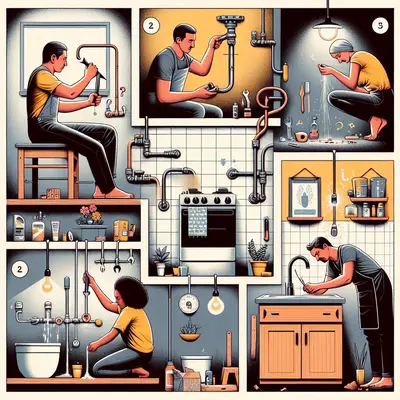
When something breaks at home, the hardest part usually isn’t the repair—it’s deciding where to start. This guide walks you through five practical, high‑impact fixes you can handle with basic tools and clear steps. Each solution is designed to be doable in an evening, even if you’re not “handy,” so you can stop stressing and get your home working again.
---
Stop a Constantly Running Toilet
A toilet that never stops running wastes water and money, but most of the time the fix is inside the tank and takes under 20 minutes.
What You’ll Need
- Adjustable wrench or pliers (optional)
- Replacement flapper (if needed)
- Towel or sponge
Step-by-Step
**Remove the tank lid and observe**
Flush once and watch what happens inside. You’ll see three main parts: the fill valve (tall piece on one side), the float (ball or cup), and the flapper (rubber piece over the flush valve at the bottom).
**Test the flapper seal**
When the tank is full, gently push down on the flapper. - If the running sound stops, the flapper is likely worn or not sealing properly. - If nothing changes, move to the float and fill level.
**Adjust the water level**
The water should be about 1 inch below the top of the overflow tube. - For older ball floats: Turn the screw on the float arm clockwise to lower the water level. - For newer cup floats: There’s usually a clip or screw on the side of the float—slide or turn it to lower the float.
**Replace a worn flapper (if needed)**
- Turn off the water supply valve behind the toilet. - Flush once to empty most of the water. - Unhook the flapper from the overflow tube and disconnect the chain. - Attach the new flapper, hook the chain to the flush handle (leave a small amount of slack), and turn the water back on.
**Test and fine‑tune**
Flush the toilet a few times. Adjust the chain if the handle feels tight or the flapper doesn’t open fully. Confirm the toilet stops running within 30–60 seconds after each flush.
---
Quiet a Squeaky Door Hinge
A squeaky door is annoying but usually simple to fix with lubricant and basic adjustment.
What You’ll Need
- WD‑40, silicone spray, or petroleum jelly
- Rag or paper towels
- Hammer and small nail or screwdriver (optional, if pin is stuck)
Step-by-Step
**Identify the squeaky hinge**
Open and close the door slowly to pinpoint which hinge makes the noise.
**Try lubricating in place first**
- Spray a small amount of lubricant directly into the top and sides of the hinge. - Open and close the door several times to work it in. Often this alone solves the squeak.
**Remove the hinge pin for a deeper fix (if needed)**
- Place a rag under the hinge to catch drips. - Use a small nail or screwdriver under the hinge pin head and gently tap upward with a hammer. - Once the pin starts moving, pull it out by hand.
**Clean and lubricate the pin**
- Wipe off old dirt or rust with a rag. - Apply a thin coat of lubricant or petroleum jelly along the length of the pin.
**Reinsert and test**
- Slide the pin back into the hinge and tap lightly until it’s fully seated. - Open and close the door. Repeat for other noisy hinges. If the squeak remains, check for loose hinge screws and tighten them.
---
Restore Power to a Dead Outlet Safely
When an outlet suddenly stops working, you don’t always need an electrician. Often the problem is a tripped breaker or GFCI outlet.
What You’ll Need
- Small lamp or phone charger (for testing)
- Flashlight (if panel is in a dark area)
- Optional: Non‑contact voltage tester
Step-by-Step
**Test the outlet with a known good device**
Plug in a lamp or charger you know works. If it’s dead, confirm nearby outlets too—sometimes multiple outlets are on the same circuit.
**Look for a tripped GFCI outlet**
- Kitchens, bathrooms, garages, and basements often use GFCI outlets. - Find outlets with “TEST” and “RESET” buttons. - Press “RESET” firmly until it clicks. Then test your outlet again.
**Check the breaker panel**
- Open the electrical panel (usually in a basement, garage, hallway, or closet). - Look for any breakers in the middle or “tripped” position. They may feel slightly loose or not fully aligned with the others.
**Reset a tripped breaker correctly**
- Push the breaker firmly to the OFF position first. - Then push it back to ON until it clicks. - Test your outlet again with the lamp or charger.
**Know when to stop and call a pro**
Call an electrician immediately if: - The breaker trips again right away. - You smell burning or see scorch marks. - The outlet is hot to the touch. These are signs of a possible short or overloaded circuit that needs professional attention.
---
Fix a Loose Cabinet Door That Won’t Line Up
Cabinet doors that sag, rub, or won’t close fully usually just need hinge adjustment—not replacement.
What You’ll Need
- Phillips screwdriver
- Small level (optional)
- Pencil
Step-by-Step
**Identify the problem area**
Close the door slowly and watch where it’s misaligned: - Top edge too high or low? - Door rubbing on the side? - Gap bigger on one side than the other?
**Locate the adjustment screws**
Most modern cabinet hinges have two visible screws on the mounting plate: - One moves the door left/right. - One moves it in/out or up/down (varies by hinge style).
**Make small horizontal adjustments**
- Open the door. - Turn the side‑to‑side adjustment screw a quarter‑turn at a time. - Close and check each time until the gap looks even and the door doesn’t rub.
**Adjust height or depth as needed**
- For doors rubbing at the top or bottom, loosen the screws on the hinge plate slightly and lift or lower the door, then tighten. - For doors that stick out or sit too deep, use the in/out screw (if present) to bring the door flush with the cabinet front.
**Fine‑tune all hinges together**
- Adjust both top and bottom hinges—changing one affects the other. - Use a level if you have one to confirm the door is straight. - When you’re satisfied, gently tighten all screws so the settings stay put.
---
Seal a Drafty Window to Cut Energy Loss
Drafty windows make rooms uncomfortable and increase energy bills, but you can often improve them with simple weather‑sealing.
What You’ll Need
- Weatherstripping tape or foam
- Caulk (latex or silicone, paintable if desired)
- Utility knife or scissors
- Caulk gun
- Mild cleaner and cloth
Step-by-Step
**Find the draft**
- On a windy day, run your hand around the window frame and sash. - For a more precise check, hold a lit stick of incense or a thin piece of tissue near the edges and watch for movement.
**Clean the surfaces**
- Wipe down the window frame and sash with a mild cleaner. - Let everything dry completely so the adhesives and caulk will stick.
**Apply weatherstripping to moving parts**
- Use adhesive foam or rubber weatherstripping around the parts of the window that open and close. - Measure each side, cut to length, and press it firmly into place so it compresses slightly when you close the window.
**Caulk stationary gaps**
- Use caulk around the exterior edges where the window frame meets the wall, and on interior gaps that don’t need to move. - Cut the tip of the caulk tube at a small angle, run a steady bead along the gap, and smooth it with a damp finger or caulk tool.
**Test and adjust**
- After the caulk cures according to the package directions, check again for drafts. - If the window is now hard to close, trim excess weatherstripping with a utility knife.
---
Conclusion
Most everyday home problems—running toilets, noisy doors, dead outlets, crooked cabinets, and drafty windows—look bigger than they actually are. With a few basic tools and clear steps, you can handle these repairs yourself, save money, and reduce the stress of waiting on a service call. Start with the issue that bothers you most, follow the steps carefully, and treat each repair as practice; the confidence you build now will make the next fix even easier.
---
Sources
- [U.S. Environmental Protection Agency – Fix a Leak](https://www.epa.gov/watersense/fix-leak-week) - Explains how common household leaks (including toilets) waste water and what to look for
- [The Family Handyman – How to Fix a Running Toilet](https://www.familyhandyman.com/project/how-to-fix-a-running-toilet) - Detailed visuals and troubleshooting tips for toilet tank components
- [U.S. Consumer Product Safety Commission – Electrical Safety](https://www.cpsc.gov/safety-education/safety-guides/electrical) - Guidance on when DIY electrical work is safe and when to call a professional
- [U.S. Department of Energy – Air Sealing Your Home](https://www.energy.gov/energysaver/air-sealing-your-home) - Best practices for finding and sealing drafts around windows and doors
- [This Old House – How to Adjust Cabinet Doors](https://www.thisoldhouse.com/cabinets/21015018/how-to-adjust-cabinet-doors) - Visual guide to adjusting modern cabinet hinges for proper alignment
Key Takeaway
The most important thing to remember from this article is that this information can change how you think about Household Repairs.