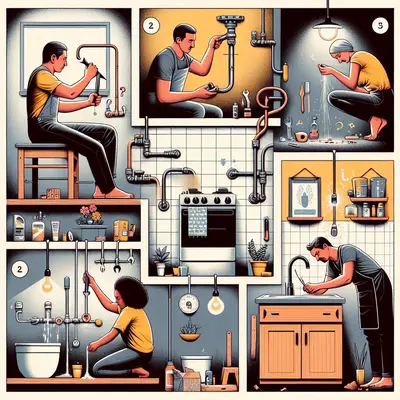
Small issues at home have a way of turning into big, expensive problems when you ignore them. The good news: a lot of everyday repairs are simple, safe, and realistic for non‑experts—if you know exactly what to do and what not to touch.
This guide walks you through five practical household fixes with clear, step‑by‑step instructions. No advanced tools. No jargon. Just straightforward solutions you can tackle in an afternoon.
---
Fix 1: Stop a Dripping Faucet (Without Replacing the Whole Thing)
A dripping faucet wastes water and slowly raises your bill. In many cases, the problem is a worn washer, cartridge, or O‑ring that you can replace in under an hour.
What you’ll need
- Adjustable wrench or basin wrench
- Flathead and Phillips screwdrivers
- Replacement washer/cartridge/O‑rings (match to your faucet model)
- Plumber’s grease (optional but helpful)
- Small container to hold screws/parts
Step‑by‑step
**Shut off the water supply**
- Look under the sink for two shutoff valves (hot and cold). - Turn them clockwise until they stop. - Open the faucet to release pressure and confirm water is off.
**Plug the drain**
- Use a sink plug or a rag so small screws and parts can’t fall in.
**Remove the handle**
- Pop off any decorative cap. - Remove the screw underneath with a screwdriver. - Gently wiggle and lift the handle off.
**Identify your faucet type**
- **Compression** (separate hot/cold handles, turns more than 90°) – likely has rubber washers. - **Cartridge, ball, or ceramic disk** – usually a single lever or smoother action; uses cartridges or seals instead of washers.
**Disassemble the valve**
- Use an adjustable wrench to loosen the packing nut or retaining nut. - Carefully pull out the stem or cartridge. - Take note or photos of the order parts come out.
**Inspect and replace wearable parts**
- Look for cracked, hardened, or deformed rubber washers or O‑rings. - On cartridge faucets, check for cracks, mineral buildup, or obvious wear. - Replace washers or O‑rings with identical sizes, or swap in a new cartridge that matches your faucet brand/model.
**Clean and lubricate**
- Wipe mineral deposits from metal surfaces with vinegar on a cloth (avoid soaking ceramic disks unless the manufacturer allows it). - Lightly apply plumber’s grease to O‑rings and moving parts (do not over‑grease).
**Reassemble in reverse order**
- Put parts back exactly as you removed them. - Tighten nuts snugly, not aggressively—overtightening can crack parts.
**Turn water back on slowly**
- Open shutoff valves gradually. - Turn the faucet on and off a few times and check for leaks around the handle and spout.
When to stop and call a pro:
If shutoff valves won’t close, the faucet body is cracked, or you can’t match a cartridge/part even after checking the manufacturer’s site, bring in a plumber.
---
Fix 2: Quiet a Running Toilet That Won’t Stop Filling
A toilet that runs constantly is usually caused by a faulty flapper, incorrect float level, or a worn fill valve. These parts are inexpensive and designed for DIY replacement.
What you’ll need
- Replacement flapper and/or fill valve (universal kits fit most toilets)
- Adjustable wrench or pliers
- Old towel or sponge
- Bucket (optional)
Step‑by‑step: Diagnose the problem
**Remove the tank lid and look inside**
- Flush and watch what happens. - If water keeps flowing into the bowl, focus on the **flapper or flush valve**. - If water rises too high and spills into the overflow tube, focus on the **float or fill valve**.
**Check the flapper first**
- Turn off the water supply at the wall (clockwise). - Flush once to lower the water. - Inspect the rubber flapper: is it warped, cracked, slimy, or not sealing the drain opening? - If it looks worn or doesn’t drop back into place cleanly, replace it.
**Replace the flapper (if needed)**
- Detach the chain from the toilet handle arm. - Unhook the flapper from the overflow tube pegs. - Attach the new flapper to the pegs. - Connect the chain, leaving slight slack so the flapper can fully close without being held up.
**Adjust the float level**
- For a **float cup** (on the fill valve body): squeeze the metal clip and slide the float down the rod slightly, or turn the adjustment screw on top (clockwise usually lowers the water level). - For an **old‑style float ball**: gently bend the float arm downward so the ball sits lower when the tank is full. - Aim for a water level about 1 inch below the top of the overflow tube.
**Test after each change**
- Turn the water back on. - Let the tank fill and listen: the water should stop completely. - Drop a few drops of food coloring into the tank and wait 10–15 minutes without flushing; if color shows up in the bowl, the flapper still leaks and needs adjustment or replacement.
**Replace the fill valve if it’s noisy or won’t shut off**
- Turn off water, flush, and sponge out excess water. - Disconnect the water supply line underneath the tank with a wrench. - Unscrew the locknut holding the fill valve and lift the valve out. - Install the new valve per instructions, adjusting height to match your tank. - Reconnect the supply line, turn water on, and check for leaks.
When to stop and call a pro:
If the tank or bowl is cracked, the shutoff valve won’t turn, or you see water seeping at the base of the toilet, get a plumber involved.
---
Fix 3: Reset a Tripped Breaker and Safely Restore Power
If part of your home suddenly loses power, a tripped circuit breaker is often the cause. Resetting it safely—and understanding why it tripped—is critical.
Important safety note
You should never remove the panel cover or touch exposed wires. The steps below assume you’re only accessing breakers behind the standard door. If anything looks burnt, melted, or smells like burning plastic, stop and call an electrician.
What you’ll need
- Flashlight
- Dry hands and dry floor (no standing water)
Step‑by‑step
**Identify what’s out**
- Note which outlets or lights don’t work. - Unplug major devices in that area (space heaters, toasters, hairdryers, window AC units) to reduce load before resetting.
**Find your main electrical panel**
- Typically in a basement, garage, hallway, or utility room. - Open the panel door (not the internal cover).
**Look for the tripped breaker**
- Most breakers will be firmly in the ON position. - A tripped breaker often sits between ON and OFF or has a red/orange indicator.
**Turn the breaker fully OFF first**
- Using one hand, firmly switch the tripped breaker to the OFF position. - Then push it back to ON until you feel it click.
**Test the affected outlets and lights**
- Check that power is restored. - Plug devices back in **one at a time**, especially high‑draw items like heaters, hairdryers, microwaves, and AC units.
**Watch for repeat trips**
- If the same breaker trips again soon after turning things back on: - Unplug or move some devices to a different circuit. - Avoid running multiple high‑wattage appliances on the same circuit. - If it **keeps** tripping with minimal load, there may be a wiring fault or failing breaker—call a licensed electrician.
When to stop and call a pro immediately:
- Burning smell, visible scorch marks, or a hot panel.
- Breaker won’t reset or immediately trips with nothing plugged in.
- Lights flicker or dim significantly when appliances start.
---
Fix 4: Patch a Small Drywall Hole So It Actually Blends In
From doorknob dents to old picture hangers, drywall damage is common. Small holes and dents are easy to repair yourself and can drastically improve how a room looks.
What you’ll need
- Spackle or lightweight joint compound
- Putty knife (2–4 inch)
- Sanding sponge or fine‑grit sandpaper (120–220 grit)
- Damp cloth
- Primer and matching paint
- Self‑adhesive drywall patch (for holes ~1–4 inches)
Step‑by‑step: Nail and screw holes
**Clean the area**
- Remove any loose paper or crumbly drywall with the putty knife. - Wipe dust away with a dry cloth.
**Apply spackle**
- Load a small amount on the putty knife. - Press into the hole and scrape across the surface at a slight angle. - Smooth it so it’s just slightly raised above the wall.
**Let it dry completely**
- Follow the product’s drying time—usually 1–2 hours for lightweight spackle.
**Sand lightly**
- Use a sanding sponge to feather the edges until flush with the wall. - Wipe off dust with a damp cloth and let dry.
**Prime and paint**
- Spot‑prime the repaired area to prevent flashing (a dull/bright difference). - Once dry, paint with a matching color, blending outward from the patch.
Step‑by‑step: Larger holes (up to ~4 inches)
**Prepare the surface**
- Remove loose material around the hole. - Wipe off dust.
**Apply a self‑adhesive patch**
- Cut the patch if needed so it extends at least 1 inch beyond the hole on all sides. - Center it and press firmly to stick it to the wall.
**Cover with joint compound**
- Using a putty knife, spread compound over the entire patch. - Feather the edges into the surrounding wall.
**Dry, sand, and repeat if needed**
- Let dry fully, then sand smooth. - Apply a second thin coat if you can still see the outline. - Sand again for a smooth surface.
**Prime and paint**
- Prime the entire patched area. - Paint to match the rest of the wall.
When to call a pro:
If the damage is large, near plumbing or wiring, or caused by a leak you haven’t fixed yet, get an expert involved to check structural and moisture issues.
---
Fix 5: Clear a Slow or Clogged Sink Without Harsh Chemicals
Slow or clogged bathroom and kitchen sinks are usually caused by hair, soap scum, grease, or food particles. In many cases you can clear them safely without chemical drain openers, which can damage pipes and are hazardous if misused.
What you’ll need
- Plunger (dedicated to sinks, not toilets)
- Bucket or bowl
- Old toothbrush or small brush
- Rubber gloves
- Drain snake or plastic drain cleaning tool (zip‑style)
- Adjustable pliers (if you’ll remove the P‑trap)
Step‑by‑step
**Start with the simplest option: clear the stopper**
- Remove the sink stopper (usually twist and pull; some require loosening a small rod under the sink). - Clean off hair, soap scum, and debris. - Run hot water and see if draining improves.
**Try plunging the sink**
- Fill the sink with enough water to cover the plunger cup. - If it’s a double sink, block the other drain with a wet cloth. - Place the plunger over the drain and plunge firmly 10–15 times. - Remove the plunger and check if the water drains.
**Use a drain snake or plastic cleaning tool**
- Insert it into the drain and gently push past curves. - Twist and pull up to capture hair and debris. - Repeat until you no longer pull out material.
**Clean the P‑trap (for persistent clogs)**
- Place a bucket under the curved pipe beneath the sink. - Loosen the slip nuts on each end of the P‑trap by hand or with pliers. - Remove the trap and dump debris into the bucket. - Clean inside with a brush and rinse. - Reassemble, making sure washers are seated correctly.
**Flush with hot water**
- Run hot (not boiling) water for a few minutes to help clear residual buildup. - Check under the sink for leaks after reassembling.
Avoid:
- Mixing different chemical drain cleaners.
- Pouring boiling water into PVC pipes (it can soften them).
- Forcing tools aggressively—if something feels solidly blocked, stop.
When to call a pro:
If multiple drains clog at once, water backs up into other fixtures, or you hear gurgling from toilets when using sinks, you may have a main line issue that requires professional equipment.
---
Conclusion
You don’t need a workshop full of tools or a background in construction to handle basic household repairs. By safely tackling small issues—like a dripping faucet, running toilet, tripped breaker, damaged drywall, or slow drain—you cut down on water and energy waste, avoid emergencies, and keep your home more comfortable day‑to‑day.
Focus on three things: shut things off before you open them, use the right replacement parts, and know when to stop and bring in a licensed professional. From there, each fix becomes less intimidating and more like what it actually is: a simple, manageable task you can check off your list in an afternoon.
---
Sources
- [U.S. Environmental Protection Agency – Fixing Leaks at Home](https://www.epa.gov/watersense/fix-leak-week) - Explains how small plumbing leaks waste water and offers basic repair guidance
- [Energy.gov – Electrical Safety at Home](https://www.energy.gov/ceser/activities/electricity-resilience/electricity-modernization/electrical-safety-home) - Provides official safety recommendations for working around home electrical systems
- [Family Handyman – How to Repair a Leaky Single-Handle Faucet](https://www.familyhandyman.com/project/how-to-repair-a-leaky-single-handle-faucet/) - Step‑by‑step walkthroughs for faucet repair with clear photos
- [This Old House – How to Fix a Running Toilet](https://www.thisoldhouse.com/plumbing/21015134/how-to-fix-a-running-toilet) - Detailed instructions and illustrations for diagnosing and repairing running toilets
- [Lowe’s – How to Patch and Repair Drywall](https://www.lowes.com/n/how-to/patch-and-repair-drywall) - Practical guide to patching various sizes of drywall damage
Key Takeaway
The most important thing to remember from this article is that this information can change how you think about Household Repairs.