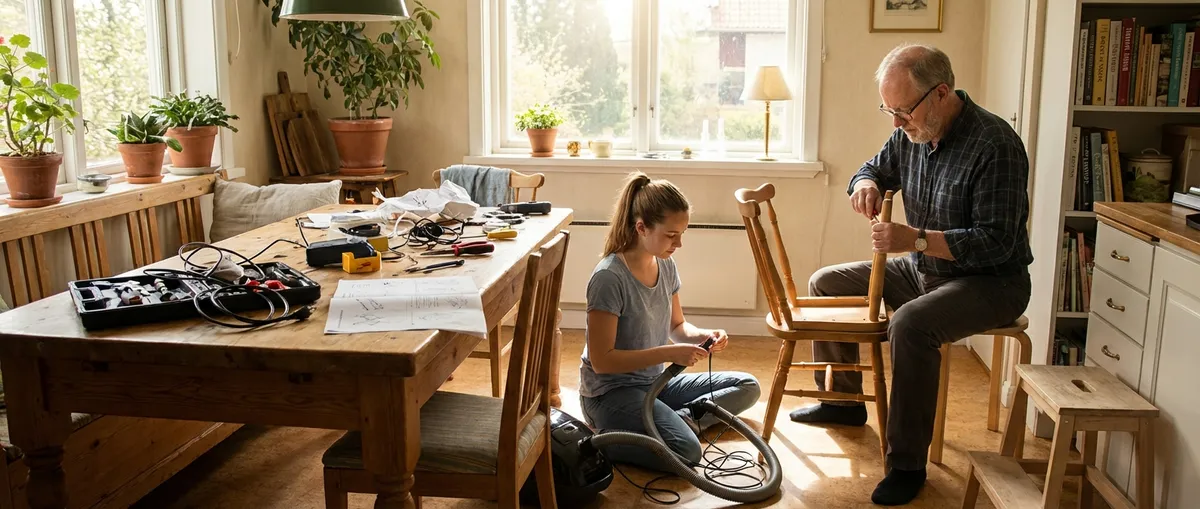
When something breaks at home, most people jump straight to “I need a pro.” Often you don’t. With a few basic tools and a calm, step‑by‑step approach, you can solve a lot of everyday issues yourself—safely and quickly. This guide walks you through five common problems, what usually causes them, and exactly how to fix them without making things worse.
---
Fix 1: Door That Won’t Latch or Keeps Popping Open
A door that won’t stay closed is usually a small alignment issue, not a big carpentry problem.
What You’ll Need
- Phillips screwdriver
- Flathead screwdriver (optional)
- Pencil or masking tape
- Small wood shims or thin cardboard (if needed)
Step‑By‑Step
**Check the obvious first**
Close the door slowly and watch how the latch meets the strike plate (the metal piece on the frame). - If the latch hits *above* the hole, the door is sagging or the strike is too low. - If it hits *below*, the strike is too high. - If it doesn’t reach deep enough, the plate may be misaligned or the door warped.
**Tighten hinge screws**
Open the door and tighten all hinge screws on both the door and frame. Use a firm, steady pressure. - Loose top hinge: door sags; latch hits low. - Loose bottom hinge: door lifts; latch hits high.
**Test again**
Close the door. If it latches now, you’re done. If not, note whether it’s still too high, low, or shallow.
**Adjust the strike plate position**
If the latch is just a bit off: - Slightly loosen the strike plate screws. - Push the plate up or down as needed. - Retighten and test. If you need more movement, you may have to slightly enlarge the hole in the frame using a flathead screwdriver as a small chisel.
**Deepen the latch pocket (if latch doesn’t go in far enough)**
If the latch touches the back of the strike plate before it fully extends: - Remove the strike plate. - Scrape or chisel out a thin layer of wood behind it. - Reinstall the plate and test again.
**Use hinge shims for sagging doors**
If the latch is still hitting high or low: - Loosen the top hinge screws slightly. - Insert a thin shim (cardboard or a dedicated hinge shim) behind the hinge, closest to the frame edge. - Retighten and test. Adjust until the latch lines up cleanly.
---
Fix 2: Dripping Faucet (Compression or Washer‑Type)
A dripping faucet is often just a worn washer or O‑ring—cheap and fixable in under an hour.
What You’ll Need
- Adjustable wrench or basin wrench
- Phillips and flathead screwdrivers
- Replacement washers and/or O‑rings (match the old ones)
- Plumber’s grease (optional but helpful)
- Rag or towel
Step‑By‑Step
**Shut off the water**
Look under the sink for two valves (hot and cold). Turn both clockwise until snug. Open the faucet to release pressure and confirm the water’s off.
**Block the drain**
Use the sink stopper or a rag so you don’t lose screws or small parts down the drain.
**Remove the handle**
- Pry off any decorative cap (hot/cold indicator) with a flathead screwdriver. - Remove the screw underneath and pull off the handle. - If it’s stuck, gently wiggle rather than force it.
**Access the faucet stem or cartridge**
Use your wrench to loosen the packing nut or retaining nut. - Carefully pull out the stem (for compression faucets) or the cartridge (for some older designs).
**Inspect and replace the washer or O‑ring**
- For compression faucets: the rubber washer is usually at the bottom of the stem. - For some designs: O‑rings sit around the body of the stem. Remove the old parts, take them to a hardware store, and match size and type exactly.
**Reassemble with new parts**
- Lightly coat O‑rings and washers with plumber’s grease. - Reinstall the stem or cartridge. - Tighten the packing nut snugly (don’t over‑torque). - Reattach the handle and decorative cap.
**Turn water back on and test**
Slowly open the shut‑off valves under the sink. Turn the faucet on and off a few times, check for drips at the spout and around the base. Tighten gently if needed.
---
Fix 3: Slow or Clogged Bathroom Sink
Most slow drains are caused by hair and soap scum just beneath the stopper—not a deep pipe problem.
What You’ll Need
- Bucket or small container
- Old toothbrush
- Wire coat hanger or plastic drain cleaning tool
- Rubber gloves
- Paper towels or cleaning rag
Step‑By‑Step
**Try hot water first**
- Run very hot tap water for 30–60 seconds. - If it’s just mildly slow, this might help. If nothing changes, move on.
**Remove and clean the stopper**
- Under the sink, find the horizontal rod going into the drain pipe—this controls the stopper. - Unscrew the retaining nut that holds the rod in place. - Pull the rod out slightly and lift the stopper out from the sink. - Clean hair and buildup from the stopper with an old toothbrush.
**Clear the drain opening**
- Use a plastic drain cleaning tool or a straightened coat hanger (with a small hook on the end). - Gently insert into the drain, twist, and pull out hair and debris. - Repeat until you’re mostly pulling out clean.
**Flush with hot water**
- Put the stopper temporarily back in place (just drop it in loosely). - Run very hot water for 1–2 minutes to rinse remaining gunk.
**Reassemble the stopper mechanism**
- Remove the stopper from the top again. - Insert the rod back into the drain pipe and into the hole at the bottom of the stopper. - Hold the stopper down while tightening the retaining nut. - Test the lift rod (the knob behind the faucet) to make sure the stopper goes up and down smoothly.
**Final test**
Run water for 30–60 seconds. If it drains quickly and consistently, you’re done. If it’s still slow, consider a small amount of enzyme‑based drain cleaner (follow label instructions) rather than harsh chemicals.
---
Fix 4: Wobbly Chair or Table (Loose Joints)
That shaky chair usually needs tightening and sometimes a little glue—not a full replacement.
What You’ll Need
- Screwdriver set
- Hex keys/Allen wrenches (for flat‑pack furniture)
- Wood glue (for dowels and non‑metal joints)
- Clamps or heavy books/weights
- Damp cloth
Step‑By‑Step
**Identify the loose joints**
- Gently rock the chair or table. - Watch where movement is happening—screws, corner brackets, dowel joints, or legs.
**Tighten all fasteners first**
- Use the correct screwdriver or hex key. - Tighten screws and bolts snugly, but don’t strip them. - Often, simply tightening everything evenly solves the wobble.
**Inspect wood joints**
- If you see gaps where legs meet the seat or table aprons, those joints may be loose. - Try wiggling the individual leg. If it moves independently, you’ll likely need glue.
**Disassemble the loose joint (if possible)**
- Remove screws or bolts holding that joint. - Gently pull apart the joint just enough to expose the dowel or tenon. - Clean out old glue with a small brush or cloth.
**Apply wood glue and reassemble**
- Put a small amount of wood glue on the dowel/tenon and into the joint. - Push pieces together firmly, wiping away excess glue with a damp cloth. - Reinstall screws/bolts if the design uses them.
**Clamp and cure**
- Use clamps to hold the joint firmly while the glue dries. - If you don’t have clamps, stack heavy books or weights carefully to keep the joint under pressure. - Let the glue cure according to the label (usually 30 minutes to 24 hours) before using the furniture.
**Final stability check**
Once cured, set the chair/table on a flat surface and test for wobble. If one leg is slightly short, you can add a felt pad to that leg to stabilize it.
---
Fix 5: Phone That Won’t Charge Reliably
Before blaming the battery or buying a new phone, rule out the easy hardware issues.
What You’ll Need
- A different charging cable and wall adapter
- Toothpick or soft plastic tool (no metal)
- Compressed air can (optional)
- Isopropyl alcohol (70% or higher) and cotton swab (for cables only, not inside the port)
Step‑By‑Step
**Test with known‑good charger and outlet**
- Plug a different device into the same outlet and adapter. - Try a different wall outlet. - Try a different cable and adapter on your phone. If your phone charges fine with a different cable/adapter, you’ve found the problem.
**Inspect the charging port**
- Power off your phone. - Shine a flashlight into the port. - Look for lint, dust, or bent pins.
**Safely remove lint and debris**
- Use a wooden toothpick or soft plastic tool. - Gently scrape along the bottom and sides of the port to lift out lint. - Never use metal tools; they can damage pins or cause a short. - Use compressed air in short bursts to blow out loosened debris.
**Check the cable ends**
- Inspect both ends of the cable for bent connectors, frayed insulation, or discoloration. - Wipe the metal contacts gently with a slightly damp (not dripping) isopropyl alcohol cotton swab. Let dry completely.
**Test charging again**
- Power the phone back on. - Plug it in and gently move the connector—there should be a solid connection without cutting out. - If the cable feels loose in the port with every cable you try, the internal port may be damaged and require professional repair.
**Reduce future charging stress**
- Avoid using your phone while it’s charging if it forces the cable to bend sharply. - Don’t yank the cable out; grip the plug, not the wire. - Keep the phone out of very hot or humid environments while charging.
---
Conclusion
Most everyday problems around the house and with your gadgets come down to minor wear, loose parts, or simple buildup—not catastrophic failure. With basic tools and a clear plan, you can safely fix a misaligned door, dripping faucet, slow drain, wobbly furniture, or unreliable phone charging in less time than it takes to schedule a repair visit.
Tackle one issue at a time, follow the steps carefully, and stop if something looks beyond your comfort level. The more you practice these small DIY solutions, the more confident and self‑reliant you become—and the less money you spend on avoidable repair calls.
---
Sources
- [U.S. Consumer Product Safety Commission – Home Maintenance Safety](https://www.cpsc.gov/Safety-Education/Safety-Guides/home) - Guidance on doing home tasks safely, including tool use and general repair precautions
- [Family Handyman – How to Fix a Door That Won’t Latch](https://www.familyhandyman.com/project/how-to-fix-a-door-that-wont-latch/) - Detailed walkthrough of diagnosing and correcting misaligned door latches and hinges
- [U.S. Environmental Protection Agency – WaterSense: Fixing Leaks](https://www.epa.gov/watersense/fix-leak-week) - Explains common household leak sources like faucets and why timely repairs matter
- [Mayo Clinic – Cell Phones and Your Health](https://www.mayoclinic.org/healthy-lifestyle/adult-health/expert-answers/cell-phones-and-health/faq-20057798) - Context on safe phone use and environmental factors that can affect device performance
- [The Spruce – How to Unclog a Bathroom Sink](https://www.thespruce.com/how-to-unclog-a-bathroom-sink-2718720) - Practical, step‑by‑step guidance on clearing sink clogs with basic tools
Key Takeaway
The most important thing to remember from this article is that this information can change how you think about DIY Solutions.