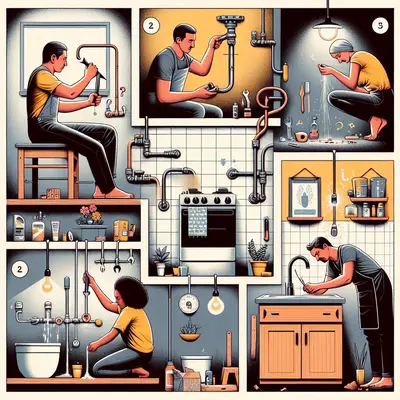
Minor issues in your home can snowball into expensive problems if you ignore them. The good news: you can handle a lot of common repairs yourself with basic tools and a straightforward plan. This guide walks you through five practical household fixes, step by step, so you can stop the damage, restore function, and prevent the same problems from coming back.
---
Stop a Dripping Faucet and Save on Your Water Bill
A dripping faucet wastes water and money, and the constant sound is annoying. Most leaks come from worn-out internal parts, not from anything seriously broken. With a few basic tools, you can usually fix it in under an hour.
What you’ll need
- Adjustable wrench or set of wrenches
- Screwdriver (Phillips and flathead)
- Replacement parts (cartridge, O-rings, or washers depending on faucet type)
- Plumber’s grease
- Rag or towel
Step-by-step
**Turn off the water supply**
Find the shutoff valves under the sink and turn them clockwise to close. Open the faucet to release any remaining water and pressure.
**Plug the drain**
Use the sink stopper or a rag. This keeps small screws or parts from falling down the drain.
**Identify your faucet type**
Common types are: - Single-handle cartridge - Double-handle compression - Ball or ceramic disk faucets Look up your brand/model online if possible for a parts diagram.
**Remove the handle**
Pry off decorative caps if present, then remove the screw underneath. Gently pull off the handle. Keep screws in a small container so you don’t lose them.
**Take out the cartridge or stem**
- For **single-handle**: Remove the retaining nut with a wrench and pull out the cartridge. - For **double-handle compression**: Unscrew the stem assembly.
**Inspect and replace worn parts**
Look for cracked rubber, flattened O-rings, or mineral buildup. Replace: - O-rings - Rubber washers - Cartridges (if damaged or very stiff) Lightly coat new O-rings or washers with plumber’s grease before installing.
**Reassemble in reverse order**
Put everything back together slowly, in the exact order it came out. Don’t overtighten screws or nuts—snug, not brutal.
**Turn water back on and test**
Slowly open the shutoff valves and test the faucet through full hot–cold range. If it still drips, tighten gently or confirm you used the correct replacement part.
---
Quiet a Running Toilet Before It Wastes More Water
A toilet that keeps running after you flush is usually a problem with the fill valve, flapper, or chain. Fixing it early can reduce water waste and lower your bill.
What you’ll need
- Replacement flapper (or fill valve if needed)
- Pliers (optional)
- Towel or sponge
Step-by-step
**Remove the tank lid and observe**
Flush the toilet and watch what happens inside the tank. Identify: - The **flapper** (rubber piece that lifts when you flush) - The **chain** connecting handle lever to flapper - The **fill valve** and **float** that control water level
**Check the chain**
If the chain is too tight, the flapper can’t fully close. If it’s too loose, it might get stuck under the flapper. Adjust so there’s a slight slack and no kinks.
**Inspect the flapper**
If it’s warped, cracked, or doesn’t sit flat, it won’t seal properly. Turn off the water at the shutoff valve behind the toilet, flush to empty the tank, then unhook the flapper from the overflow tube and chain.
**Install a new flapper**
Hook the new flapper’s ears onto the overflow tube and attach the chain to the flush lever with slight slack. Turn water back on, let the tank fill, and test the seal by pressing gently on the flapper. The running should stop.
**Check the water level**
If water is flowing into the overflow tube, the level is too high. Adjust the float: - For a float arm: bend it slightly downward so the valve closes sooner. - For a vertical float: turn the adjustment screw or slide the clip down.
**Replace the fill valve if needed**
If it hisses constantly or doesn’t shut off, replace it: - Turn off water and drain tank. - Disconnect the water supply line from underside of the tank. - Remove the nut holding the fill valve, lift out the old valve. - Install the new valve per manufacturer instructions, reconnect supply, and adjust water level.
**Final test**
Flush several times. The toilet should stop running within a minute and stay quiet.
---
Fix a Door That Won’t Latch or Keeps Swinging Open
A door that won’t stay closed or drags is more than just annoying—it can damage hinges and frames over time. Often, the fix is simple alignment work, not full replacement.
What you’ll need
- Screwdriver
- Wood toothpicks or wooden matchsticks
- Wood glue (optional but helpful)
- Chisel (for more stubborn issues)
- Hammer
Step-by-step
**Check the hinge screws first**
Open the door and tighten all hinge screws on both the door and frame. Loose screws are the most common cause of a sagging door that won’t latch.
**Fix stripped screw holes**
If screws just spin, the wood is likely stripped. Remove the screw, fill the hole with wood glue and a few wood toothpicks or matchsticks (without the match head). Break them off flush, let dry, then reinstall the screw.
**Test the latch alignment**
Close the door slowly and see where the latch hits the strike plate. - If it hits **above** the hole, the door is sagging down. - If it hits **below**, the door may be pushed up or the frame has shifted.
**Adjust the top hinge to fix sagging**
If the latch hits low on the strike plate, slightly tighten the top hinge screw closest to the latch side, and check. In stubborn cases, use a longer screw in the top hinge, angled slightly toward the stud, to pull the door up.
**Shift the strike plate if needed**
If minor hinge adjustments don’t solve it: - Remove the strike plate screws. - Chisel the mortise (the recessed area) slightly higher or lower as needed. - Reposition the plate, pre-drill new screw holes if required, and reinstall.
**Fix a door that swings by itself**
If the door won’t stay open or closed, hinge alignment is slightly off. A quick trick: - Remove the hinge pin from the middle hinge. - Lay it on a hard surface and give it a very slight bend with a hammer. - Reinstall. The increased friction helps keep the door in place.
**Check for frame warping**
If nothing works and you see visible warping or gaps, you may have a structural issue. At that point, consider a professional assessment, especially if there are cracks in nearby walls.
---
Clear a Slow Sink Drain Without Harsh Chemicals
Slow-draining sinks are usually caused by hair, soap scum, and buildup—not a serious plumbing failure. You can often clear them without using aggressive chemical cleaners that can damage pipes over time.
What you’ll need
- Rubber gloves
- Bucket
- Plunger (small sink type)
- Plastic drain snake or zip tool
- Adjustable wrench (for P-trap access)
- Baking soda and vinegar (optional)
Step-by-step
**Remove the stopper or drain cover**
If your sink has a pop-up stopper, lift it out. For bathroom sinks with a lever-operated stopper, you may need to unplug the pivot rod under the sink to release the stopper.
**Physically remove debris first**
Use a plastic drain snake or even a bent wire hanger (with a small hook) to pull up hair and gunk from just below the drain opening. This alone often solves the problem.
**Try plunging the sink**
- Block any overflow holes with a wet cloth. - Fill the sink with enough water to cover the plunger cup. - Plunge up and down firmly for 20–30 seconds, maintaining a seal. - Lift plunger and see if water drains faster.
**Clean the P-trap if it’s still slow**
- Place a bucket under the P-trap (the curved pipe under the sink). - Unscrew the slip nuts holding it in place (hand-tight or with a wrench). - Remove the trap and clean out any debris. - Reassemble, making sure washers are seated correctly and nuts are snug.
**Use a gentle baking soda/vinegar flush (optional)**
With the drain reassembled, pour about 1/2 cup baking soda into the drain, followed by 1/2 to 1 cup vinegar. Let it fizz for 10–15 minutes, then flush with hot tap water.
**Check for recurring issues**
If the drain clogs repeatedly: - Avoid rinsing coffee grounds, grease, or large food scraps. - Use a hair catcher in bathroom sinks and showers. - Consider having a plumber inspect further for deeper line issues.
---
Patch a Small Hole in Drywall for a Clean, Solid Wall
Nail pops, doorknob dings, and small accidental holes don’t require a full wall replacement. With basic patching, you can restore a smooth surface that’s ready for paint.
What you’ll need
- Premixed joint compound (or lightweight spackle for very small holes)
- Putty knife (2"–4" wide)
- Sanding sponge or fine-grit sandpaper (120–220 grit)
- Self-adhesive mesh patch (for larger holes, roughly 1–6 inches)
- Primer and touch-up paint
Step-by-step
**Assess the size of the damage**
- **Pinholes/nail holes**: smaller than a pea. - **Small holes**: up to about a quarter size. - **Medium holes**: up to about a few inches—use a mesh patch.
**Prep the area**
Lightly scrape away loose paint or crumbling drywall around the hole. Wipe with a dry cloth to remove dust.
**Fill small holes (nail or screw holes)**
- Press a small amount of spackle into the hole with a putty knife. - Scrape off excess so the patch is flush with the wall. - Let it dry as directed, then lightly sand smooth.
**Use a mesh patch for larger holes**
- Place a self-adhesive mesh patch centered over the hole. - Apply a thin layer of joint compound over the patch, feathering it outward beyond the edges to blend with the wall.
**Apply additional coats as needed**
Joint compound shrinks as it dries: - Let the first coat dry completely. - Sand lightly, then apply a second, thinner coat, feathering out a bit farther. - For very visible walls, a third skim coat can help the patch disappear.
**Sand and inspect**
Sand in a circular motion until smooth and level with surrounding wall. Run your hand over it—if you feel ridges, sand a bit more.
**Prime before painting**
Unprimed patches often flash through the finish paint. Apply a primer to the repaired area, let dry, then paint to match your wall. For best blending, paint corner-to-corner on that wall rather than spotting just the patch.
---
Conclusion
You don’t need a workshop full of tools or a contractor’s license to tackle common household repairs. By focusing on the root cause—worn parts, misalignment, or simple buildup—you can stop wasted water, noisy toilets, sticking doors, slow drains, and ugly wall damage before they become expensive jobs. Start with one repair, follow the steps carefully, and build your confidence. Each fix you complete makes your home more efficient, more comfortable, and less reliant on emergency calls to a pro.
---
Sources
- [U.S. Environmental Protection Agency – Fixing Leaks at Home](https://www.epa.gov/watersense/fix-leak-week) - Details on how leaking toilets and faucets waste water and basic guidance on repairs
- [Family Handyman – How to Fix a Leaky Faucet](https://www.familyhandyman.com/project/how-to-repair-a-compression-faucet/) - Step-by-step faucet repair methods and faucet type explanations
- [The Spruce – How to Fix a Running Toilet](https://www.thespruce.com/fix-running-toilet-2718718) - Clear walkthrough of diagnosing and repairing common toilet tank issues
- [Home Depot – How to Clear a Clogged Sink](https://www.homedepot.com/c/ah/how-to-unclog-a-sink/9ba683603be9fa5395fab90ed1f4944) - Visual and written guide to clearing sink drains with different methods
- [Lowe’s – How to Patch and Repair Drywall](https://www.lowes.com/n/how-to/patch-and-repair-drywall) - Instructions and illustrations for repairing various sizes of drywall damage
Key Takeaway
The most important thing to remember from this article is that this information can change how you think about Household Repairs.