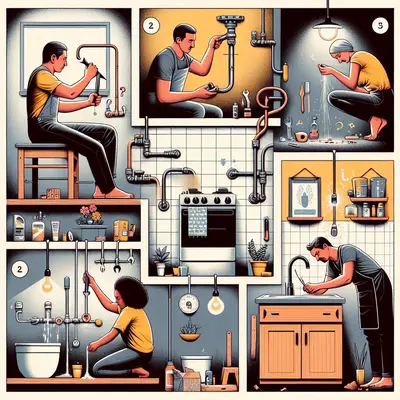
When something breaks at home, you don’t always need a toolbox the size of a suitcase or an expensive service call. With a few basic tools and a clear plan, you can solve a lot of small but annoying problems on your own. This guide walks you through five practical repairs that most people can handle safely in under an hour, often with items you already own.
---
Stop a Dripping Faucet
A dripping faucet wastes water and slowly raises your bill. The good news: many leaks come from worn internal parts you can swap out without calling a plumber.
Step-by-step
**Turn off the water supply**
Look under the sink for two shutoff valves (hot and cold). Turn both clockwise until they stop. Open the faucet to release any remaining water.
**Plug the drain**
Use a sink plug or a rag. Small screws and parts can easily disappear down the drain.
**Remove the handle**
- Pop off any decorative cap with a flat screwdriver. - Unscrew the handle screw with a screwdriver or Allen key. - Lift the handle off to expose the cartridge or stem.
**Identify your faucet type**
Most modern faucets use a **cartridge**; older ones often use **compression** (with separate hot and cold knobs). Take a clear photo for reference.
**Pull and inspect the cartridge or stem**
- Use pliers or a wrench to gently loosen and pull it out. - Look for cracked rubber seals, O-rings, or mineral buildup.
**Replace worn parts**
- Take the old cartridge/stem and O-rings to a hardware store and match them. - Install the new parts in the same orientation as the old ones. Lightly coat rubber O-rings with plumber’s grease if available.
**Reassemble and test**
- Reinstall the handle and tighten the screw. - Turn the shutoff valves back on slowly. - Run the faucet and then turn it off. Check for leaks around the base and spout.
When to call a pro:
If the shutoff valves won’t turn, the faucet body is cracked, or you can’t remove a corroded part without risking damage.
---
Quiet a Running Toilet
A toilet that runs randomly or won’t stop filling is usually wasting water through the tank. Most fixes involve simple adjustments or replacing inexpensive parts in the tank.
Step-by-step
**Remove the tank lid and observe**
Flush once and watch what happens. You’re mainly looking at the **fill valve**, **float**, and **flapper**.
**Check the flapper**
- The flapper is the rubber piece at the bottom of the tank. - If it’s warped, slimy, deteriorated, or doesn’t seal properly, water keeps leaking into the bowl, making the toilet run.
**Test the flapper seal**
- Push down gently on the flapper with your hand (clean water in the tank). - If the running sound stops, the flapper is likely the problem.
**Replace the flapper (simple, cheap fix)**
- Turn off the water to the toilet (valve on the wall behind it). - Flush once to empty most of the water from the tank. - Unhook the flapper from the overflow tube and chain. - Take it to a store to match size and style. - Install the new flapper and connect the chain so there’s a little slack but not too much.
**Adjust the float level**
- If water rises too high and spills into the overflow tube, the fill level is set too high. - For float-cup designs: turn the adjustment screw or pinch clip to lower the float. - For older ball-float arms: gently bend the metal arm down a bit.
**Turn water back on and test**
- Let the tank fill and mark the water level with a pencil. - Wait 10–15 minutes. If the level drops, there’s still a slow leak or an issue with the flush valve.
When to call a pro:
If you see cracks in the tank, water on the floor around the base, or the shutoff valve is seized.
---
Fix a Door That Won’t Latch or Won’t Stay Closed
Doors that won’t latch, rub, or pop open on their own are usually victims of minor misalignment, not structural issues.
Step-by-step
**Diagnose the problem**
- Close the door slowly and watch where the latch meets the strike plate (the metal piece on the frame). - If the latch hits **above or below** the opening, the door has shifted. - If it won’t go into the strike plate easily, the plate is misaligned or recessed too much.
**Tighten hinge screws**
- Use a screwdriver to snug all hinge screws on the door and the jamb. - Loose screws can cause sagging. - If a screw just spins, replace it with a longer one (2.5–3 inches) to bite into the framing.
**Adjust the strike plate position (minor shift)**
- If the misalignment is small, you can file the opening slightly with a metal file where the latch hits. - Test frequently so you don’t over-file.
**Reposition the strike plate (bigger shift)**
- Remove the strike plate screws. - Chisel the mortise (recess) slightly higher or lower as needed, or fill the old screw holes with toothpicks and wood glue. - Move the plate up or down a few millimeters and reattach using longer screws if necessary.
**Fix doors that swing open by themselves**
- Remove the top hinge pin. - Slightly bend it by tapping it in the middle with a hammer on a hard surface. - Reinstall. The added friction often keeps the door in place.
**Check the result**
Open and close the door multiple times, trying the latch gently and firmly. Make small further adjustments rather than big one-time changes.
When to call a pro:
If the frame is cracked, the wall is visibly shifting, or the door is severely warped.
---
Restore Power to a Dead Outlet Safely
If one outlet stops working, it’s often tied to a tripped GFCI, a tripped breaker, or a loose connection in a chain of outlets. You can safely diagnose the simple causes without touching live wires.
Safety first
- If you ever feel unsure, stop and call a licensed electrician.
- Never work on outlets with the breaker on if you’re removing covers or touching wiring.
Step-by-step
**Test what’s actually dead**
- Plug a known working lamp or phone charger into the dead outlet. - Try other outlets in the same room and adjacent rooms. - Note where power is out; dead outlets are often on the same circuit.
**Check GFCI outlets**
- Look for outlets with “TEST” and “RESET” buttons in kitchens, bathrooms, garages, and basements. - Press the RESET button firmly. - Retest the dead outlet. Sometimes a single GFCI feeds several standard outlets down the line.
**Inspect the breaker panel**
- Locate your electrical panel. - Look for breakers that sit between ON and OFF or are clearly marked as tripped. - Flip any tripped breaker fully to OFF, then back to ON. - If it immediately trips again, stop and call an electrician—this can indicate a short or overloaded circuit.
**Examine the outlet (if comfortable and safe)**
- Turn the breaker for that circuit OFF. - Use a non-contact voltage tester to confirm there’s no power. - Remove the cover plate and gently pull the outlet forward without touching bare metal. - Look for loose wires, burned or melted plastic, or discoloration.
**Tighten connections or replace a damaged outlet**
- If wires are loose on screw terminals, tighten them gently. - If the outlet is cracked or burned, replace the entire receptacle with an identical rating (15A vs 20A). - Carefully reconnect wires to the same terminals they were originally on (take a photo first).
**Restore power and retest**
- Push the outlet back into the box carefully and reinstall the cover plate. - Turn the breaker back ON and test with your lamp/charger.
When to call a pro:
If breakers keep tripping, you see heat damage, smell burning, or feel unsure about any wiring steps.
---
Seal a Drafty Window to Cut Energy Loss
Drafts around windows make rooms uncomfortable and quietly increase your heating or cooling bill. You can usually fix them with basic weatherstripping and/or caulk, without replacing the window.
Step-by-step
**Find the draft source**
- On a windy day, hold your hand around the window frame and sash edges. - Use a lit incense stick or a small strip of tissue; watch where the smoke or tissue moves. - Note if air is coming from the **frame edges**, **sash joints**, or **glass-to-frame seal**.
**Clean the area**
- Wipe the frame and sash with a mild cleaner and dry thoroughly. - Remove any loose old caulk or paint flakes with a putty knife.
**Use weatherstripping for movable parts**
- For gaps where the sash meets the frame, apply adhesive-backed foam or rubber weatherstripping. - Measure the gap and choose an appropriate thickness so the window can still close and lock. - Cut to length with scissors, then stick it along the clean, dry surfaces.
**Caulk stationary gaps**
- Use exterior-grade caulk for outside gaps; interior-grade latex or silicone for inside. - Run a steady bead along gaps between the window frame and the wall or trim. - Smooth with a damp finger or finishing tool. Wipe away excess before it skins over.
**Consider temporary solutions for very old windows**
- Apply removable plastic window insulation film in winter. - Use rope caulk or non-permanent sealant around frames you rarely open.
**Recheck for drafts**
- After the caulk and weatherstripping cure (check package instructions), repeat the smoke/tissue test. - Adjust or add more weatherstripping if you still feel air movement.
When to call a pro:
If the window frame is rotten, glass is cracked, or you see moisture damage in the wall around the window.
---
Conclusion
Most everyday home problems—drips, drafts, sticky doors, running toilets, and “dead” outlets—come down to worn parts, loose screws, or small misalignments. With basic tools, a bit of patience, and a clear step-by-step approach, you can tackle many of these repairs yourself, save money, and avoid waiting on a service call.
Start with the simplest fix that matches your comfort level: maybe it’s replacing a toilet flapper or sealing a drafty window. As you succeed with smaller jobs, your confidence and skills grow—making the next repair less intimidating and your home more reliable day to day.
---
Sources
- [U.S. Environmental Protection Agency – Fix a Leak](https://www.epa.gov/watersense/fix-leak-week) – Explains the impact of household leaks and common sources like faucets and toilets
- [Energy.gov – Air Sealing Your Home](https://www.energy.gov/energysaver/air-sealing-your-home) – Government guidance on detecting and sealing drafts around windows and doors
- [Lowe’s – How to Fix a Leaky Faucet](https://www.lowes.com/n/how-to/fix-a-leaky-faucet) – Visual, step-by-step instructions for common faucet types
- [The Family Handyman – How to Fix a Running Toilet](https://www.familyhandyman.com/project/how-to-fix-a-running-toilet) – Detailed walkthrough of diagnosing and repairing running toilets
- [U.S. Consumer Product Safety Commission – Electrical Receptacles Safety](https://www.cpsc.gov/s3fs-public/513.pdf) – Safety considerations and basics around household electrical outlets and receptacles
Key Takeaway
The most important thing to remember from this article is that this information can change how you think about Household Repairs.