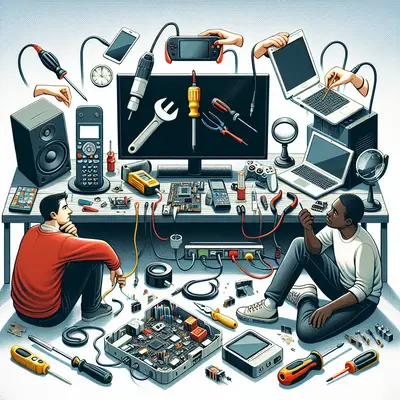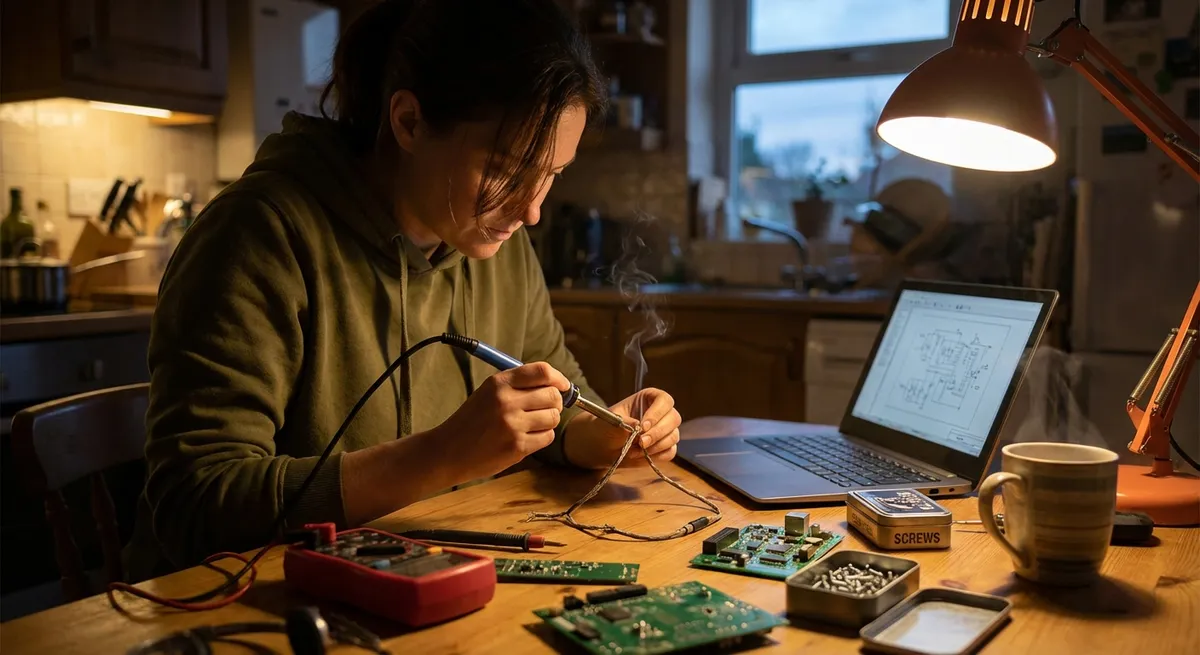
Electronics usually fail at the worst possible moment—right before a meeting, when the game is on, or as a deadline hits. Calling a tech or replacing gear isn’t always necessary, though. With a systematic approach and a few simple checks, you can solve many issues yourself safely and quickly.
This guide walks through five common everyday electronics problems and shows you exactly what to do, step by step. No guesswork, no fancy tools—just practical troubleshooting you can actually follow.
---
1. When Your TV Shows “No Signal”
A TV that turns on but only shows “No Signal” usually has a connection or input issue, not a broken screen. Work through these steps in order—most fixes happen in the first few minutes.
Step‑by‑step fix
**Confirm the source device is actually powered on**
- Look for lights on your cable box, streaming stick, or console. - Press the power button on the device itself, not just the remote. - If there are no lights, unplug it for 30 seconds, then plug it back in.
**Check the TV input setting**
- Press the *Input* or *Source* button on the TV remote (or TV side buttons). - Cycle through HDMI 1, HDMI 2, AV, etc., and pause 3–5 seconds on each. - Match the input to where your device is plugged in (e.g., HDMI 1).
**Inspect and reseat HDMI or AV cables**
- Turn off the TV and the connected device. - Unplug the HDMI cable from both ends; check for bent or damaged pins. - Plug it back in firmly until you feel it “click” into place. - If you have another HDMI cable at home, swap it to rule out a bad cable.
**Test with another device or another HDMI port**
- Plug in a different device (like a laptop or game console) to the same port. - If the new device works, the problem is likely with the original device. - If none of your devices work on that port, move to another HDMI port.
**Power‑cycle everything in the chain**
- Turn off the TV and the source device. - Unplug both from power for 60 seconds. - Plug in and power on the source device first, wait 30 seconds, then the TV.
**Reset TV input settings (if available)**
- In the TV settings menu, look for “Input”, “External Device Manager”, or similar. - Turn off any unusual features like “HDMI‑CEC” or custom input renaming temporarily. - Save and retry your usual setup.
If you still see “No Signal” after all this, the HDMI port or the source device may be faulty. At that point, using a different input or contacting the device manufacturer is your best next move.
---
2. Laptop Won’t Charge or Turn On
A dead laptop doesn’t always mean a dead battery or motherboard. Often the issue is power delivery, a loose connection, or a simple static lockup.
Step‑by‑step fix
**Check the outlet and power strip first**
- Plug a lamp or phone charger into the same outlet. - If it doesn’t work, try a different outlet or reset the power strip.
**Inspect the charger and cable**
- Look for frayed insulation, kinks, or burn marks. - Ensure any removable power brick and cable segments are fully seated. - If you have a compatible spare charger, test with that.
**Remove external accessories**
- Disconnect USB drives, printers, HDMI cables, and SD cards. - A problematic accessory can prevent proper startup or charging.
**Perform a “hard reset” (for most Windows laptops)**
- Disconnect the charger. - If the battery is removable: - Remove the battery. - Hold the power button for 15–20 seconds to discharge residual power. - Reinstall the battery and reconnect the charger. - If the battery is internal: - Just disconnect the charger and hold the power button for 15–20 seconds, then reconnect the charger.
**Look for charging indicators**
- Check for LEDs near the charging port or on the side. - If the light blinks in a pattern, note it; many manufacturers document what those codes mean in their support pages.
**Try a “screen check” to rule out display issues**
- Turn on the laptop and listen for fan noise or drive activity. - Shine a flashlight at an angle across the screen—if you see a faint image, the laptop is on but the backlight is off. - Connect the laptop to an external monitor or TV via HDMI. If you see a display there, the main screen may be the only problem.
**Check for a “Reset” or “Pin‑hole” button (common on some brands)**
- Look along the sides or bottom for a tiny hole labeled *Reset* or with a battery icon. - Use a paperclip to press and hold it for 10–15 seconds, then try powering on again.
If the laptop only runs while plugged in, the battery may be worn out. If there is no response at all (no lights, sounds, or charging indicator) with a known‑good charger, professional diagnosis is recommended.
---
3. Bluetooth Headphones Won’t Pair or Keep Disconnecting
Bluetooth issues are often about interference, old pairing data, or simple confusion between devices. A clear reset usually solves the problem.
Step‑by‑step fix
**Turn Bluetooth off and back on at the source device**
- On your phone, tablet, or laptop, toggle Bluetooth off. Wait 10 seconds. Turn it back on. - This refreshes active connections and clears minor glitches.
**Delete old pairing records**
- In Bluetooth settings, find your headphones in the device list. - Tap *Forget*, *Remove*, or *Unpair*. - If you’ve paired the headphones with multiple devices (phone, laptop, TV), remove the pairing from all of them.
**Reset the headphones to factory Bluetooth settings**
- Most models use a button combo, such as: - Hold *Power* + *Volume Down* for 10–15 seconds, or - Hold the *Power* button until you hear “Factory reset” or see an LED pattern. - Check the brand’s support page for your exact model’s reset procedure.
**Put the headphones in pairing mode correctly**
- Start with the headphones powered off. - Hold the *Power* or dedicated *Pairing* button until the LED flashes red/blue or you hear “Pairing mode”. - Keep them close (within 1–2 meters) to the device you want to pair.
**Clear interference and signal obstacles**
- Move away from microwaves, cordless phones, or Wi‑Fi routers if possible. - Keep your phone and headphones out of pockets with keys, coins, or thick cases that might block signal. - Avoid standing between a laptop and router while trying to pair.
**Pair with only one device at a time**
- Disable Bluetooth on other nearby devices that have previously paired with these headphones. - Some headphones support multipoint (multiple devices), but many get “confused” and drop connections.
**Check for firmware or OS updates**
- Update your phone/laptop’s operating system. - Some brands offer firmware updates for headphones via their companion app. Install if available.
If the headphones still won’t appear in any Bluetooth device list after a reset and multiple tests, the Bluetooth radio inside might be faulty. At that point, repair or replacement is your realistic option.
---
4. Smartphone Overheating and Draining Battery Fast
Overheating and rapid battery drain usually come from demanding apps, poor ventilation, or power settings—not an instant battery failure. You can often stabilize things in a few minutes.
Step‑by‑step fix
**Remove the case and let the phone breathe**
- Take off heavy or insulated cases, especially rubber or waterproof ones. - Place the phone on a hard, flat surface out of direct sunlight. - Avoid putting it in the fridge or freezer—rapid temperature changes can cause damage.
**Close high‑demand apps**
- On iOS, swipe up from the bottom and close gaming, streaming, or navigation apps. - On Android, use the “Recent Apps” button and swipe away intensive apps. - Pay attention to apps that play video, run GPS, or use camera features.
**Disable unnecessary background activity**
- Turn off Bluetooth, GPS/location, and Wi‑Fi when not needed. - Switch to *Battery Saver* or *Low Power Mode* in settings. - Reduce screen brightness to a comfortable lower level.
**Check battery usage stats**
- In Settings → Battery (wording varies by brand), see which apps consume the most power. - If a single app is using far more power than expected, force stop it or uninstall and reinstall. - Disable “background app refresh” or “allow background activity” for non‑essential apps.
**Restart the phone**
- A full restart clears temporary glitches and stuck processes. - Power off the phone fully, wait 30 seconds, then power back on.
**Update the operating system and apps**
- Outdated software can cause battery and heat issues. - Update the OS through your device settings and update apps via the App Store/Play Store.
**Check charging habits and environment**
- Avoid using heavy apps (games, video calls, 4K recording) while charging. - Do not leave the phone charging under pillows, on couches, or in cars in the sun. - Use chargers and cables that meet your phone’s specifications (preferably from reputable or original manufacturers).
If the phone continues to overheat or shut down even at low usage, or the battery percentage drops dramatically in minutes, the battery may be degraded. In that case, a professional battery replacement is often the most effective long‑term solution.
---
5. Wi‑Fi Is Connected but the Internet Is Slow or Not Working
Seeing “Connected” but still waiting for pages to load is one of the most frustrating everyday issues. The good news: most Wi‑Fi problems are fixable with a clear reset and a few simple checks.
Step‑by‑step fix
**Confirm if the problem is local or widespread**
- Test on another device (phone, tablet, laptop). - If everything is slow, the issue is likely your router or internet provider. - If only one device has trouble, focus your fixes there.
**Restart the modem and router properly**
- Unplug the modem and router from power. - Wait at least 30–60 seconds. - Plug in the modem first; wait until all its lights stabilize. - Plug in the router and wait 1–2 minutes. - Test again on your main device.
**Move closer to the router and reduce obstacles**
- Thick walls, metal shelves, and appliances can kill Wi‑Fi signal. - Move within 1–2 rooms of the router. - Avoid placing the router on the floor or inside cabinets; higher and open is better.
**Forget and reconnect to the Wi‑Fi network**
- On your device, go to Wi‑Fi settings and tap *Forget* on your network. - Restart the device. - Reconnect by entering the Wi‑Fi password again.
**Check for bandwidth hogs and background downloads**
- Pause or stop streaming on TVs, game updates, cloud backup, and large downloads on other devices. - On your computer, check if software updates or file sync (e.g., OneDrive, Google Drive) are running in the background.
- **Change Wi‑Fi band or channel (2.4 GHz vs 5 GHz)**
- If your router offers both 2.4 GHz and 5 GHz networks, try switching to the other.
- 2.4 GHz goes farther but is more crowded; 5 GHz is faster but has shorter range.
- Log into your router’s admin page to see if there’s an option to automatically choose a less congested channel.
**Test your actual internet speed**
- Use a reputable speed test service on a device near the router. - Compare the result to the speed you’re paying for from your provider. - If the speed is consistently far below what you pay for, contact your internet service provider and provide your test results.
If your internal Wi‑Fi works but the modem loses connection often (blinking “Internet” or “Online” light), the issue may be with the line into your home or the provider’s network—something only they can address.
---
Conclusion
Most everyday electronics failures—no TV picture, dead‑looking laptops, flaky Bluetooth, hot phones, or stubborn Wi‑Fi—aren’t instant death sentences for your gear. When you approach them with a clear, step‑by‑step plan, you can rule out simple causes, solve many problems on the spot, and know exactly when it’s time to call in a pro or replace a device.
Use these walkthroughs as your personal checklist the next time something stops working. Start with the fastest, lowest‑risk steps, observe what changes, and move forward methodically. That mindset alone will save you time, stress, and often the cost of a new gadget.
---
Sources
- [Federal Communications Commission (FCC) – Interference and Wi‑Fi Tips](https://www.fcc.gov/consumers/guides/interference-other-electronics-devices) – Explains common causes of wireless interference and practical ways to improve signal quality.
- [Microsoft Support – Troubleshoot Surface Not Turning On or Waking From Sleep](https://support.microsoft.com/en-us/surface/surface-won-t-turn-on-or-wake-from-sleep-3c3071ae-ba3b-718e-67fa-ff3c2735a5f1) – Provides general guidance that also applies to many Windows laptops that won’t power on.
- [Apple Support – If Your iPhone, iPad, or iPod Touch Gets Too Hot or Too Cold](https://support.apple.com/en-us/HT201678) – Details how heat affects smartphones and what to do when a device overheats.
- [Google – Fix Internet Connection Problems on Android](https://support.google.com/android/answer/9075847) – Step‑by‑step instructions for diagnosing Wi‑Fi and data issues on Android devices.
- [Sony – Troubleshooting Bluetooth Pairing Issues](https://www.sony.com/electronics/support/articles/00023057) – Real‑world examples and solutions for common Bluetooth headphone connection problems.
Key Takeaway
The most important thing to remember from this article is that this information can change how you think about Electronics.