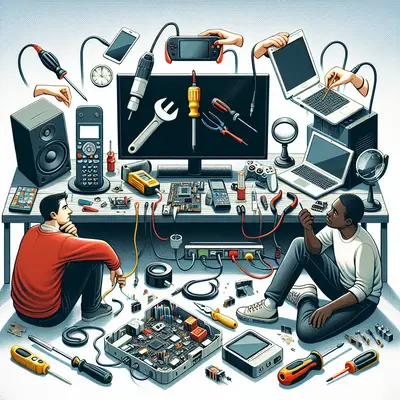
Modern gadgets fail at the worst possible time—but a lot of “broken” electronics aren’t actually broken. They’re dirty, misconfigured, or suffering from a cheap part that’s easy to replace. This guide walks you through five common problems and gives you clear, step‑by‑step fixes you can try before paying for repairs or buying new.
---
1. Laptop That Overheats and Shuts Down
An overheating laptop is usually fighting dust, poor airflow, or too much workload. Left alone, heat can damage components and shorten your laptop’s life.
What You’ll Need
- Small Phillips screwdriver (for models with removable panels)
- Compressed air can (with straw)
- Soft brush or clean, dry paintbrush
- Flat, stable surface
- Optional: laptop cooling pad
Step‑by‑Step Fix
**Shut down and unplug**
Turn the laptop completely off. Disconnect the charger and any accessories (USB drives, HDMI cables, etc.).
**Move to a clean, hard surface**
Avoid beds, couches, or carpets. These block vents and trap heat. A table or desk is best.
**Inspect the vents**
Look at the sides, back, and bottom for air intake and exhaust vents. If they’re clogged with dust, that’s a major heat source.
**Blow out dust from the outside**
- Hold the compressed air can upright. - Short bursts only; don’t spin the fan like a windmill—this can damage it. - Blow air into the vents from different angles. - Use the brush to gently loosen visible dust, then blow again.
**(If your model allows) Open the bottom panel**
- Remove screws from the bottom cover. Keep them in a small container. - Gently lift the panel off. - You should see the fan, heat pipes, and maybe a dust filter. - Use compressed air and the brush to carefully remove dust from the fan and heat sink fins. Avoid touching the circuitry.
**Reassemble and restart**
Put the panel back, tighten the screws, and boot the laptop. Listen for the fan—if it runs smoother and quieter, the cleaning helped.
**Reduce software load**
- On Windows: open Task Manager (Ctrl+Shift+Esc), go to “Processes,” and close programs hogging CPU. - On macOS: open Activity Monitor (Applications > Utilities) and quit high‑usage apps. - Disable heavy background apps (e.g., multiple browser tabs, game launchers, unnecessary startup apps).
**Improve airflow during use**
- Use the laptop on a hard, flat surface. - Tilt the back slightly with a stand or cooling pad to improve intake airflow. - Avoid blocking side or rear vents.
When to stop and call a pro: If the laptop still overheats quickly, you may need fresh thermal paste or a new fan—both better handled by a repair shop unless you’re comfortable with deep disassembly.
---
2. Phone That Won’t Charge Reliably
If you have to “wiggle” the cable or hold your phone at an angle to charge, the problem is often dirt, lint, or a worn cable—not a dead phone.
What You’ll Need
- Good‑quality charging cable (preferably OEM or certified)
- Known‑good charger or USB power source
- Wooden or plastic toothpick
- Small flashlight
Step‑by‑Step Fix
**Test with a different cable and charger**
- Swap in a cable you know works with another device. - Try a different wall adapter or USB port. - If the phone charges normally, your original cable or adapter is bad—replace it.
**Inspect the charging port**
- Power off the phone. - Use the flashlight to look inside the port. - Check for lint, dust, or bent pins.
**Gently clear lint and debris**
- Use a *dry*, wooden or plastic toothpick—never metal. - Very gently scrape along the bottom of the port to lift lint. - Do not force it and do not touch or bend the metal contacts. - Tap the phone lightly (port facing down) to let debris fall out.
**Clean with air (optional but helpful)**
- Short, gentle bursts of compressed air aimed at the port. - Keep the can upright to avoid moisture.
**Reconnect and test**
- Plug in the cable firmly but gently. - See if the cable sits more securely and charges without moving. - Check if fast‑charge features reappear, if your phone supports them.
**Check settings and software**
- Make sure battery saver or “optimized charging” modes aren’t confusing you (some slow charging intentionally). - Restart the phone—temporary software glitches can cause weird charging behavior.
When to stop and call a pro: If the port feels loose, the plug doesn’t “click” in anymore, or pins look damaged, the charging port may need replacement. That typically requires microsoldering or board‑level work.
---
3. TV With No Picture but Sound Works
Hearing audio but seeing nothing (or a faint picture) is usually a backlight or settings issue—not always a dead TV.
What You’ll Need
- Remote control
- Flashlight
- Access to TV settings menu
Step‑by‑Step Fix
**Check brightness and picture mode**
- Press “Menu” or “Settings” on the remote. - Navigate (even if the screen looks dark) to “Picture” or “Display.” - Raise brightness and backlight settings. - Switch picture mode (e.g., from “Movie” to “Standard”) to reset defaults.
**Look for a faint image**
- In a dark room, shine the flashlight at an angle onto the screen while the TV is on. - If you see a very dim image (menus, movement, etc.), the backlight may be failing, but the panel and electronics are working.
**Check input and cables**
- Press the “Input” or “Source” button to cycle through HDMI, AV, etc. - Make sure your streaming box, game console, or cable box is powered on. - Unplug and firmly reseat HDMI or other cables at both ends. - Try a different HDMI port or a different cable.
**Power cycle the TV**
- Turn the TV off. - Unplug it from the wall for 60 seconds. - Hold the TV’s power button (on the TV itself) for 10–15 seconds to discharge residual power, if accessible. - Plug back in and power on.
**Disable energy‑saving/eco modes**
- Some “Eco” or “Power Saving” modes dim the backlight aggressively. - In the Picture or General settings, turn off energy‑saving options and retest.
**Run built‑in self‑test (if available)**
- Many modern TVs have a self‑diagnostic or picture test in the settings menu. - If the test shows a proper image but your source doesn’t, the issue is likely with your cable box, console, or streaming device.
When to stop and call a pro: If you have sound, a faint image in flashlight tests, and normal inputs, the backlight (LED strips or inverter) is probably failing. Replacing these parts involves opening the TV and handling fragile glass panels—best left to an experienced technician.
---
4. Wi‑Fi Router That Keeps Dropping the Connection
Random disconnects and slow speeds can come from bad placement, overheating, interference, or outdated settings—not always your ISP.
What You’ll Need
- Access to your router’s admin page (username/password)
- A phone or laptop connected to Wi‑Fi or Ethernet
- Basic understanding of your home layout
Step‑by‑Step Fix
**Reboot the basics (modem and router)**
- Unplug the router and modem from power. - Wait at least 30 seconds. - Plug the modem back in first. Wait until all its status lights stabilize. - Then plug in the router and wait for it to fully boot.
**Improve router placement**
- Move the router to a central, elevated, open spot (e.g., on a shelf, not in a cabinet). - Keep it away from thick walls, large metal objects, microwaves, and cordless phone bases. - Avoid setting it on the floor.
**Check for overheating**
- Touch the router—warm is normal, but very hot to the touch is a problem. - Clean dust from vents with compressed air. - Make sure it has good airflow around it; don’t stack devices on top.
**Update firmware**
- Log into the router’s admin page (often at 192.168.0.1 or 192.168.1.1; check the label). - Look for “Firmware Update,” “System,” or “Administration” section. - Apply any pending firmware updates and restart the router if prompted.
**Optimize Wi‑Fi settings**
- If your router supports both 2.4 GHz and 5 GHz, enable both and give them clear names (e.g., “Home‑2G” and “Home‑5G”). - 2.4 GHz: better range, slower; 5 GHz: faster, shorter range. - Set security to WPA2 or WPA3 if available. - On congested networks (apartments), manually choose a less crowded channel if your router allows it.
**Test with a wired connection**
- Connect a laptop directly to the router/modem with an Ethernet cable. - If wired internet is stable while Wi‑Fi drops, the problem is with your Wi‑Fi configuration or router hardware—not your ISP.
**Reduce device overload**
- Too many devices (phones, tablets, TVs, cameras) on older routers can cause drops. - Disconnect devices you don’t use. - If the issue goes away, consider upgrading to a newer router designed for higher device counts.
When to stop and call your ISP or a pro: If wired connections also drop, there may be an issue with your line, modem, or service. Contact your Internet provider and report the symptoms and tests you’ve already done.
---
5. Bluetooth Headphones That Won’t Pair or Keep Cutting Out
Bluetooth issues are often caused by old pairings, interference, or confused settings rather than hardware failure.
What You’ll Need
- Your Bluetooth headphones or earbuds
- The device you’re pairing with (phone, tablet, laptop)
- Access to Bluetooth settings
Step‑by‑Step Fix
**Reset pairings on the device**
- On your phone/tablet: - Open Bluetooth settings. - Find your headphones in the list of paired devices. - Tap and choose “Forget,” “Remove,” or “Unpair.” - Do this on *all* devices that previously used those headphones.
**Put headphones in pairing mode**
- Usually: hold the power or pairing button for several seconds until you see a rapidly blinking LED (often blue or blue/red). - Some earbuds require holding both earpieces or using the case button. - If unsure, check the brand’s support page for exact instructions.
**Re‑pair from scratch**
- Turn Bluetooth off and on again on your phone or laptop. - Select the headphones when they appear in the “Available devices” list. - Confirm any pairing code if asked. - Wait until the status changes to “Connected.”
**Minimize interference**
- Keep the headphones within 1–2 meters during initial pairing. - Move away from microwaves, crowded Wi‑Fi routers, and other Bluetooth devices. - Remove your phone from metal cases or bags while testing.
**Clean the charging contacts (for true wireless earbuds)**
- Power off and remove earbuds from your ears. - Use a dry cotton swab to gently clean the charging contacts on the earbuds and inside the case. - Ensure they’re fully seated and charging—low battery can cause random disconnections.
**Update firmware and OS (if available)**
- Some major headphone brands offer firmware updates through their apps. - Update your phone or laptop’s operating system to the latest stable version; Bluetooth stacks improve over time.
**Test with another device**
- Pair the headphones with a different phone or tablet. - If they work perfectly there, the issue is likely in your original device’s Bluetooth settings or drivers.
When to stop and consider replacement or repair: If the headphones refuse to enter pairing mode, only connect for a second, or constantly disconnect across multiple devices, the internal battery, antenna, or Bluetooth chip may be failing.
---
Conclusion
Most “dead” electronics are just dirty, misconfigured, or struggling with minor wear and tear. By cleaning ports and vents, checking cables and settings, and restarting systems the right way, you can often bring laptops, phones, TVs, routers, and headphones back to life without spending a cent.
Work methodically: one change at a time, test, then move on. If you hit a clear hardware limit—burnt smell, cracked screen, liquid damage, or parts that require soldering—that’s the point to stop and involve a professional. Until then, these practical steps give you a safe, realistic way to keep your everyday electronics working longer and costing you less.
---
Sources
- [Apple Support: If your iPhone or iPad won’t charge](https://support.apple.com/en-us/HT201569) – Official guidance on diagnosing charging issues and safe port cleaning practices
- [Microsoft Support: Surface and Windows device overheating and fan noise](https://support.microsoft.com/en-us/windows/surface-or-windows-device-is-running-warmer-than-expected-or-the-fan-is-running-more-than-expected-35e1aa2a-6920-f8a3-40b9-b8323e44c9e9) – Explains causes of overheating and basic cooling strategies relevant to laptops
- [Federal Communications Commission (FCC): Interference FAQs](https://www.fcc.gov/consumers/guides/interference-faqs) – Background on wireless interference that can affect Wi‑Fi and Bluetooth reliability
- [Samsung Support: TV has no picture](https://www.samsung.com/us/support/troubleshooting/TSG01001011/) – Manufacturer steps for diagnosing TVs with sound but no visible image
- [Federal Trade Commission (FTC): How to buy a router](https://www.consumer.ftc.gov/articles/how-buy-router) – Practical advice on router features and performance that relate to solving Wi‑Fi problems
Key Takeaway
The most important thing to remember from this article is that this information can change how you think about Electronics.