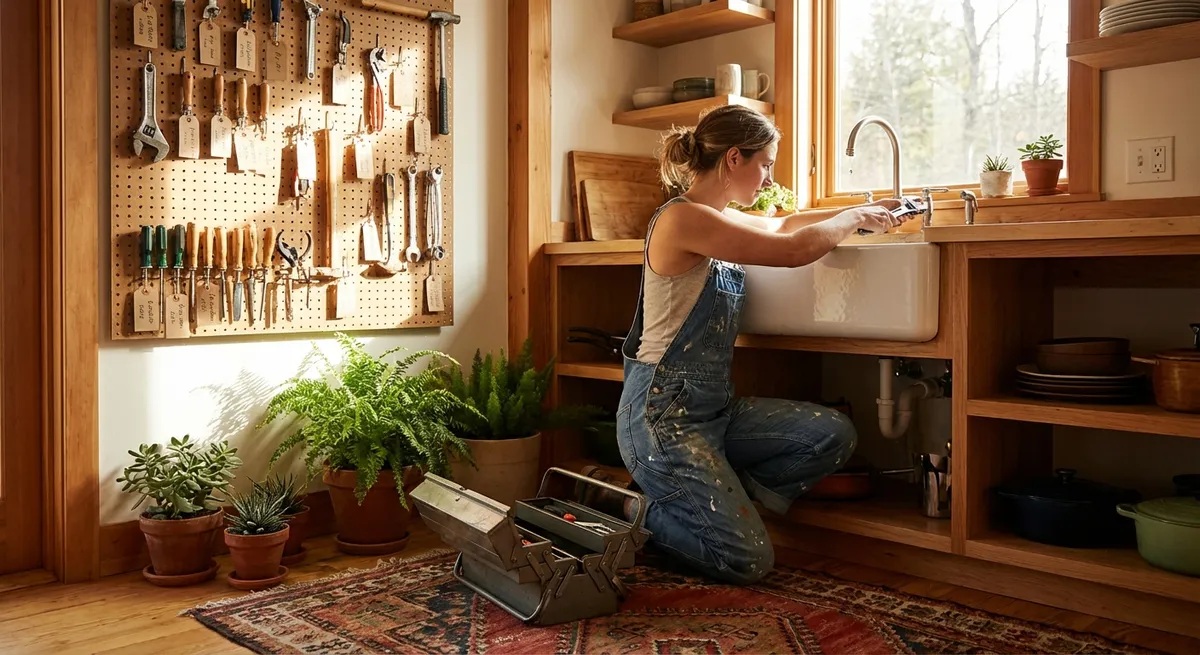
Sometimes you don’t need a new product or a professional visit—you just need a clear, practical plan to fix what’s in front of you. This guide walks through five common everyday problems and shows you exactly how to tackle them with tools and supplies most homes already have. Follow the steps, stay safe, and you’ll turn “I should call someone” into “I already fixed it.”
---
1. Quiet a Squeaky Door Hinge
A squeaky hinge is annoying, but it’s also one of the easiest home problems to solve without special skills.
What you’ll need
- Old towel or paper towels
- Small flathead screwdriver (optional)
- Lubricant: silicone spray, white lithium grease, or petroleum jelly
- Cotton swab or small brush (optional)
Step-by-step
**Stabilize the door**
Open the door halfway so it’s balanced and not pulling strongly in or out. This makes the hinge easier to work on.
**Wipe off visible dust and grime**
Use a towel or paper towel to wipe the hinge. Removing dirt helps the lubricant work better and prevents a sticky mess.
**Apply lubricant to the hinge joints**
- If using spray: - Place a paper towel under the hinge to catch drips. - Spray a small amount right at the hinge pin and moving parts. - If using petroleum jelly/grease: - Use a cotton swab or fingertip to rub a thin layer onto the hinge’s moving joints.
**Work the door back and forth**
Open and close the door 10–15 times. This spreads the lubricant inside the hinge. You should notice the squeak getting quieter or disappearing.
**Wipe away the excess**
Clean off extra lubricant so it doesn’t drip on floors or collect dust.
**If it still squeaks, lift the hinge pin (optional)**
- Use a small flathead screwdriver under the bottom of the hinge pin and gently tap it upward with your hand or a light tool. - Pull the pin out, wipe it clean, add a thin layer of lubricant, and slide it back in. - Open and close the door again to distribute it.
**Check the screws**
If the door still feels rough or misaligned, lightly tighten the hinge screws with a screwdriver. Don’t overtighten—just snug.
---
2. Unclog a Slow Bathroom Sink Without Harsh Chemicals
A slow-draining sink is usually caused by hair, soap scum, and debris just below the drain—often fixable in a few minutes.
What you’ll need
- Rubber gloves
- Small bucket or bowl
- Old toothbrush or small cleaning brush
- Bendable plastic drain snake (or straightened wire hanger with a small hook)
- Baking soda and white vinegar (optional, but helpful)
- Flashlight (optional)
Step-by-step
**Clear the area and protect what’s underneath**
Remove items from under the sink. Place a small bucket or bowl under the drain trap (the curved pipe).
**Remove the sink stopper**
- Many bathroom stoppers are held by a rod under the sink. - Look for a horizontal rod entering the back of the drainpipe. Unscrew the small nut holding it in place. - Gently pull the rod out; the stopper should lift out from the top of the sink.
**Clean the stopper**
- Put on gloves. - Remove hair and debris from the stopper using an old toothbrush or paper towel. - Rinse it with warm water.
**Fish out debris from the drain**
- Shine a flashlight down the drain. - Insert the plastic drain snake or hooked hanger and twist gently while pulling up. - Remove all visible clumps of hair and gunk, repeating until you stop bringing up debris.
**Optional: flush with baking soda and vinegar**
- Pour about ½ cup baking soda down the drain. - Add ½–1 cup vinegar and let it foam for 10–15 minutes. - Flush with hot (not boiling) tap water for 1–2 minutes.
**Reinstall the stopper assembly**
- Insert the stopper from the top. - From underneath, slide the rod back into the same hole in the drain piece so it connects to the stopper. - Tighten the nut, then test the stopper up and down.
**Test the drain**
Run water for 1–2 minutes. If it drains quickly and steadily, you’re done. If still slow, repeat the debris removal step once more.
---
3. Stop a Wobbly Chair or Table
A wobbly chair or table is often caused by loose hardware or uneven legs. You can usually stabilize it in under 20 minutes.
What you’ll need
- Screwdriver (Phillips and/or flathead)
- Allen (hex) keys (often included with flat-pack furniture)
- Wood glue (for loose wooden joints)
- Small wood shims, felt pads, or folded cardboard
- Damp cloth
Step-by-step
**Flip the furniture safely**
Place the chair or table upside down on a soft surface (rug, blanket, or towel) to avoid scratching it.
**Tighten all visible screws and bolts**
- Work methodically around the frame. - Tighten each screw/bolt until snug; don’t overtighten, especially in particleboard or older wood. - Pay special attention to cross-braces and corner joints.
**Check for loose wooden joints**
- Gently move each leg and joint by hand. If it wiggles independently of the rest of the frame, that joint is loose. - If disassembly is easy, pull the loose joint apart, wipe away dust with a damp cloth, and let it dry.
**Reinforce with wood glue (for wood furniture)**
- Apply a small amount of wood glue inside the loose joint. - Press the pieces together firmly, wiping off any squeeze-out with a damp cloth. - If you have clamps, use them to hold the joint tight while drying (follow glue’s cure time—often several hours).
**Address uneven legs**
- Set the furniture upright on a flat, hard floor. - Gently rock it to identify which leg is shorter or not contacting the floor. - For small gaps: - Add a felt pad or two under the shorter leg. - For slightly larger gaps: - Place a thin wood shim or folded cardboard under the leg, then trim it to size.
**Retest stability**
Sit on the chair or lightly apply pressure to the table from different angles. If it no longer rocks or wobbles, your fix is complete. If it’s better but not perfect, revisit screw tightness and shims.
---
4. Fix a Loose Door Handle That Keeps Spinning
A loose interior door handle can progress from annoying to totally nonfunctional. Tightening the mechanism early prevents bigger issues.
What you’ll need
- Phillips and/or flathead screwdriver
- Small container for screws
- Optional: thread-locking compound (medium strength)
Step-by-step
**Identify how your handle is held together**
- Look closely at the base (escutcheon) of the handle. - You may see exposed screws, a small slot, or a decorative cover hiding screws.
**Remove any decorative cover (if present)**
- If there’s a smooth cover, look for a tiny notch. - Insert a small flathead screwdriver and gently twist to pop it off, exposing the mounting screws.
**Tighten the mounting screws**
- Use the correct screwdriver to tighten screws on both sides of the door. - Tighten each a little at a time, alternating sides so the handle base seats evenly against the door surface.
**Check the through-bolts (if applicable)**
- Many modern handles have long bolts that connect both sides. - If you can see these, ensure they are snug but not overtightened (which can strip the threads or compress the door material).
**Optional: add thread-locking compound**
- If the handle repeatedly comes loose over time, remove each screw one at a time. - Apply a small drop of medium-strength thread locker to the threads, then reinstall and tighten. - This helps prevent vibration from loosening the screws.
**Test handle movement and latch function**
- Turn the handle several times and make sure the latch fully retracts and extends. - Close the door and ensure the latch engages smoothly with the strike plate.
**Reattach decorative covers**
- Snap the cover back onto the base, aligning any notches. - Verify that tightening the screws hasn’t caused the handle to bind or scrape.
---
5. Patch a Small Wall Hole So It’s Nearly Invisible
Whether from a doorknob, wall anchor, or misplaced nail, small wall holes are easy to fix neatly with the right approach.
What you’ll need
- Spackle or lightweight joint compound
- Putty knife (2–4 inch)
- Fine-grit sandpaper (120–220 grit) or sanding sponge
- Damp cloth or sponge
- Primer and matching wall paint
- Small paintbrush or roller
- Optional: self-adhesive wall patch (for larger holes, ~1–4 inches)
Step-by-step
**Clean and prep the area**
- Remove any loose drywall, flaking paint, or broken plaster around the hole. - Use your fingers or the edge of the putty knife to chip off loose bits. - Wipe with a damp cloth to remove dust and let dry.
**For nail/screw holes (small)**
- Scoop a small amount of spackle onto the putty knife. - Press it firmly into the hole, then pull the knife across the surface at a shallow angle to scrape off excess. - The patch should be slightly raised above the wall surface, not sunken.
**For larger holes (up to a few inches)**
- If the hole is too big for spackle alone, use a self-adhesive wall patch: - Stick the patch over the hole, pressing edges firmly. - Apply joint compound over the patch with a putty knife, feathering the edges outward 1–2 inches beyond the patch. - Let dry fully per product instructions (usually several hours).
**Lightly sand the patched area**
- Once dry, gently sand with fine-grit sandpaper until the patch is smooth and level with the surrounding wall. - Don’t oversand—just remove ridges and high spots.
**Wipe off dust and spot-prime**
- Use a damp cloth to remove sanding dust and let dry. - Apply a small amount of primer to the patched area. This prevents the patch from flashing (showing through) the final paint.
**Paint to blend**
- Once primer is dry, apply your matching wall paint in thin coats. - Feather the paint slightly beyond the patched area to blend with the existing wall. - Let dry, then apply a second coat if needed.
**Check the finish in natural light**
- Step back and look at the wall from different angles. - If the patch is still slightly visible, an additional very light sanding and final thin paint coat often makes it disappear.
---
Conclusion
Most everyday household problems don’t require specialized tools or professional help—just a calm approach, the right basic materials, and a clear sequence of steps. By quieting a squeaky hinge, clearing a slow drain, stabilizing wobbly furniture, tightening loose door hardware, and patching wall damage, you not only save money but also build confidence in your ability to take control of your space. Start with one of these fixes today, and soon “I can’t fix that” will turn into “I’ve done this before.”
---
Sources
- [U.S. Department of Energy – Home Weatherization and Maintenance Tips](https://www.energy.gov/energysaver/weatherize) – General guidance on basic home upkeep and small maintenance tasks
- [Family Handyman – How to Fix a Squeaky Door](https://www.familyhandyman.com/project/how-to-fix-a-squeaky-door/) – Practical techniques for lubricating and adjusting door hinges
- [Mayo Clinic – Household Chemical Safety](https://www.mayoclinic.org/healthy-lifestyle/adult-health/in-depth/household-chemicals/art-20046494) – Safety considerations when using chemical drain cleaners and other products
- [Bob Vila – How to Unclog a Sink](https://www.bobvila.com/articles/how-to-unclog-a-sink/) – Step-by-step methods for clearing slow or clogged drains
- [Lowe’s – How to Patch and Repair Drywall](https://www.lowes.com/n/how-to/patch-drywall) – Detailed instructions on repairing different sizes of wall damage
Key Takeaway
The most important thing to remember from this article is that this information can change how you think about DIY Solutions.