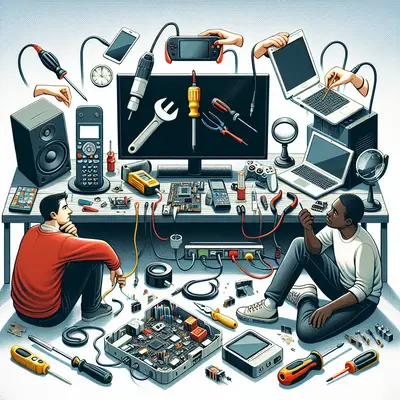
When a gadget stops working, most people jump straight to “I need a new one.” Often, you don’t. Many “dead” or glitchy devices are just running into simple, fixable issues: power problems, dust, bad settings, or worn-out cables. This guide walks you through five practical, step-by-step solutions you can use right now to get common electronics working again—without expensive tools or advanced skills.
---
1. When Your Device Won’t Turn On: Power & Reset Checks
Before assuming your phone, laptop, or game console is dead, rule out basic power issues. A systematic check can save you from costly, unnecessary replacements.
- **Confirm the outlet or power strip works.**
- Plug in a lamp or phone charger you know works.
- If nothing powers on, reset the power strip or try a different outlet.
- Avoid daisy-chaining multiple power strips; it can cause voltage drops.
- **Inspect cables and adapters.**
- Look for cuts, fraying, kinks, or burn marks on the power cord.
- Wiggle the connector gently where it plugs into the device—if power cuts in and out, the cable may be failing.
- Try a known-good compatible charger or power cable if you have one.
- **Check for hidden power switches and battery locks.**
- Some monitors, speakers, and desktop PCs have hard power switches on the back in addition to front buttons.
- Removable-battery devices (older laptops, cameras, tools) may have a battery lock—make sure it’s fully seated and locked.
- **Perform a “drain and reset” on laptops and some devices.**
- Shut down the device completely (not just sleep).
- Unplug the power cable and remove the battery if possible.
- Hold the power button for 15–30 seconds to discharge residual power.
- Reinstall the battery, reconnect power, and try turning it on again.
- **Look and listen for life signs.**
- Fans spinning, indicator lights flashing, or startup sounds mean the device is getting power, even if the screen is blank.
- In that case, the issue may be with the display (see the next section) instead of total failure.
If the device still shows no signs of life after these steps and a known-good charger, the power supply or internal components may be faulty. At that point, a professional diagnosis is usually worth it before you replace the device.
---
2. Screen On But No Image: Fixing Display and Connection Problems
If your monitor, TV, or laptop screen is lit but shows “No Signal,” flickers, or stays black, the display system—not the entire device—is likely at fault.
- **Confirm the display input source.**
- On TVs and monitors, press the “Input” or “Source” button on the remote or panel.
- Cycle through HDMI 1, HDMI 2, DisplayPort, etc., until you reach the one your device is connected to.
- For laptops with external displays, press the display toggle shortcut (often Fn + F4/F8/Fn key with a monitor icon).
- **Reseat the video cable.**
- Turn off both the display and the connected device.
- Unplug the HDMI/DisplayPort/VGA cable at both ends.
- Check for bent pins on older VGA/DVI cables and visible damage on HDMI/DP plugs.
- Firmly reconnect until you feel a click or snug fit, then power everything back on.
- **Test with another cable and port.**
- Swap in a different HDMI or DisplayPort cable if you have one.
- Try another port on the TV/monitor (e.g., HDMI 2 instead of HDMI 1).
- If the image returns, you’ve found a bad cable or port—stick with the working setup.
- **Adjust resolution and refresh rate (computers).**
- If the screen briefly shows an image then goes blank, the resolution or refresh rate may be too high.
- Connect to a different monitor or start in Safe Mode / low resolution mode.
- Reduce resolution and refresh rate to a setting supported by your display (e.g., 1920×1080 at 60 Hz).
- **Address dim or flickering laptop screens.**
- Shine a flashlight at an angle on a black screen—if you see a faint image, the backlight may be failing.
- Try adjusting brightness keys and disabling auto-brightness in system settings.
- Persistent dimness or flicker usually means a failing backlight or screen cable—this often needs a professional or experienced DIY replacement.
If an external monitor works but the built-in laptop screen does not, the problem is usually in the laptop display assembly, not the graphics hardware, which can guide your repair or replacement decision.
---
3. Overheating and Random Shutdowns: Clean, Cool, and Optimize
Electronics that get hot to the touch, run fans constantly, or shut down without warning are often suffering from heat issues. Dust buildup and poor airflow are the usual suspects.
- **Power down and unplug before cleaning.**
- Turn off the device completely and disconnect from power.
- For laptops, also disconnect any accessories and, if possible, remove the battery.
- **Clear external vents and fans.**
- Use a can of compressed air to blow dust out of vents, grills, and fan openings. Short bursts work best.
- Hold the fan blades still with a toothpick or plastic tool so they don’t spin wildly and get damaged.
- Avoid using household vacuum cleaners directly on electronics—they can create static.
- **Elevate and improve airflow.**
- Don’t place laptops on blankets, beds, or soft surfaces that block vents.
- Use a hard, flat surface. A cooling pad with fans can lower temperatures further.
- For consoles and set-top boxes, keep at least a few inches of space around all sides and never stack them on top of other heat-producing gear.
- **Reduce workload and background tasks.**
- On computers, close unused programs and browser tabs.
- Uninstall unnecessary startup apps so they don’t run automatically.
- On game consoles, exit games fully instead of leaving them paused for hours in hot environments.
- **Monitor temperatures with software (for PCs).**
- Install a reputable monitoring tool (e.g., from your PC or motherboard manufacturer).
- If CPU or GPU temps regularly exceed manufacturer-recommended limits under normal use, a deeper cleaning or fresh thermal paste may be needed—this is a more advanced repair, often best left to experienced DIYers or technicians.
If overheating persists after basic cleaning and airflow improvements, internal fans may be failing or heatsinks may be clogged from the inside—problems that usually justify a professional cleaning, especially on expensive laptops or desktops.
---
4. No Sound or Distorted Audio: Quick Checks for Speakers and Headphones
Silent videos, crackling speakers, or only one earbud working often come down to simple fixes. Work through these steps before assuming your audio hardware is dead.
- **Verify volume and mute settings on every device.**
- Check the physical volume buttons on your phone, tablet, or laptop.
- Look for a mute icon in the system tray (computer) or media player app.
- On TVs, confirm that external devices (like streaming sticks or consoles) also have volume turned up.
- **Inspect audio connections.**
- For wired headphones/speakers, make sure the plug is fully inserted until it “clicks.” A partial connection can cause sound in only one ear or no sound.
- Try a different audio port if available (front vs. back of a PC).
- For powered speakers, verify the speaker’s own power switch and volume knob.
- **Test with known-good audio and devices.**
- Play a simple, local audio file (like a downloaded song) instead of streaming. Streaming issues can be network-related.
- Try the same headphones or speakers on a different phone or computer.
- If they work elsewhere, the problem is with the original device’s audio settings or port.
- **Check sound output settings.**
- On computers, open sound settings and confirm the correct output device is selected (headphones, speakers, HDMI audio, etc.).
- If you see multiple options (monitor speakers, headphones, Bluetooth devices), switch between them while playing a test sound.
- On TVs, disable external sound systems (like soundbars) temporarily and set audio to TV speakers for testing.
- **Address Bluetooth audio glitches.**
- “Forget” the device in Bluetooth settings, then re-pair from scratch.
- Keep the distance short and remove nearby wireless interference (other Bluetooth devices, microwaves, crowded Wi‑Fi channels).
- Make sure only one audio device is actively paired and playing at a time; some gadgets struggle with multiple active connections.
If audio still fails across multiple devices and cables, the internal audio jack or amplifier may be damaged. For laptops and phones, external USB or Bluetooth audio devices can be a practical workaround if repair costs are high.
---
5. Wi-Fi and Connectivity Problems: Simple Steps to Get Back Online
Slow, unstable, or missing connections often have straightforward roots: router issues, software glitches, or physical obstacles. Before calling your internet provider, try these steps.
- **Restart devices in the right order.**
- Turn off your modem and router (or your combined gateway device).
- Wait 30–60 seconds.
- Turn the modem back on and wait until all status lights stabilize.
- Turn the router on next, then finally reconnect your phone, laptop, or TV after a minute.
- **Check signal strength and placement.**
- Look at the Wi‑Fi icon—fewer bars means weaker signal.
- Move closer to the router and see if performance improves.
- Keep the router in a central, elevated location, away from thick walls, metal cabinets, and microwaves.
- **Forget and reconnect to the network.**
- On your device, “Forget” the Wi‑Fi network, then reconnect and re-enter the password.
- Double-check that you’re connecting to the correct network name (SSID), especially in apartment buildings where many networks look alike.
- **Separate 2.4 GHz and 5 GHz bands (if possible).**
- Log in to your router’s control panel (the address is often on a sticker, like 192.168.1.1).
- Give your 2.4 GHz and 5 GHz networks different names (e.g., “HomeNet_2G” and “HomeNet_5G”).
- Use 5 GHz for fast, close-range devices (like streaming boxes in the same room) and 2.4 GHz for longer-range or older gadgets.
- **Reduce interference and device overload.**
- Disconnect or power down devices you’re not using that might be hogging bandwidth (smart TVs, game consoles, cloud backup software).
- For desktops or TVs far from the router, consider a wired Ethernet connection or a reputable Wi‑Fi extender or mesh system.
- If the connection is still unstable across multiple devices at different locations, the problem may be with your ISP or line—document the issue and contact their support.
Once your connection is stable, note what fixed it (location change, new cable, network reset) so you can quickly repeat the solution next time instead of starting from scratch.
---
Conclusion
Most electronics don’t fail suddenly for mysterious reasons—they break down in predictable, fixable ways. By methodically checking power and cables, verifying display settings, cleaning for better cooling, resetting audio, and tightening up your network, you can solve a huge share of everyday tech problems on your own. Start with the simplest step, change one thing at a time, and keep track of what works. That approach will save you time, money, and frustration—and help you decide confidently when a DIY fix is enough and when it’s time to call in a pro.
---
Sources
- [U.S. Department of Energy – Electronics and Power Management](https://www.energy.gov/energysaver/reducing-electricity-use-and-costs) – General guidance on reducing energy use and handling electronics safely
- [Apple Support – If your Mac doesn’t turn on](https://support.apple.com/en-us/HT204267) – Official step-by-step power and reset checks that mirror best practices for many laptops and desktops
- [Microsoft Support – Troubleshoot black screen or blank screen errors](https://support.microsoft.com/en-us/windows/troubleshoot-black-screen-or-blank-screen-errors-in-windows-10-3a7a39fb-7a47-8278-56ab-63c2d88baec5) – Detailed display and connection troubleshooting for Windows PCs
- [Federal Communications Commission (FCC) – Interference and Wi-Fi](https://www.fcc.gov/consumers/guides/interference-home-electronics) – Explains how common household items interfere with wireless signals and how to reduce issues
- [Mayo Clinic – Electronics and heat safety](https://www.mayoclinic.org/healthy-lifestyle/adult-health/expert-answers/overheated-devices/faq-20133166) – Background on heat, device safety, and why managing temperatures on electronics matters
Key Takeaway
The most important thing to remember from this article is that this information can change how you think about Electronics.